
Established 1893 | BS 460:2002 Certified | UK & International Supply | Expert Technical Support | 0333 987 4452
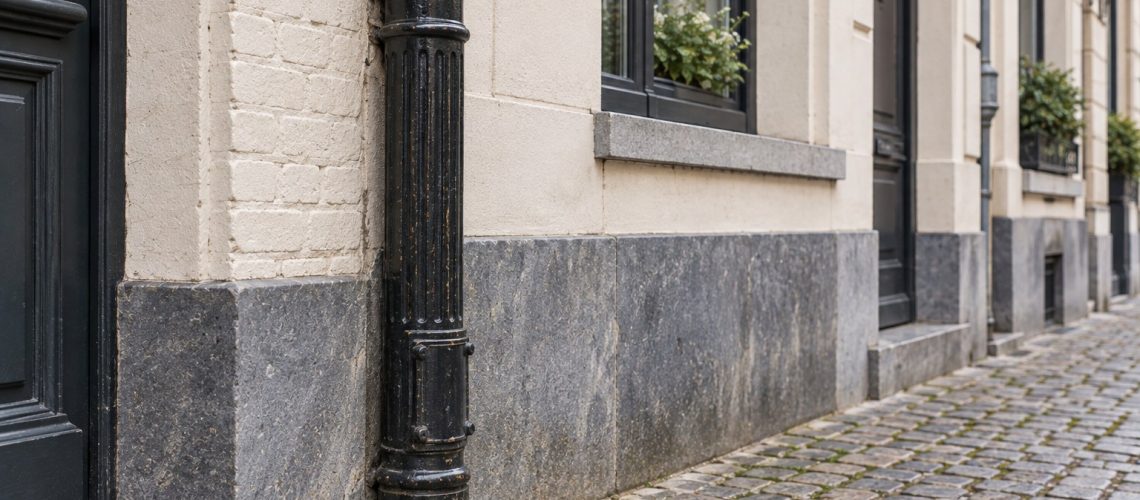
For British architects, contractors and owners working on historic buildings in Belgium, and for local specifiers who read English. What the cast iron base section is, how local rainwater terms translate, and how to order an exact copy from the UK.
Nederlands: Gietijzeren ondereinden voor regenpijpen in België · Français: Dauphins en fonte pour les bâtiments anciens en Belgique
On historic Belgian buildings, gutters and downpipes are traditionally zinc, sometimes copper. Cast iron is used mainly for the bottom section of the downpipe: the gietijzeren ondereind (Dutch) or dauphin (French), typically one to one and a half metres long, which protects the zinc pipe and connects it to the drain. Old sections are straight or bent, round or square, plain or fluted, sometimes with an inspection hatch. We copy cast them to order with a socket sized to the existing pipe, and supply complete BS 460 cast iron systems for British-style buildings. Consent depends on the region: Onroerend Erfgoed in Flanders, urban.brussels in Brussels and AWaP in Wallonia.
The cast iron base section is the heavy bottom length of a Belgian downpipe, fitted where the zinc pipe is most exposed to knocks.
Belgian merchants still sell cast iron base sections in lengths of around half a metre to one and a half metres, straight or bent, plain or fluted, round or square, some with cleaning hatches. Historic examples survive across Brussels, Ghent, Antwerp, Liège and other towns; many have been broken or replaced with plain modern pipe.
Britain has no exact equivalent: a British cast iron downpipe usually runs full height and ends in a shoe or drain connector.
Most Belgian rainwater terms have a direct British equivalent; the cast iron base section is the one without an exact match. Use both sets of terms on a schedule for a project in Belgium.
| Belgian term | British term | Notes |
|---|---|---|
| Hanggoot / gouttière pendante | Eaves gutter | |
| Bakgoot / chéneau | Box gutter | The most common gutter form in the Low Countries. |
| Regenpijp / tuyau de descente | Downpipe | |
| Vergaarbak / cuvette | Hopper head | |
| Uitloop / naissance | Running outlet | |
| Gietijzeren ondereind / dauphin | No exact equivalent (nearest: shoe or drain connector) | Cast iron base section. |
| Goothaak / crochet | Gutter bracket | |
| Onroerend Erfgoed / AWaP / urban.brussels | Heritage authority (regional) | Flanders / Wallonia / Brussels. |
We reproduce cast iron base sections by casting from a surviving example, measured photographs or drawings. The more complete the reference, the closer the copy.
Lead time is typically 12–14 weeks from pattern approval; linseed oil paint adds 6–7 weeks. Our guide to copy casting explains the process.
Heritage protection in Belgium is regional, so the consent route depends on whether the building is in Flanders, Brussels or Wallonia.
Orders to Belgium are quoted individually and travel by pallet road freight, with courier for small items. Goods enter the EU through customs. Goods meeting the UK–EU rules of origin enter free of customs duty, but import VAT and clearance charges usually apply. UK VAT is zero-rated on exports with proof of export. See international supply and shipping for full details.
In Belgium it is usually called “gietijzeren ondereind” in Dutch and “dauphin” in French. It is the cast iron bottom section of a downpipe whose upper part is zinc, sometimes copper, fitted to resist impact and connect the downpipe to the drain.
Rarely. Historic gutters and upper downpipes in Belgium are usually zinc, sometimes copper. Cast iron appears mainly at the foot of the downpipe, and on some British-style buildings.
Yes. We copy cast base sections from a surviving example, measured photographs or drawings, matching length, profile, socket and any decoration. Allow typically 12–14 weeks from pattern approval, plus road freight.
Yes, if we have the outside diameter of the existing pipe and the size of the connection to the drain. The upper pipe sits in the socket of the cast iron section, which we make to the measured size.
Possibly. Heritage protection is regional: in Flanders a toelating from Onroerend Erfgoed may be needed; in Brussels works to protected buildings need a permis d’urbanisme unique, with some minor-works exemptions; in Wallonia a permis d’urbanisme involving AWaP. Check before starting work.
By pallet road freight, with courier for small items. Goods enter the EU through customs; goods meeting the UK–EU rules of origin enter free of customs duty, but import VAT and clearance charges usually apply.
In Belgium, cast iron belongs mainly at the foot of the downpipe, where it protects the zinc pipe and gives the façade its finished detail. A base section copied exactly, sized to the existing pipe and finished correctly, restores that detail. We copy cast downpipe bases to order and supply complete BS 460 cast iron systems for British-style buildings. Send photographs and measurements through our contact page or call +44 333 987 4452.