
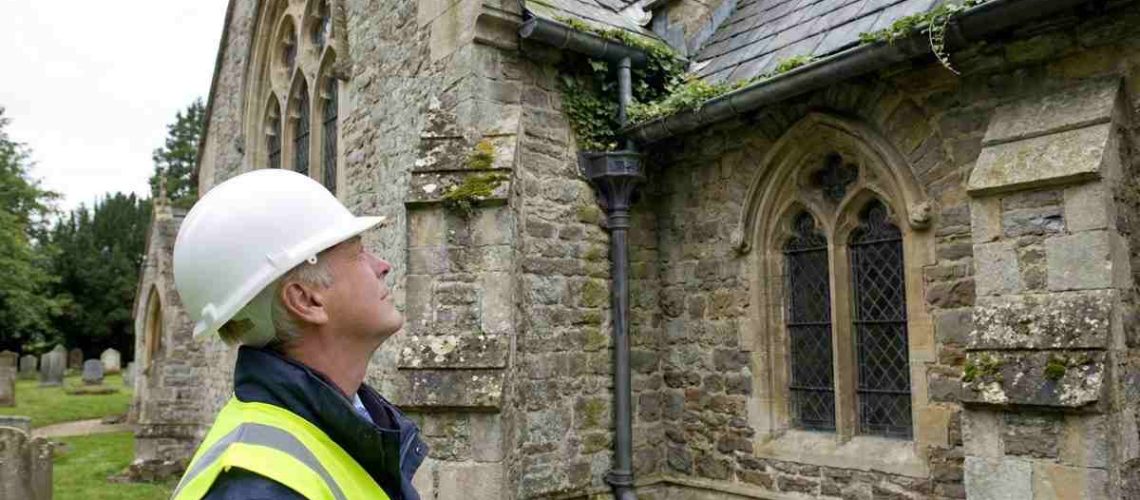
Cast iron rainwater systems are the single most important line of defence protecting a historic church from water ingress, structural decay, and the costly cascade of damage that follows. On listed ecclesiastical buildings — which range from pre-Conquest parish churches to Victorian Gothic masterpieces — the gutters, downpipes, and hopper heads that carry rainwater safely away from the fabric are not peripheral details. They are structural components whose failure initiates decay in precisely the locations where it is most destructive and most expensive to arrest.
At Tuscan Foundry Products, we have been manufacturing and supplying cast iron rainwater goods for churches and ecclesiastical buildings since 1893. In that time, the fundamental case for cast iron on sacred buildings has not changed: no other material matches its combination of hydraulic performance, visual authenticity, long-term durability, and conservation compliance. What has changed, significantly, is the climate in which these systems are operating. Met Office data indicates that winter rainfall totals across the UK could increase by approximately thirty-three per cent, with much of that precipitation arriving in short, intense bursts rather than prolonged showers. Historic rainwater systems originally engineered for more moderate Victorian weather patterns are increasingly being overwhelmed by contemporary deluges. For conservation professionals, ensuring that the rainwater goods on a listed church are correctly specified, properly installed, and diligently maintained is no longer simply a matter of heritage stewardship — it is a matter of climate resilience.
This guide addresses the full specification challenge: material selection, hydraulic design, galvanic corrosion, jointing mechanics, regulatory compliance under the Faculty Jurisdiction, and the changed funding landscape following the closure of the Listed Places of Worship Grant Scheme. It is written for the architects, surveyors, and church wardens who bear professional and custodial responsibility for these buildings.
Works to listed churches in England and Wales do not follow the standard Listed Building Consent route. Instead, they are governed by the Ecclesiastical Exemption and, within the Church of England and Church in Wales, by the Faculty Jurisdiction. Understanding this framework is essential to specifying and procuring cast iron rainwater works correctly.
Under the revised Faculty Jurisdiction Rules — most recently amended in 2022 — works are categorised by their potential impact on historic fabric. Routine maintenance and like-for-like repairs of small sections of cast iron rainwater goods fall within List A: they may proceed without a faculty. More substantial like-for-like replacements of a full elevation of cast iron, undertaken to an identical profile and material, fall within List B and require written notice to the Archdeacon. Any departure from the original material or profile — changing from cast iron to aluminium, introducing new downpipe runs, or significantly altering gutter capacity — requires a Full Faculty, with full Diocesan Advisory Committee (DAC) scrutiny and public consultation.
The 2022 amendments to the Faculty Jurisdiction Rules also formally integrated the Church of England’s Net Zero Carbon commitment. Applicants must now demonstrate due regard to net-zero guidance. This is directly relevant to rainwater specifications: damp masonry is highly thermally conductive, drastically increasing heating demand and rendering insulation ineffective. A secure, well-maintained cast iron rainwater system is a prerequisite for thermal efficiency, and rapid Faculty approval for rainwater repairs is intrinsically linked to a church’s wider environmental goals.
Specifiers should note that like-for-like replacement on a Grade I or Grade II* listed church requires strict adherence to the original material, profile, and detailing. In exceptional circumstances — where access for cyclical repainting of cast iron is genuinely hazardous — cast marine-grade aluminium or GRP may be considered, but each requires formal justification and Faculty approval. Unauthorised material substitution constitutes an enforcement offence.
The starting point for any ecclesiastical specification is BS 460:2002, the British Standard governing cast iron rainwater goods. This standard defines dimensional tolerances, mechanical properties, and jointing requirements for pipes from nominal size DN 50 to DN 150, covering standard half-round, beaded half-round, deep run, and traditional ogee profiles.
Profile selection must be driven by the existing building fabric, not by catalogue convenience. On a medieval nave, the surviving section may be a bespoke ogee that predates any current standard. On a Victorian Gothic church, the specification may call for a deep-run section with a moulded front face and corbelled stop ends. We hold patterns for a wide range of historic profiles and offer copy casting and pattern replication where the original section has been lost or cannot be matched from stock. Photographs, surviving fragments, or measured drawings all provide a sufficient basis for pattern development. Lead time for bespoke copy casting is typically 8–10 weeks — a factor that should be communicated to the contractor programme at the earliest possible stage.
For conservation specifications, understanding the manufacturing process is important: it directly affects both visual authenticity and long-term hydraulic performance. We produce round cast iron downpipes by centrifugal casting, a method that ensures a precisely uniform wall thickness and smooth internal bore, critical for maintaining unobstructed flow during intense rainfall events. The socket is cast integrally during this process, avoiding the internal ridges that welded-on sockets create and which can snag debris and initiate blockages.
Gutters, decorative hopper heads, and complex fittings are sand-cast using historic dies. Sand casting leaves a subtle surface texture that is characteristic of nineteenth-century ironwork and contributes directly to the visual authenticity of the installation. Our pattern library enables us to replicate specific Victorian ogee profiles, bespoke radius gutters for apse roofs and turrets, and ornamental hopper heads incorporating dates, initials, or heraldic devices appropriate to the building’s period and status.
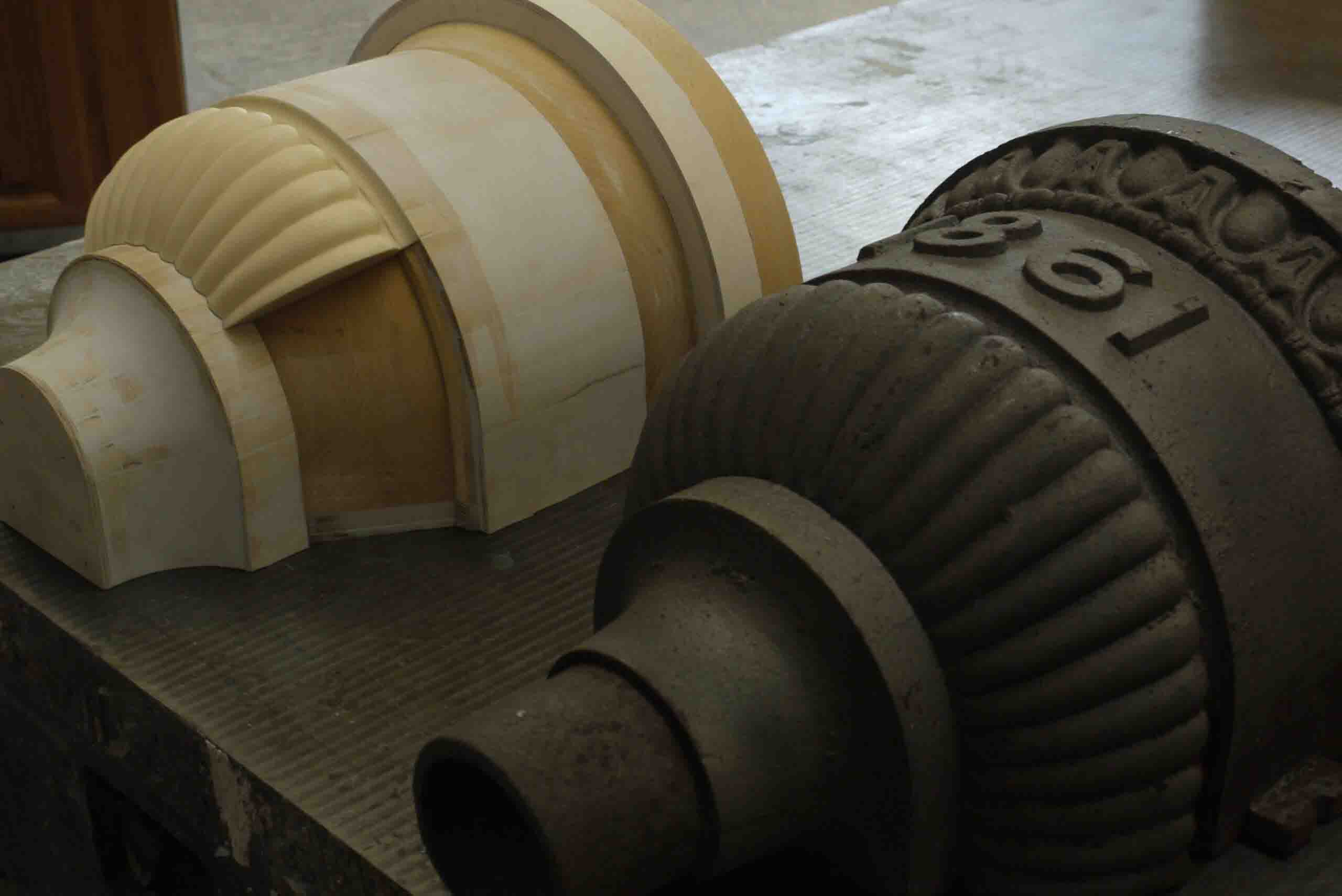
As rainfall intensity increases, hydraulic undersizing is becoming a critical failure mode on historic churches. The correct methodology for calculating required flow rates is set out in BS EN 12056-3, which takes into account effective roof area, pitch, surface runoff coefficient, and localised geographic rainfall intensity data. On churches with complex geometries — multiple pitched roofs, valley junctions, apse roofs — this calculation requires care.
Where existing gutters are correctly sized but overflow during heavy downpours, the bottleneck is frequently at the drop outlet, hopper head, or downpipe transition rather than in the horizontal gutter run itself. Enlarging the internal diameter of the outlet or specifying a tapered, aerodynamically efficient hopper head can significantly increase discharge velocity and prevent overtopping. Where gutters have lost their fall through structural settlement — a common occurrence in medieval churches where foundation movement over centuries alters roof geometry — re-pitching via rise-and-fall brackets restores flow and prevents standing water.
In cases where the visual profile must remain identical to satisfy conservation requirements, we can cast bespoke gutters that maintain the original frontal appearance but incorporate an extended, deeper rear profile, substantially increasing volumetric capacity while remaining visually unobtrusive from ground level. This is a technically straightforward solution that our foundry team will discuss with specifiers on a project-by-project basis.
One of the most common — and most avoidable — causes of cast iron system failure on historic churches is not the iron itself, but the catastrophic failure of fixings through galvanic corrosion. When two dissimilar metals are placed in electrical contact in the presence of an electrolyte — and on the exterior of a church, rainwater, condensation, and atmospheric moisture provide a constant electrolyte — the less noble metal corrodes rapidly to protect the more noble.
The most destructive specification error we encounter is the use of passive 316-grade stainless steel brackets and fixings against cast iron. The electrochemical differential between stainless steel (-0.05V anodic index) and cast iron (-0.69V) is 0.64V — more than four times the 0.15V threshold for severe external galvanic corrosion. Compounding this is the relative surface area effect: a large stainless bracket acting as a massive cathode draws electrons from a small contact point on the cast iron, causing rapid, highly localised pitting at precisely the structural junction where failure is most dangerous.
The correct specification is heavy-gauge mild steel fixings with robust zinc plating or hot-dip galvanisation. Mild steel and cast iron sit adjacently on the anodic index, coexisting without destructive interaction. The zinc coating provides a sacrificial secondary defence. Where coastal or marine environments necessitate stainless steel, fixings must be isolated from the cast iron using nylon or neoprene washers and gaskets to break the galvanic circuit entirely.
Bracket spacing and type are equally important. Standard fascia brackets should be set at a maximum of 915mm centres, with additional brackets within 150mm of every corner, joint, and drop outlet. Where no fascia board is present — common in medieval masonry churches — rise-and-fall brackets with drive-in spikes must be anchored using breathable hydraulic lime mortar or compatible epoxy resins. Portland cement must be avoided: it is impermeable, rigid, and causes severe freeze-thaw spalling in historic stonework.
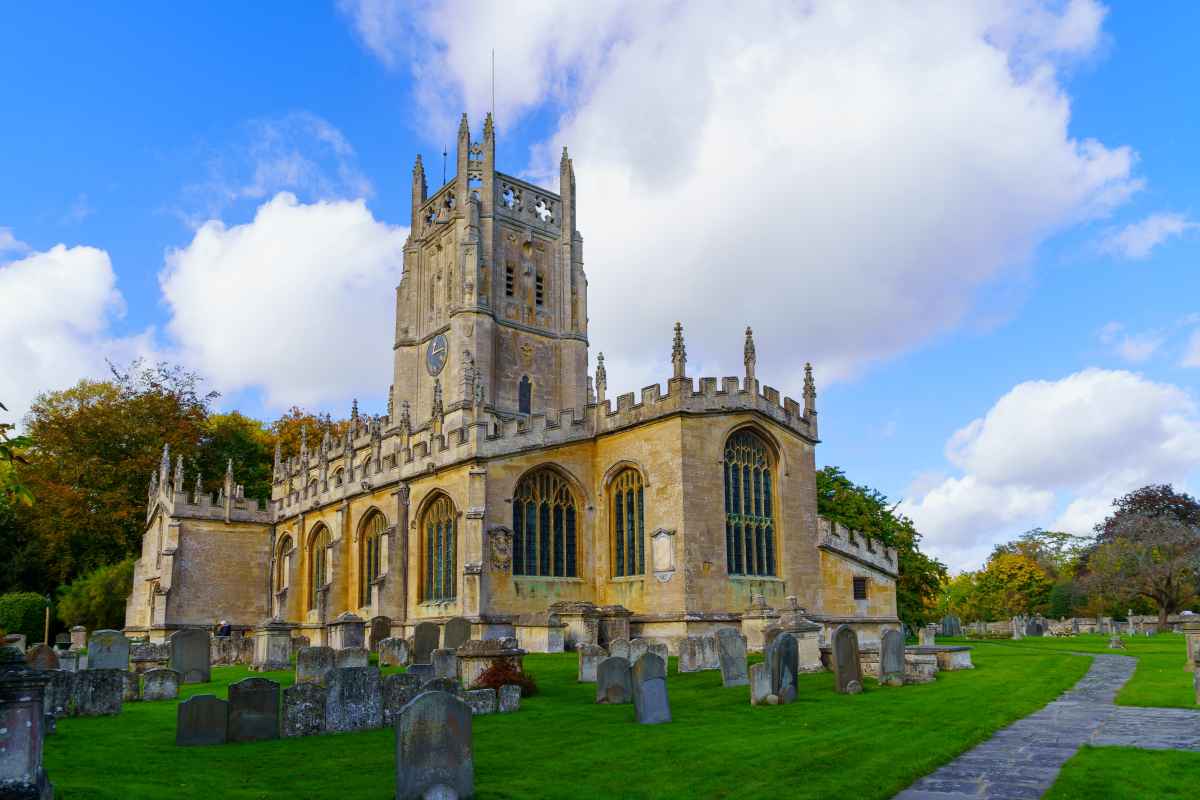
St Mary the Virgin, Fairford, Gloucestershire — Grade I, c.1490
St Mary the Virgin is one of the most complete late-medieval Perpendicular Gothic churches in England, famous for its unbroken sequence of original stained glass. Its complex multi-pitched nave and aisle roofs, combined with a central tower, create multiple valley junctions and a large aggregate catchment area. A recent specification review identified that historical settlement had altered the gutter fall along the north aisle, creating a persistent low point with standing water. Rise-and-fall bracket adjustment, combined with re-sealing of aged cast iron joints using butyl rubber sealant, resolved the overtopping without any structural alteration requiring Faculty approval.
All Saints, Brixworth, Northamptonshire — Grade I, Anglo-Saxon
Brixworth is among the finest surviving Anglo-Saxon churches in Europe, retaining substantial original fabric from the late seventh century. Its towering nave walls and prominent position on a ridge expose the building to high wind-driven rainfall. The existing half-round cast iron rainwater system, installed in the early twentieth century, had developed multiple fractures at bracket fixings, caused by the substitution of stainless steel bolts during a 1980s repair. Replacement of all fixings with zinc-plated mild steel, combined with the supply of matching centrifugally-cast downpipes, eliminated the galvanic failure and restored the system to full hydraulic integrity.
St David’s Church, Laleston, Bridgend, Wales — Grade I, 13th Century
A project completed by Tuscan Foundry Products for this medieval Welsh church in the perpendicular Gothic style involved the supply of a complete new cast iron rainwater system, comprising 125mm plain half-round cast iron gutter and 75mm cast iron downpipes. The church, founded in the thirteenth century, retains limewashed interiors with wall engravings from the seventeenth and eighteenth centuries. Maintaining a weathertight envelope was essential to protecting this irreplaceable internal fabric. The project proceeded under List B of the Faculty Jurisdiction Rules, with all new cast iron matched precisely to the existing profile and finish.
St Michael and All Angels, Booton, Norfolk — Grade I, Victorian Gothic, c.1876
Booton is a remarkable Victorian Gothic church designed by the amateur architect Whitwell Elwin, featuring soaring twin towers and intricate flintwork. The eccentric roofline, with multiple pinnacles and steeply pitched sections converging at tight valleys, places extreme demands on the rainwater disposal system. Lead valley gutters serving the junction between the nave and north aisle had failed due to oversized bays without adequate drips, causing dry rot in the principal rafters. A programme of lead valley renewal, combined with the supply of bespoke cast iron ogee gutters with a deepened rear profile, resolved the ingress and satisfied the DAC’s requirement for exact visual continuity.
St Cuthbert, Benfieldside, County Durham — Grade II*, Victorian
The 2022 Quinquennial Inspection report for St Cuthbert specifically mandated urgent gutter and hopper cleaning alongside resealing of cast iron rainwater joints to mitigate active damp caused by friable stonework and poor gully arrangements. Following the QI, a comprehensive programme of cast iron joint resealing using low-modulus silicone, combined with gully clearing and installation of eared-socket downpipe holderbats to improve air circulation behind the pipes, addressed the Category 1 defects and significantly reduced damp penetration into the nave walls.
We understand that specifying cast iron rainwater goods for churches and ecclesiastical buildings is rarely straightforward. Complex geometries, unusual historic profiles, high-level access challenges, and the close scrutiny of DACs and conservation officers demand a supplier with genuine technical depth, not simply a catalogue.
We offer a comprehensive service from initial enquiry through to supply. For complex restorations, bespoke castings, or projects where the existing profile cannot be matched from stock, we strongly recommend commissioning a site survey before specification is finalised. Our site surveys — which are a chargeable professional service — involve ground-level inspection and, where appropriate, high-level aerial platform surveys. They produce precise measurements of existing sections, photographic documentation for planning records, and a prioritised condition assessment. For a project proceeding through Faculty, a professional survey report provides exactly the evidence of need that the DAC and Archdeacon will require.
For churches in Scotland, works are governed by the Listed Building Consent process administered by Historic Environment Scotland (HES). The conservation principles are identical: like-for-like reinstatement in cast iron is the baseline expectation, and our heritage buildings product range is available for supply across the whole of the UK and for export internationally.
Standard stock items are available for prompt despatch. Bespoke and copy casting commissions carry a lead time of typically 8–10 weeks. Radius and curved gutters, which are sand-cast to order for each specific project geometry, require 12–14 weeks. We recommend that these lead times are built into the contractor programme from the outset to avoid delays.
The following sequence of actions will produce the best outcome on a church rainwater specification:
1. Assess the existing system before anything else. Conduct a thorough inspection — ideally during or immediately after heavy rainfall — to identify overflow points, failing joints, corroded fixings, and blocked hoppers. Use a hand mirror to check the rear faces of downpipes against the masonry. Document everything photographically.
2. Calculate hydraulic requirements using BS EN 12056-3. Do not assume the existing system is correctly sized. On many Victorian churches, the original gutters were sized for nineteenth-century rainfall patterns that are no longer adequate. Verify flow rates against current Met Office intensity data for the specific location.
3. Identify the correct profile. Match the existing section precisely. If the profile cannot be matched from stock, provide us with photographs, measured drawings, or a surviving fragment and we will advise on copy casting options and lead times.
4. Specify fixings correctly. Mandate zinc-plated or hot-dip galvanised mild steel throughout. Specify hydraulic lime mortar or compatible epoxy for spike anchoring into masonry. Rule out stainless steel in direct contact with cast iron.
5. Confirm your Faculty category. Verify whether the works fall within List A, List B, or require a Full Faculty before contractor procurement. For any alteration to profile, material, or downpipe layout, allow adequate time for DAC consultation.
6. Specify linseed oil paint as the finish system. On heritage buildings and churches, linseed oil paint is the conservation-appropriate choice. It remains permanently flexible, breathable, and saturates the microporosity of the iron, providing a finish that ages gracefully and requires only minimal periodic maintenance rather than complete strip and re-coat.
7. Implement a maintenance calendar. Autumn leaf clearance, spring post-frost inspection, and a biannual rainy-day patrol of the building perimeter are minimum requirements. Quinquennial Inspection reports should be acted upon promptly: data consistently shows that deferred rainwater maintenance inflates consequential repair costs by 15–20 per cent on average.
The Listed Places of Worship Grant Scheme (LPWGS) — which allowed eligible churches to reclaim VAT on repair works — closed in March 2025. It has been replaced by the Places of Worship Renewal Fund (PWRF), an England-only competitive capital grant scheme delivered by Historic England with a four-year budget of £92 million. The PWRF offers three funding streams: Small Grants (£10,000–£50,000) for urgent fabric repairs including broken rainwater goods; Medium Grants (£50,001–£350,000) for substantial roof and rainwater system overhauls; and Large Grants up to £1,000,000 for major structural interventions.
Unlike the LPWGS, the PWRF is a competitive scheme, not an entitlement. Priority is weighted towards buildings in areas of high deprivation or significant community need. Churches in Scotland, Wales, and Northern Ireland are excluded entirely and must pursue National Lottery Heritage Fund grants, the Wolfson Foundation, the Pilgrim Trust, or the National Churches Trust for fabric repair support.
Since 1893, we have been manufacturing and supplying cast iron rainwater systems for churches, cathedrals, and ecclesiastical buildings across the UK and internationally. We understand the complexity of sacred buildings: the unusual profiles, the demanding access conditions, the scrutiny of Diocesan Advisory Committees, and the absolute requirement that the work is done once and done correctly. Whether you need standard stock items for prompt despatch, bespoke copy castings to replicate historic sections, radius gutters for curved architectural features, or an on-site survey to inform a complex specification, we are here to support the project from first enquiry through to successful installation. To discuss your church project, please call us on 0333 987 4452, or visit tuscanfoundry.com to send an enquiry.