
Established 1893 | BS 460:2002 Certified | UK & International Supply | Expert Technical Support | 0333 987 4452
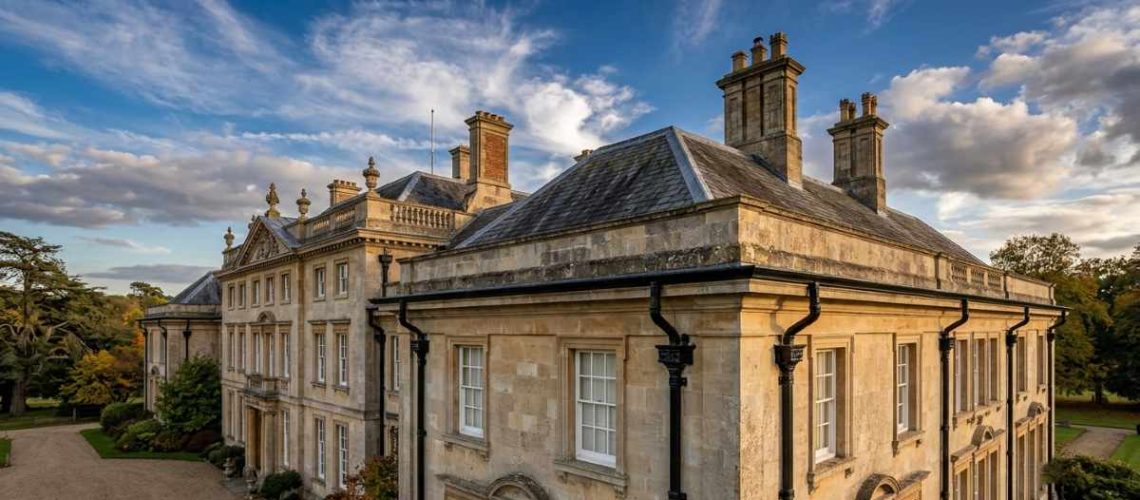
Selecting the correct cast iron gutter size is about far more than measuring width. Profile geometry, hydraulic capacity, roof area, downpipe diameter, and heritage accuracy all bear equally on the outcome. This guide sets out everything you need to specify a cast iron rainwater system with confidence — whether you are working on a Victorian terrace, a Georgian manor, a listed church, or a twentieth-century civic building.
Choosing the right cast iron gutters is one of those decisions that looks straightforward on the surface and reveals its complexity the moment you look more closely. Size, profile, capacity, fall, outlet placement, downpipe diameter, and the conservation requirements of the building all intersect. Get one element wrong and the consequences range from persistent overflow to costly remediation work — or, on a listed building, a compliance problem with the local authority.
At Tuscan Foundry, we have been supplying heritage cast iron rainwater systems since 1893. We understand the hydraulic principles, the conservation constraints, and the practical realities of working on sensitive buildings. This guide brings together everything a specifier, conservation architect, or building surveyor needs to know about cast iron gutter sizing — including when standard tables are not enough and when a on-site survey is the correct starting point.
When cast iron gutters are described as 100mm, 115mm, 125mm or 150mm, this nominal measurement refers to the width of the gutter opening at the top. It does not describe the cross-sectional area available for water flow, which is equally determined by profile depth and shape. This distinction matters enormously in practice.
Two gutters with the same nominal width but different profiles will carry substantially different volumes of water. A Deepflow half-round at 125mm holds considerably more than a shallow Victorian Ogee at the same nominal size. For standard domestic roofs this rarely causes problems, but for long runs, complex roofs, or high-rainfall regions, the distinction is the difference between a system that performs and one that overflows.
The factors that together determine gutter performance are:
Our flow rate calculations guide covers the hydraulic methodology in full detail. For complex or sensitive projects, we strongly recommend working through a proper drainage calculation before ordering.
The following table sets out the most common cast iron gutter sizes in the UK, their typical applications, and their usual pairing with downpipe diameters. These are starting points for specification, not substitutes for hydraulic calculation on large or complex roofs.
| Gutter Size | Typical Application | Downpipe Size | Notes |
|---|---|---|---|
| 100mm (4″) | Porches, bay windows, small outbuildings, single-storey extensions | 65mm (2.5″) | Suitable for small catchment areas only. Often too small for main rooflines. |
| 115mm (4.5″) | Traditional domestic rooflines, Victorian and Edwardian terraces | 75mm (3″) | The characteristic size of much pre-war housing stock. Match carefully on listed buildings. |
| 125mm (5″) | Standard domestic roofs, most replacement work on period houses | 75mm (3″) | The most common replacement size for domestic heritage properties. |
| 150mm (6″) | Larger houses, long gutter runs, commercial and institutional buildings | 100mm (4″) | Essential where high roof areas or extended runs increase hydraulic demand. |
| Custom / bespoke | Large country houses, churches, civic buildings, complex heritage roofs | 100mm–150mm+ | We produce bespoke profiles and sizes to match any existing system. |
As a working rule of thumb: 100mm is small; 115mm and 125mm are the standard domestic range; 150mm is for higher-capacity applications. However, do not assume that because the original system used a particular size it was correctly sized. Many historic rainwater systems were installed to the knowledge and materials of their time, and may have been altered, extended, or patched in the intervening decades.
Profile selection on heritage and listed buildings is not merely an aesthetic decision. It is a conservation requirement. The profile of a gutter is part of the building’s architectural character, and like-for-like replacement is the standard required by Historic England, Cadw, and most local authority conservation officers. Matching the existing profile accurately — in both shape and dimensions — is therefore as important as matching the size. Our full product catalogue sets out all the profiles we hold in stock.
Half round is the most widely used profile and appears across buildings from the Georgian period through to the mid-twentieth century. Its clean, unornamented section suits a wide range of property types and makes hydraulic calculation straightforward because the cross-sectional geometry is simple. Available in 100mm, 115mm, 125mm, and 150mm as standard.
Beaded half round is identical in section to plain half round but carries a small decorative bead along the front edge. It is commonly associated with Victorian and Edwardian domestic architecture and is the correct profile for many terraced and semi-detached houses of that era. Sizes and outlets must be matched like-for-like: a beaded profile will not sit correctly in fittings designed for plain half round, and vice versa.
The Ogee family of profiles — characterised by the distinctive S-curve section — is strongly associated with mid-to-late Victorian construction. On many listed buildings, the specific Ogee variant is architecturally significant and must be replicated precisely, including any decorative moulding on the front face. Ogee gutters are described by both width and depth, and two visually similar profiles can differ enough that outlets, angles, and union pieces are not interchangeable. Careful measurement and comparison of the full profile is essential before ordering.
Deepflow profiles offer a deeper section than standard half round at the same nominal width, providing greater hydraulic capacity without changing the external appearance significantly. They are appropriate where rainfall loading is high or where the original specification was demonstrably inadequate. On conservation projects, their use should be agreed with the conservation officer, particularly if the existing profile is part of the listed building’s character.
For major country houses, churches, civic buildings, and other large-scale heritage properties, we supply cast iron rainwater systems in sand-cast profiles that replicate the substantial moulded sections found on nineteenth-century institutional buildings. Where no stock profile matches the existing system, our copy casting service allows us to replicate any profile from drawings, photographs, or physical samples, with a lead time of 8–10 weeks.
Gutter sizing and cast iron downpipes must be specified together. A gutter that carries water effectively but discharges into an undersized downpipe will still overflow at the outlet. As a general hydraulic rule, the downpipe flow capacity should be at least ten times that of the gutter. In practice this means:
| Downpipe Diameter | Capacity (approx.) | Typical Pairing | Notes |
|---|---|---|---|
| 65mm (2.5″) | Up to 3.5 l/s | 100mm gutter | Small domestic, porches, bay windows |
| 75mm (3″) | Up to 5 l/s | 115mm–125mm gutter | Standard domestic; the most common size on Victorian and Edwardian housing |
| 100mm (4″) | Up to 7 l/s | 125mm–150mm gutter | Larger houses, long gutter runs, institutional buildings |
| 150mm (6″) | Up to 15+ l/s | 150mm+ gutter or multiple gutters | Large commercial, church, civic, or country house applications |
Rectangular and square downpipes offer greater flow capacity for a given face dimension and are commonly found on churches, schools, and civic buildings where the original installation used a box-section pipe for architectural reasons. We supply rectangular cast iron downpipes in four standard sizes from 100×75mm up to 150×100mm, with capacities to 15.2 litres per second. Square pipes are available from 75×75mm to 125×125mm.
The most reliable method for establishing gutter and downpipe sizes is a proper hydraulic calculation based on the effective catchment area of the roof, the design rainfall intensity for the location, and the hydraulic characteristics of the chosen profile. The following simplified table provides guidance for initial sizing on straightforward single-plane roofs:
| Effective Roof Area | Recommended Gutter Size | Recommended Downpipe | Notes |
|---|---|---|---|
| Up to 18m² | 100mm | 65mm | Single-storey extension, porch, small outbuilding |
| 18–50m² | 115mm or 125mm | 75mm | Standard domestic half, semi or terraced house |
| 50–100m² | 125mm or 150mm | 75mm–100mm | Larger domestic, long runs, or steeper pitches |
| 100–250m² | 150mm | 100mm (multiple) | Large houses, institutional buildings, churches |
| Over 250m² | Bespoke sizing required | 100mm–150mm+ | Always commission a hydraulic calculation; contact us for advice |
Note that effective catchment area is not simply the footprint of the roof: for pitched roofs it is the plan area of the slope discharging into each gutter, and adjustments are made for very steep pitches, parapet walls, and adjacent structures that add to the hydraulic load. Where any uncertainty exists, we strongly recommend commissioning a formal hydraulic calculation before specifying.
On straightforward projects — a single-slope domestic roof, a like-for-like replacement in a standard profile and size — specification from drawings and dimensions may be entirely appropriate. However, for any project involving complex roof geometry, unknown or damaged existing pipework, copy casting requirements, or the conservation sensitivity of a listed building, we recommend beginning with a professional on-site survey before a single measurement is taken from a drawing.
A site survey allows us to establish the true condition and configuration of the existing rainwater system, identify any deviations from what drawings suggest, record profiles accurately from physical measurement rather than estimation, assess fixings and structural condition, and spot problems — blocked outlets, inadequate falls, failed joints, corroded fixings — that are invisible from the ground or from a desk.
This matters particularly on listed buildings. Specify incorrectly and the consequences include a failed installation, the need for Listed Building Consent to alter what has been installed, and the reputational risk of a conservation project that does not deliver. A site survey is a chargeable service, but it is an investment that consistently protects the project outcome and is recoverable in any professional fee structure.
Our survey team works across the UK. We can conduct a full condition assessment, produce a specification report, and recommend the correct profiles, sizes, and fittings from first principles. For listed building questions about consent and specification, our technical team is available to advise directly.
Rainfall intensity in the UK has increased measurably over the past three decades, and climate projections indicate this trend will continue. For buildings expected to remain in service for the coming century — which includes virtually every listed and heritage property — specifying a rainwater system on historical rainfall data alone carries a growing risk of inadequacy.
We advise specifiers to consider the following when sizing systems on significant heritage properties: applying an uprating factor of 10–20% to the design rainfall figure to account for future intensity; ensuring that gutter falls are adequate to prevent ponding; and confirming that any existing storm drainage infrastructure — gulleys, soakaways, drains — has sufficient capacity for the increased discharge. Cast iron’s structural robustness and longevity make it the appropriate material for this long-term thinking; its capacity can be considered in conjunction with
cast iron as a building material — a material that, correctly maintained, will outlast any subsequent intervention.
Sizing and profile selection complete the functional specification, but the finish applied to a cast iron rainwater system is equally significant on a heritage building. We advocate the use of linseed oil paint as the heritage-appropriate and environmentally responsible choice for cast iron gutters and downpipes. Unlike conventional solvent-based or two-pack coatings, linseed oil penetrates the surface of the iron, providing a breathable, self-healing film that has been used on cast iron for well over a century.
For heritage buildings where surface texture and sheen level are part of the architectural character, linseed oil produces a natural, period-appropriate finish that modern coatings struggle to replicate. It is also the finish recommended by SPAB (the Society for the Protection of Ancient Buildings) for painted ironwork on historic structures.
At Tuscan Foundry Products, we have been supplying heritage cast iron rainwater systems since 1893. Gutter sizing is something our team understands not just theoretically but practically: from the smallest domestic replacement to the largest country house or institutional building, we bring over 130 years of manufacturing and conservation experience to every specification. We supply the full range of standard profiles in stock sizes for prompt despatch, and offer a copy casting service for profiles and sizes that fall outside our standard catalogue, with an 8–10 week production lead time. Where sizing or specification is uncertain, our on-site survey service provides the technical foundation for a confident, accurate order. We work with conservation architects, heritage contractors, building surveyors, diocesan authorities, and estate managers across the UK and internationally — and we are always glad to discuss the specific requirements of your project. Call us on 0333 987 4452 or visit tuscanfoundry.com to speak with our technical team.
This early nineteenth-century Gothic Revival castle presented a particularly demanding sizing exercise: long gutter runs on steeply pitched turret roofs, compounded by multiple roof planes discharging into shared valley gutters. The existing 150mm moulded sand-cast profiles were surveyed in situ to establish the exact profile geometry, which differed materially from any standard stock section. A copy-cast solution replicated the original profiles, matched the existing decorative mouldings, and the system was sized with a 15% climate uprating factor applied to the hydraulic calculations. The restored system returned the building to fully functional rainwater management for the first time in several decades.
Victorian sandstone churches present a particular sizing challenge: large, complex roof planes with steep pitches, multiple valley gutters, and architectural details — gargoyles, string courses, dormer abutments — that redirect rainwater unpredictably. The specification for St Cuthbert’s involved an on-site survey to map every discharge point and identify two blocked outlets that had been causing periodic internal water ingress for years. The replacement system used 150mm half-round gutters throughout, paired with 100mm round downpipes at closer centres than the original installation, correcting the hydraulic deficiency and resolving the water ingress problem without any alteration to the building’s external appearance.
Terrace properties within Bath’s World Heritage Site operate under exceptionally stringent conservation requirements: not only must all external materials be approved by the local authority, but the profile, section, and finish of any rainwater goods must match the character of the original installation. The original half-round gutters had been replaced in sections over the decades with at least three different profiles, none correct. A full-terrace survey established the original profile from surviving original sections, and the replacement used matched 115mm beaded half-round cast iron throughout. The specification included linseed oil paint in traditional black, applied on site, to achieve the correct sheen level required by Bath & North East Somerset Council.
Kinross House, a late seventeenth-century William Bruce mansion, carries the particular challenge of very deep, elaborate moulded gutter profiles characteristic of Scottish Restoration-period architecture. Standard English profiles are architecturally inappropriate, and the existing large-section sand-cast rhones (the Scottish term for gutters) required copy casting from surviving sound sections used as physical patterns. Quantities were established from a measured survey of all eaves lines, and the project was managed with an 8–10 week lead time for the cast elements. The outcome preserved the building’s architectural integrity without compromise and returned a fully functioning rainwater system to this nationally significant property.
Large civic buildings of the Edwardian era frequently carry substantial, architecturally assertive rainwater systems: projecting cast iron rainwater heads, large-section rectangular downpipes, and wide moulded gutters that form a deliberate part of the façade composition. The Bristol Municipal Library required replacement of all rainwater heads and downpipes following corrosion-related failures in the rectangular pipe system. A survey established that the existing 100×75mm rectangular downpipes were undersized for the roof area, and the replacement used 150×100mm sections at slightly closer centres, correcting the hydraulic deficiency while remaining visually consistent with the original design intent. All cast iron rainwater heads were matched to the original decorative pattern.
For most Victorian terraced properties, 115mm or 125mm half-round or beaded half-round cast iron guttering paired with 75mm round downpipes is the appropriate specification. However, the correct size depends on the actual roof area, the length of the gutter run, and the number and position of outlets. We recommend checking against a hydraulic calculation rather than assuming the original system was correctly sized — many historic installations have been altered over the decades.
No — not without conservation officer approval. On listed buildings, the profile of the rainwater goods is part of the architectural character of the building, and replacement must be like-for-like in profile as well as size. A Victorian Ogee cannot simply be substituted with a plain half-round because the dimensions are similar. The correct process is to identify the original profile, match it precisely, and confirm the specification with the local authority conservation officer before ordering.
Calculate the effective catchment area for each gutter run separately: this is the plan area of the roof slope (or slopes) that discharge into that run. Apply the design rainfall intensity for your region (available from the Environment Agency or BS EN 12056-3), incorporate a climate uprating factor, and use the flow capacity data for your chosen profile to confirm adequacy. For complex or large roofs, we strongly recommend a hydraulic calculation by a qualified engineer or our technical team rather than relying on simplified sizing tables.
Nominal size refers to the width of the gutter opening and provides only a rough indication of capacity. Actual flow capacity depends on the cross-sectional area of the profile (which varies significantly between deep and shallow sections of the same nominal width), the gradient at which the gutter is laid, and the position and size of outlets. A 125mm Deepflow half-round will carry substantially more water than a 125mm shallow Victorian Ogee at the same nominal width. Always refer to the hydraulic performance data for the specific profile you are specifying.
For straightforward like-for-like replacements on simple roof plans, specification from drawings and measurements is often sufficient. For any project involving complex geometry, copy casting, unknown or altered existing systems, or listed building status, we strongly recommend a professional on-site survey before ordering. A survey protects the project outcome by establishing ground truth rather than relying on drawings that may not reflect the as-built condition. Our site survey service is chargeable but is an investment that consistently prevents costly mistakes.
Bespoke and copy-cast elements carry a lead time of 8–10 weeks from receipt of confirmed order and approved drawings or samples. Radius and curved gutters typically require 12–14 weeks. Standard stock profiles in our catalogue sizes are available for prompt despatch. For conservation projects with programme constraints, we advise discussing lead times at the earliest stage of specification, before tender documents are issued, to avoid programme risk.
Linseed oil paint is the heritage-appropriate and conservation-preferred finish for cast iron rainwater goods on historic buildings. It has been used on cast iron since the nineteenth century, penetrates the metal surface to provide a breathable and self-healing film, and produces the natural sheen level associated with period ironwork. It is recommended by SPAB and is accepted by the vast majority of local authority conservation officers. Modern coatings are available for applications where durability is the primary concern, but linseed oil remains the first choice for sensitive heritage work.
cal foundation for a confident, accurate order. We work with conservation architects, heritage contractors, building surveyors, diocesan authorities, and estate managers across the UK and internationally — and we are always glad to discuss the specific requirements of your project. Call us on 0333 987 4452 or visit tuscanfoundry.com to speak with our technical team.