We are able to place dates and initials and insignia onto most of our flat faced rainwater hopper heads.
Established 1893 | BS 460:2002 Certified | UK & International Supply | Expert Technical Support | 0333 987 4452
£110.78 – £195.16Price range: £110.78 through £195.16 +VAT
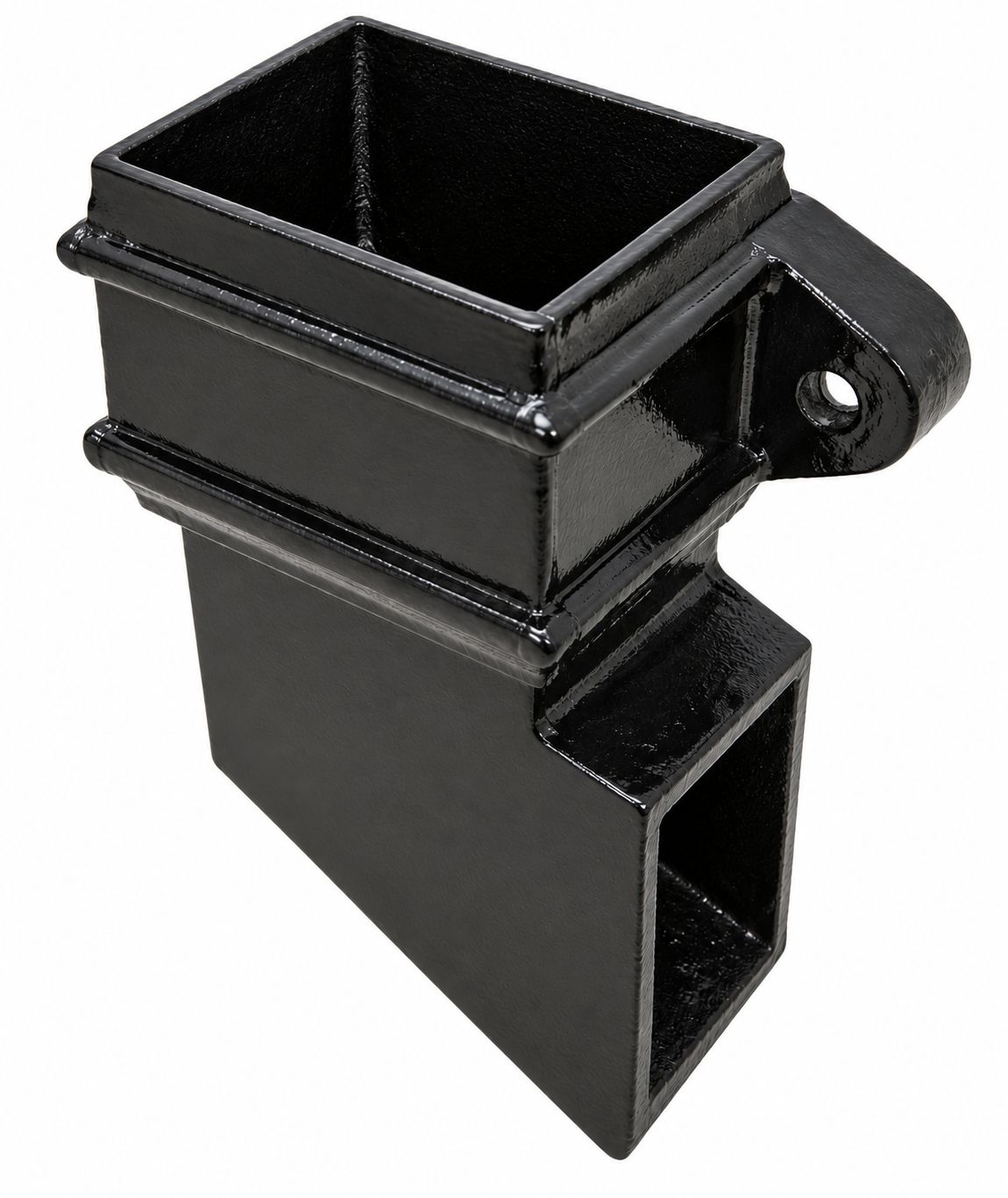
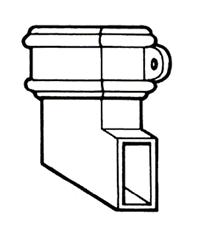
The Square Pipe Side Shoe Eared is a side-facing termination fitting for a cast iron square downpipe run, directing water flow sideways away from the wall. The eared version incorporates integral ears for direct wall fixing. Used where a side rather than front discharge is required — for example where a drain or gully is positioned to the side of the pipe run rather than directly in front of the building face.
Available in three sizes: 75×75mm (3″×3″), 100×100mm (4″×4″), and 125×125mm (5″×5″). Supplied in primed or factory black finish. Manufactured in cast iron to BS 460:2002. For specification support, call 0333 987 4452.
| Size | 75mm x 75mm, 100mm x 100mm, 125mm x 125mm |
|---|---|
| Hand | Left, Right |
We are able to place dates and initials and insignia onto most of our flat faced rainwater hopper heads.
Yes. Cast iron rainwater goods are widely accepted by conservation officers and historic environment bodies as the appropriate material for listed buildings. Tuscan Foundry's hopper heads are manufactured in solid cast iron to BS 460 specification and are suitable for all listed building grades. A linseed oil paint finish is also available, which is particularly appropriate for conservation projects.
The satin chrome telescopic rooflight hand winder is well suited to contemporary and transitional interiors where a brushed chrome finish complements modern or minimal ironmongery. It is compatible with Lumen Rooflights and timber-framed skylights.
The Pultney Tapered Hopper Head is available in three pipe connection sizes: 65mm (2.5"), 75mm (3"), and 100mm (4"). Each size connects directly to matching cast iron downpipes via spigot and socket. Compatible downpipe codes are: 65mm — RH025, XRH025; 75mm — RH03, XRH03; 100mm — RH04, XRH04.
A hit and miss vent has a sliding plate on the back of the grille that can be opened, partially restricted, or closed entirely without removing the vent from the wall. This allows airflow to be controlled from inside the building, making it suitable for underfloor void ventilation and through-wall ventilation where adjustable airflow is needed.
The Polished Lacquered finish suits buildings where period ironwork was finished bright rather than painted — formal entrance elevations, listed properties, and settings where the grille contributes to the decorative programme of the facade. It is appropriate for conservation specifications and high-specification heritage new build.
The Ornamental Airbrick is most appropriate on Victorian Gothic buildings — churches, chapels, vicarages, almshouses, collegiate buildings, and high-specification estate architecture — where decorative ironwork was part of the original design. It suits listed building replacements in kind and heritage new build where period accuracy in detailing is expected.
Cast iron radiators cost no more to run than modern steel or aluminium radiators. Cast iron is a very efficient material at emitting heat, thus you have items like le creuset cast iron pans. Cast iron holds it’s heat extremly well, which means that the radiators stay warm for longer.
The louvre face provides directional airflow and offers some resistance to driven rain entering the subfloor void, making it a practical choice for exposed elevations or properties in areas with significant prevailing wind and rainfall. The square-grid (school board) pattern offers a larger open ventilation area but less weather protection.
For rooflights directly above a worktop or sink, a telescopic screw-jack hand winder is the most practical choice. Available in polished brass, satin chrome, and polished chrome, these openers allow controlled ventilation from a fixed handle position without requiring a pole. The 150mm or 250mm size is typically appropriate for standard-height kitchen rooflights.