Established 1893 | BS 460:2002 Certified | UK & International Supply | Expert Technical Support | 0333 987 4452
£281.40 – £665.10Price range: £281.40 through £665.10 ex VAT (£337.68 – £798.12 inc VAT)
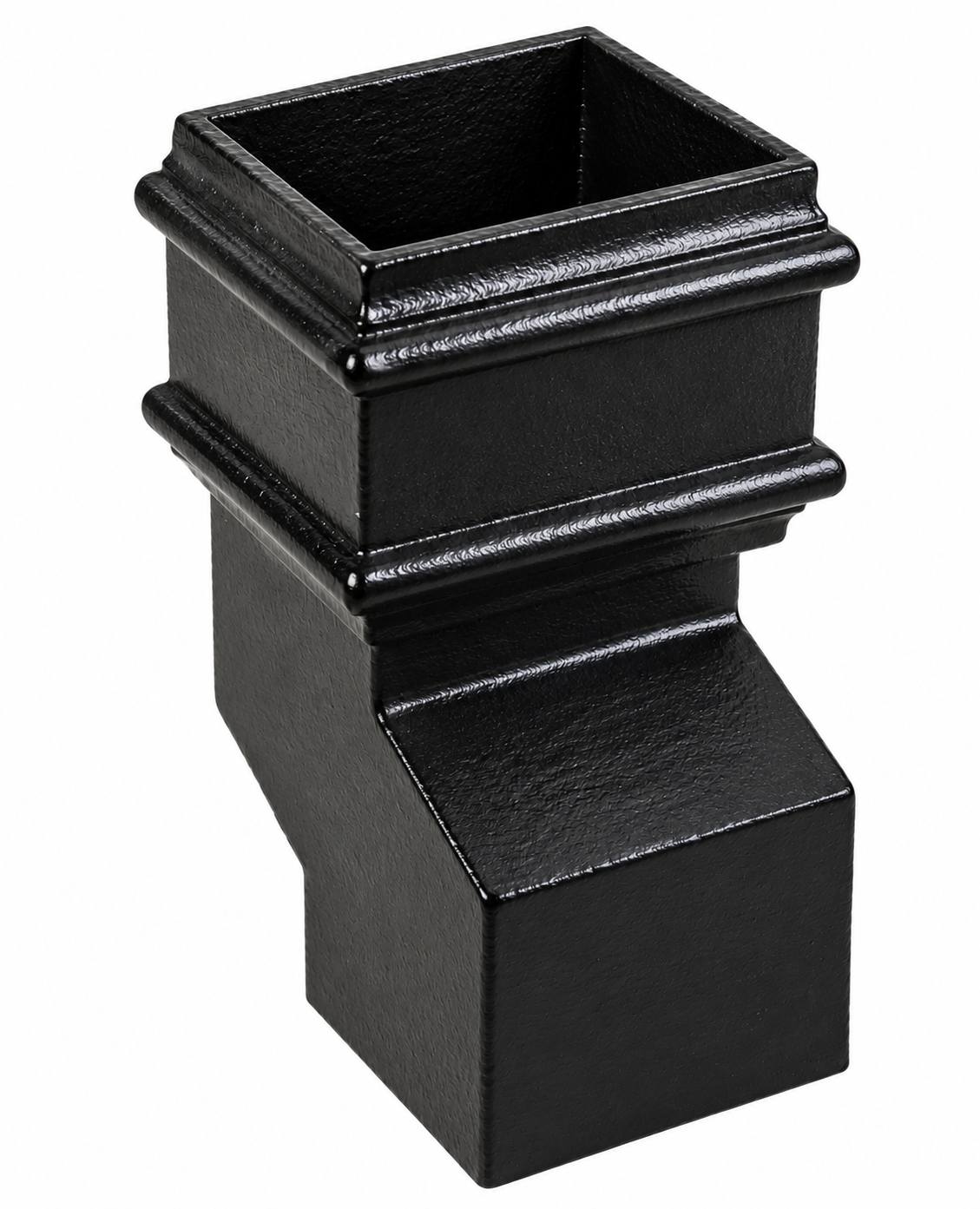
Cast iron plain anti-splash shoe for rectangular downpipes, 100x75mm to 150x100mm, in primer or black painted finish.
UK delivery from £30. Fittings are despatched boxed. See delivery rates.
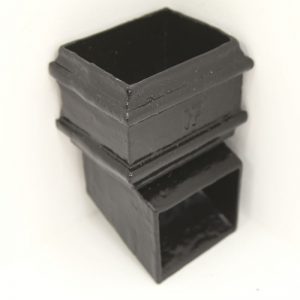
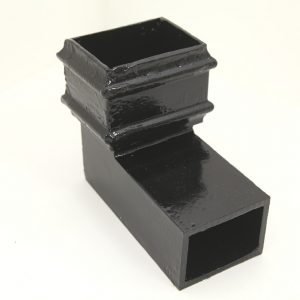
The Rectangular Anti Splash Pipe Shoe Plain is a short-outlet shoe for the foot of a rectangular downpipe. Its low, stepped outlet releases water close to the ground, reducing splashing back onto the wall and plinth.
It has a plain, un-eared socket to match runs fixed with build-in holderbats or earbands.
Where a fixing is needed at the shoe, use the eared anti-splash shoe.
All fittings in our rectangular range are cast iron to BS 460:2002, made to the same moulded profile so pipes and fittings line up neatly on the elevation. Every fitting is supplied either in primer, ready for painting on site, or in factory black. For listed buildings and conservation areas we also offer hand-applied linseed oil paint in heritage colours, which stays breathable and flexible and is straightforward to maintain. Stocked items are usually dispatched within 5 to 7 working days; allow around 6 to 7 weeks where a linseed oil finish is specified.
Rectangular pipe sizes: 100mm x 75mm (4″ x 3″), 125mm x 70mm, 125mm x 100mm (5″ x 4″) and 150mm x 100mm (6″ x 4″).
Suitable for listed buildings, conservation areas and heritage restoration. For specification support or a project quotation, call 0333 987 4452.
| Size/Finish | Primer 100mm x 75mm, Primer 125mm x 70mm, Primer 125mm x 100mm, Primer 150mm x 100mm, Black Painted 100mm x 75mm, Black Painted 125mm x 70mm, Black Painted 125mm x 100mm, Black Painted 150mm x 100mm |
|---|
The H542A measures 240mm wide x 240mm deep x 290mm high, making it well suited to a compact square profile suited to smaller Georgian and Victorian properties, extensions and outbuildings.
Please call 0333 987 4452 or use the contact form with the size, quantity and connection details, and we'll provide a quotation.
Our cast iron hopper heads are available with 65mm, 75mm and 100mm round outlets, 75mm, 100mm and 125mm square outlets, and 100x75mm, 125x100mm and 150x125mm rectangular outlets, to match the downpipe already on site or specified for the project.
Tuscan Foundry's cast iron hopper heads are available in Standard Black and Heritage Colour finishes. A linseed oil paint finish is also offered — a sustainable, vapour-permeable option particularly appropriate for listed buildings and conservation projects. Heritage colour swatches are available from the team on request.
The Ornamental Airbrick (OAB) is available in three sizes: 225mm × 75mm (2.8kg), 225mm × 150mm (4.1kg), and 225mm × 225mm (5.8kg). All sizes have a uniform depth of 75mm, making them consistent to install across a subfloor ventilation course.
Our cast iron airbricks are available in three standard sizes: 225mm × 75mm (single course), 225mm × 150mm (double course), and 225mm × 225mm (square format). These correspond to the standard airbrick positions used in Victorian and Edwardian brickwork. Each size is available across the School Board, Louvre, and Ornamental pattern ranges.
The Antique Black finish is cast iron with a blackened surface — the most historically accurate finish for cast iron ironwork and the most appropriate for the majority of heritage applications. Polished Lacquered is cast iron with a bright polished surface sealed with clear lacquer, suited to interiors and sheltered locations where polished ironwork is the specification. Polished Brass is solid polished brass throughout — the correct choice where existing building fittings are in brass or where a warm metal tone is required.
We manufacture a wide variety of brackets for many different cast iron gutter and pipe profiles. More common types are the rise and fall, top fix and side fix rafter and the holderbat or pipe clip.
We can also offer traditional drive brackets, repair brackets and fascia brackets in both steel and cast iron.
It is always advisable to replace like with like because quite often the brackets form and important part of the buildings architecture. Occasionally buildings have special decorative brackets and our UK manufacturing allows us to produce small quantities of bespoke brackets when required.
Our cast iron hopper heads are available with 65mm, 75mm and 100mm round outlets, 75mm, 100mm and 125mm square outlets, and 100x75mm, 125x100mm and 150x125mm rectangular outlets, to match the downpipe already on site or specified for the project.
Please call 0333 987 4452 or use the contact form with the size, quantity and connection details, and we'll provide a quotation.