
The H528 measures 760mm wide x 370mm deep x 565mm high, making it well suited to the largest properties in the range — substantial country houses, civic buildings and ecclesiastical projects.
Established 1893 | BS 460:2002 Certified | UK & International Supply | Expert Technical Support | 0333 987 4452
£3.90 ex VAT (£4.68 inc VAT)
UK delivery from £30. Fittings are despatched boxed. See delivery rates.
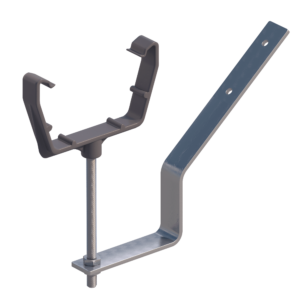
The Osma Drive-in Gutter Spike is a 340mm galvanised steel fixing pin used in conjunction with Osma rise and fall gutter brackets. The spike is driven through the fascia board to provide a secure, concealed fixing point for the bracket riser, avoiding visible surface fixings on the face of the fascia.
Manufactured in high-grade mild steel with a galvanised finish for corrosion resistance. At 340mm, the spike provides sufficient depth of engagement through the fascia and into the rafter or noggin behind. Suitable for use across the Osma range including Roundline, Squareline, Stormline, Superline, and Roofline systems.
Commonly used on new-build housing and refurbishment projects where the clean appearance of the fascia installation is a priority, and where the gutter bracket is being set at a precise fall rather than a fixed angle. The drive-in spike is a consumable item and is typically required one per bracket position.
Available for immediate dispatch. Order in multiples to match bracket quantities on site.
Compatibility: Osma Roundline, Squareline, Stormline, Superline, and Roofline rise and fall bracket systems. For trade pricing or technical queries, call 0333 987 4452.
The H528 measures 760mm wide x 370mm deep x 565mm high, making it well suited to the largest properties in the range — substantial country houses, civic buildings and ecclesiastical projects.
Yes. Both the satin and polished chrome telescopic rooflight hand winder openers are compatible with Lumen Rooflights and most timber-framed skylights. Call 0333 987 4452 if you need to confirm compatibility with a specific model.
Hopper heads are supplied in red oxide primer ready for on-site painting, or pre-finished in black. A full range of Heritage Colours in traditional linseed oil paint is also available on request — please contact us for the swatch chart.
The H530 measures 330mm wide x 150mm deep x 350mm high, making it well suited to Georgian and Victorian terraces, where a compact, narrow footprint is needed.
Polished chrome has a bright mirror finish, while satin chrome has a brushed, low-sheen appearance. Both are available in the telescopic hand winder range. The finish choice typically depends on the ironmongery specification for the project.
Prices are shown on the product pages at tuscanfoundry.com. For project or volume enquiries, please call 0333 987 4452 or use the contact form on our website.
Traditional Express (TX) is a cast iron push-fit soil system. Socketless pipes are joined with push-fit sockets and couplings using rubber seals, so there is no caulking on site. LCC uses caulked socket-and-spigot joints and a bitumen coating. TX is quicker to install and can be painted; LCC is the closer match to an original Victorian stack. Our Traditional Express vs LCC guide compares the two in detail.
Our cast iron airbricks are supplied in primed finish, ready for on-site painting. This allows them to be finished to match the existing ironwork or masonry colour of the building. Standard black gloss is the most common finish for conservation and heritage projects.
Traditional Express can be painted, including in our linseed oil finish. LCC is supplied with a black bitumen coating, which cannot be reliably overpainted with conventional paints; maintain it with a compatible bituminous paint. Where a painted soil stack is required, specify Traditional Express.
In most cases, replacing like-for-like cast iron guttering on a listed building does not require Listed Building Consent (LBC), provided the replacement matches the existing profile, material, and finish exactly. However, any change of material away from cast iron will almost always require consent. We recommend consulting your local conservation officer before proceeding, and we can provide specification documentation to support your application if required.


