Established 1893 | BS 460:2002 Certified | UK & International Supply | Expert Technical Support | 0333 987 4452
£48.40 – £61.30Price range: £48.40 through £61.30 ex VAT (£58.08 – £73.56 inc VAT)
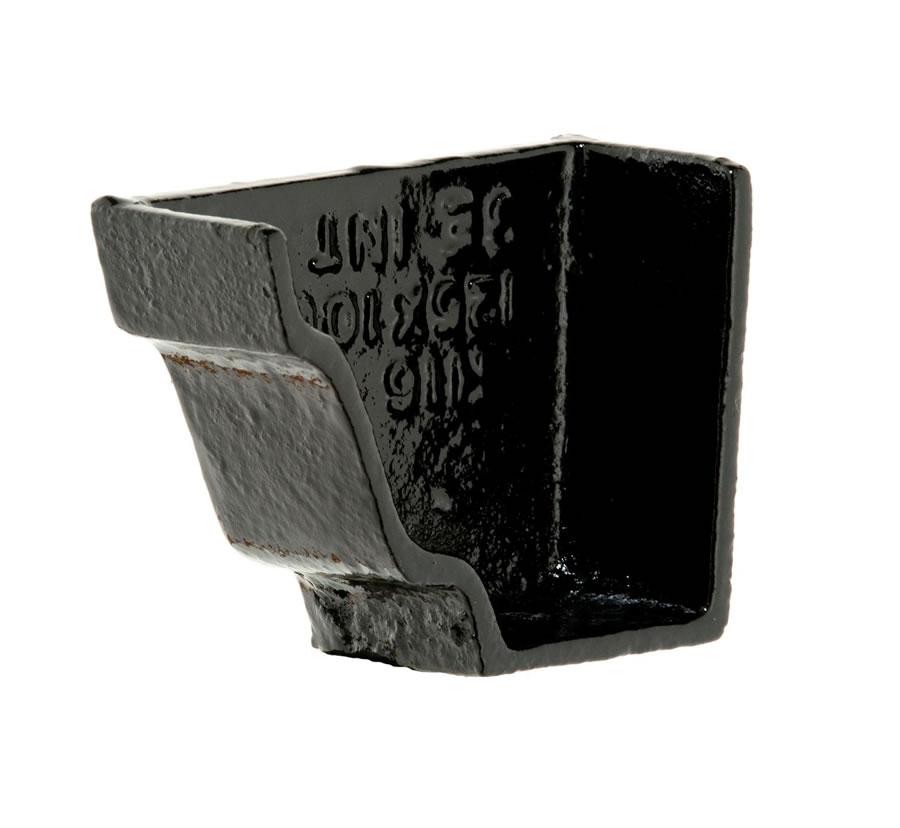
Stop end for H16 moulded gutter
UK delivery from £30. Fittings are despatched boxed. See delivery rates.
The H16 No.16 stop end closes the open end of a Regent No.16 moulded ogee gutter run at a gable end, chimney return, or other termination point. The full H16 moulded profile is maintained at the terminal point, completing the run consistently on the large Victorian and Edwardian properties and civic buildings where the No.16 pattern is the standard.
The H16 carries a right-hand internal joint, and stop ends are handed accordingly — internal and external variants exist, and they work in the reverse of the common ogee range. The asymmetric profile means stop ends cannot be reversed. Identify whether an internal or external stop end is required for your run before ordering: standing in front of the gutter, an external stop end caps the right-hand end, and an internal stop end caps the left — the reverse of the common OG convention.
Manufactured in solid cast iron to BS 460:2002. Available in both H16 sizes: 125×100mm (5″×4″) and 150×100mm (6″×4″). Supplied in primed or factory black finish. For listed buildings and heritage projects. For specification support, call 0333 987 4452.
| Size/Finish | Primer 125mm x 100mm, Primer 150mm x 100mm, Black 125mm x 100mm, Black 150mm x 100mm |
|---|---|
| Socket | Internal, External |
The H530 measures 330mm wide x 150mm deep x 350mm high, making it well suited to Georgian and Victorian terraces, where a compact, narrow footprint is needed.
Hopper heads are supplied in red oxide primer ready for on-site painting, or pre-finished in black. A full range of Heritage Colours in traditional linseed oil paint is also available on request — please contact us for the swatch chart.
The Pultney Tapered Hopper Head is well suited to Georgian and Regency townhouses, Victorian terraces, rural farmhouses, barns, and functional estate buildings where a plain, period-correct hopper is the appropriate specification. It also works well on new heritage-style construction. Its unfussy, chamfered form makes it a versatile choice across a wide range of traditional building types.
Our cast iron hopper heads are available with 65mm, 75mm and 100mm round outlets, 75mm, 100mm and 125mm square outlets, and 100x75mm, 125x100mm and 150x125mm rectangular outlets, to match the downpipe already on site or specified for the project.
Yes. Cast iron is the original material for external soil stacks on most period buildings, and like-for-like replacement in cast iron is usually what conservation officers expect. Check with your local planning authority whether listed building consent is needed for the works.
Yes. Our telescopic screw-jack openers and pole-operated handles are compatible with Lumen Rooflight systems. They are also suitable for use with other timber-framed rooflights and skylights fitted with appropriate catches or stays. If you are unsure of compatibility, call us on 0333 987 4452 and we can advise.
Yes. Decorative cast iron and brass ventilation grilles of this pattern were widely used in Victorian and Edwardian buildings, and like-for-like replacements are generally accepted by conservation officers for listed building works. We can provide product specifications and material details to support listed building consent applications if required.
The Pultney Tapered Hopper Head is available in three pipe connection sizes: 65mm (2.5"), 75mm (3"), and 100mm (4"). Each size connects directly to matching cast iron downpipes via spigot and socket. Compatible downpipe codes are: 65mm — RH025, XRH025; 75mm — RH03, XRH03; 100mm — RH04, XRH04.
Yes. Polished brass ironmongery is historically appropriate for period buildings and is generally acceptable to conservation officers for listed building projects. If you require confirmation for your specific scheme, we are happy to advise — call 0333 987 4452.
The Ornamental Airbrick is suited to Victorian villas, bay-fronted terraces, Gothic Revival institutional buildings, church halls, and civic buildings where decorative ironwork is part of the architectural language. It is also appropriate for listed buildings and conservation area properties where the airbrick is on a prominent elevation and the ventilation grille is expected to carry decorative character.