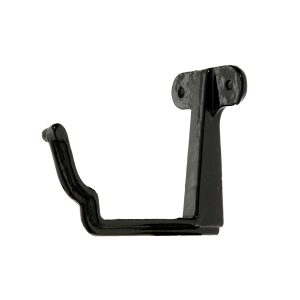
Our standard spike or sturt length is 300mm (12″). Other sizes are available upon request.
Established 1893 | BS 460:2002 Certified | UK & International Supply | Expert Technical Support | 0333 987 4452
£154.30 – £195.42Price range: £154.30 through £195.42 +VAT
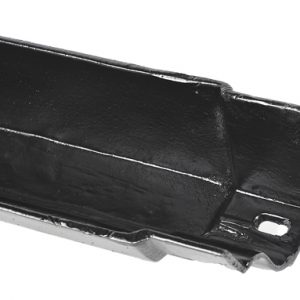
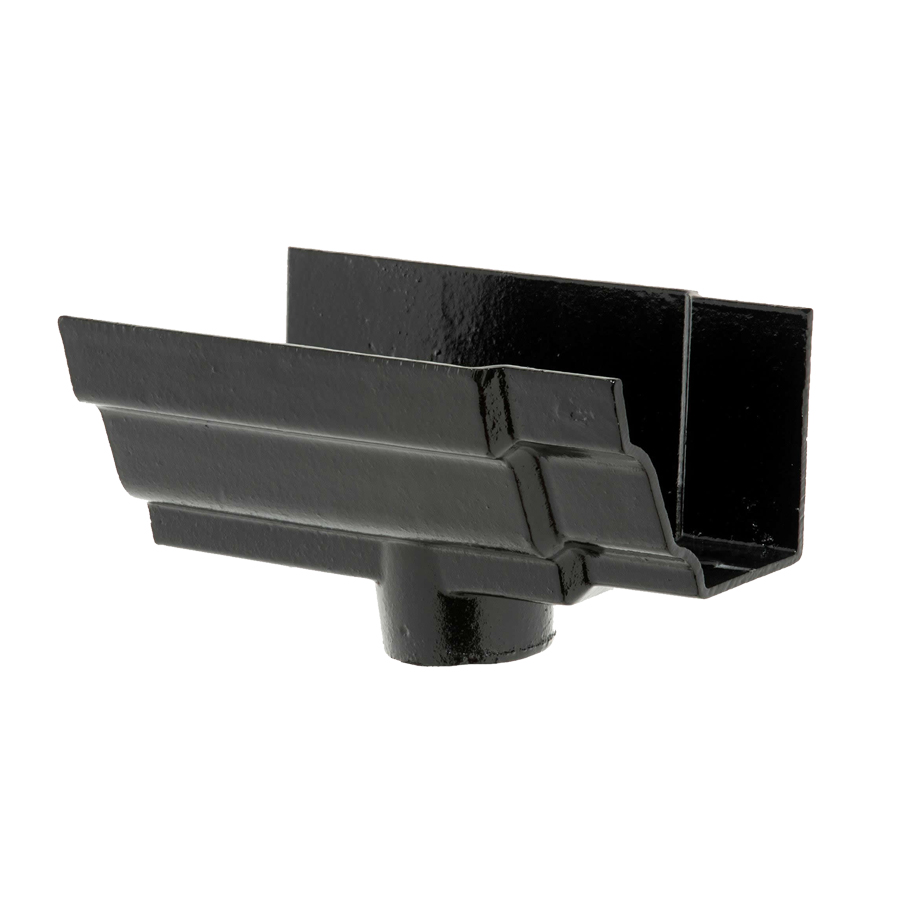
Moulded dropend for H16 gutter internal or external
The H16 No.16 drop end outlet provides a downpipe connection at the end of a Regent No.16 moulded ogee gutter run, used where the run terminates and drainage needs to drop to a downpipe from the end section rather than a central nozzle. A common requirement on the large-scale Victorian and Edwardian buildings and civic properties where the H16 is typically found.
The H16 carries a right-hand internal joint, and drop end outlets are handed accordingly. The asymmetric profile means fittings cannot be reversed. Identify whether an internal or external drop end is required for your installation before ordering, noting that internal and external work in the reverse of the common ogee range due to the right-hand joint of the H16.
Manufactured in solid cast iron to BS 460:2002. Available in both H16 sizes: 125×100mm (5″×4″) and 150×100mm (6″×4″). Supplied in primed or factory black finish. For listed buildings and heritage projects where the H16 No.16 moulded pattern is the original profile. For specification support, call 0333 987 4452.
| Size/Finish | Primer 125mm x 100mm, Primer 150mm x 100mm, Black 125mm x 100mm, Black 150mm x 100mm |
|---|---|
| Socket | Internal, External |
Our standard spike or sturt length is 300mm (12″). Other sizes are available upon request.
Victorian properties most commonly used Ogee (OG) gutter profiles, including the standard Cast Iron Ogee and the G46 Moulded Ogee. Half Round guttering was also widely used, particularly in the later Victorian period. The correct profile depends on what is already present on the building — we recommend inspecting any surviving sections and matching the profile, size, and socket direction exactly. We supply 19 standard gutter profiles and can copy-cast any non-standard profile from a drawing, photograph, or physical sample.
Where a standard profile can't match an existing design, we offer a bespoke casting service in association with our pattern makers, typically with an 8–10 week lead time. Please call 0333 987 4452 or use the contact form to discuss your project.
Prices are shown on the product page. For project quantities, specification support, or a formal quotation, call 0333 987 4452 or use the contact form.
The physical properties of cast iron are sustained throughout its working life, so with proper maintenance we'd expect our gutters and pipes to last over 100 years under normal conditions.
The Gothic foliate tracery design of the Ornamental Airbrick provides a good free-flow ventilation area relative to its face size. The open area is comparable to other standard cast iron airbrick patterns. The visual density of the pattern at a distance reads as solid ironwork, which suits formal and decorative elevations without compromising subfloor ventilation effectiveness.
The H530 measures 330mm wide x 150mm deep x 350mm high, making it well suited to Georgian and Victorian terraces, where a compact, narrow footprint is needed.
The School Board Airbrick suits Victorian and Edwardian institutional, civic, and residential buildings where the square-grid airbrick pattern was standard — including school buildings, civic halls, estate housing, terrace houses, and warehouses. It is also appropriate on listed buildings and conservation area properties as a like-for-like replacement for worn square-grid cast iron vents.
Yes. Cast iron hopper heads are the historically correct choice for listed and period buildings, and a like-for-like cast iron replacement is generally accepted without objection by conservation officers. We manufacture to BS 460 for genuine heritage character and durability.
The H460 is well suited to Georgian, Regency, and Victorian buildings where a plain, undecorated rectangular hopper is the appropriate choice — particularly listed properties, conservation area buildings, and institutional or commercial buildings in historic town centres. Its clean, restrained form makes it equally appropriate on modern heritage-style construction where period accuracy is required without ornamental detail.