Established 1893 | BS 460:2002 Certified | UK & International Supply | Expert Technical Support | 0333 987 4452
£34.14 – £49.62Price range: £34.14 through £49.62 ex VAT (£40.97 – £59.54 inc VAT)
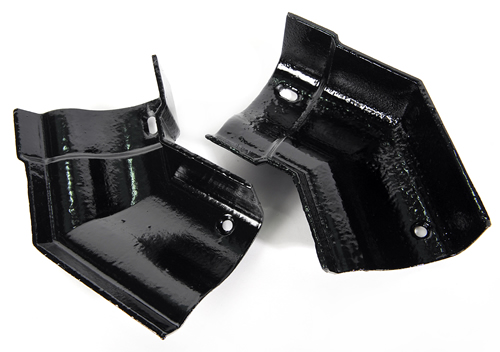
Our cast iron Og gutter 135 degree angle is a cast iron og guttering angle
suited to most period property renovations. Cast iron ogee gutter is available
in primed and black as standard.
Sizes Available:
100mm (4″)
115mm (4.5″)
125mm (5″)
Cast iron Og gutter 135 degree angle external: OG4012, OG4512, OG5012, XOG4012, XOG4512, XOG5012
Cast iron Og gutter 135 degree angle internal: OG4013, OG4513, OG5013, XOG4013, XOG4513, XOG5013
A genuine cast iron rainwater system with the traditional ogee (OG) curved pattern.
UK delivery from £45. Longer items are despatched palletised. See delivery rates.
The cast iron ogee gutter 135 degree angle provides an obtuse corner fitting for the ogee profile, handling bay windows, angled elevations, and returns where a square 90 degree turn is not appropriate. The ogee S-curve is maintained through the fitting, preserving the architectural character of the profile at every junction on the building.
Manufactured in solid cast iron to BS 460:2002 and available in the three standard sizes: 100mm (4″), 115mm (4.5″), and 125mm (5″). Supplied in primed or factory black finish. Commonly specified on Georgian and Victorian properties — particularly bay-fronted terraces, villa-style houses, and rectories — where angled elevations require the 135 degree fitting to complete the run correctly.
Accepted by conservation officers across England and Wales as the appropriate fitting for period cast iron ogee rainwater work on listed buildings and conservation area properties.
Compatibility: Cast iron ogee gutter 100mm, 115mm, 125mm. For specification support, call 0333 987 4452.
| Size/Finish | Primer 100mm, Primer 115mm, Primer 125mm, Black 100mm, Black 115mm, Black 125mm |
|---|---|
| Socket | Internal, External |
Please call 0333 987 4452 or use the contact form with the size, quantity and connection details, and we'll provide a quotation.
Yes. Polished brass is a historically appropriate finish for period and listed buildings and is generally acceptable to conservation officers. If your project requires specific confirmation, we are happy to advise — call 0333 987 4452.
Please call 0333 987 4452 or use the contact form with the size, quantity and connection details, and we'll provide a quotation.
Yes. Cast iron hopper heads are the historically correct choice for listed and period buildings, and a like-for-like cast iron replacement is generally accepted without objection by conservation officers. We manufacture to BS 460 for genuine heritage character and durability.
BTU stand’s for British Thermal Units. This was the old (Imperial) measurement for heat in connection with plumbing. Although BTU’s is a term still commonly used within the heating and plumbing, the industry is now going over to KW’s Kilowatts.
Hopper heads are supplied in red oxide primer ready for on-site painting, or pre-finished in black. A full range of Heritage Colours in traditional linseed oil paint is also available on request — please contact us for the swatch chart.
Please call 0333 987 4452 or use the contact form with the size, quantity and connection details, and we'll provide a quotation.
Select your required size and finish options from the product page and add to cart for an instant price. For project quantities, bespoke requirements, or any specification queries, please call 0333 987 4452 or use the contact form at tuscanfoundry.com.
Yes. Cast iron hopper heads are the historically correct choice for listed and period buildings, and a like-for-like cast iron replacement is generally accepted without objection by conservation officers. We manufacture to BS 460 for genuine heritage character and durability.
The Paxton H82 is a large-format hopper with decorative collar mouldings, making it particularly well suited to late Victorian and Edwardian buildings where the rainwater system forms part of the architectural composition. Typical applications include commercial heritage buildings, civic buildings, large detached houses, institutional premises, and warehouse conversions where a more substantial fitting is appropriate.