
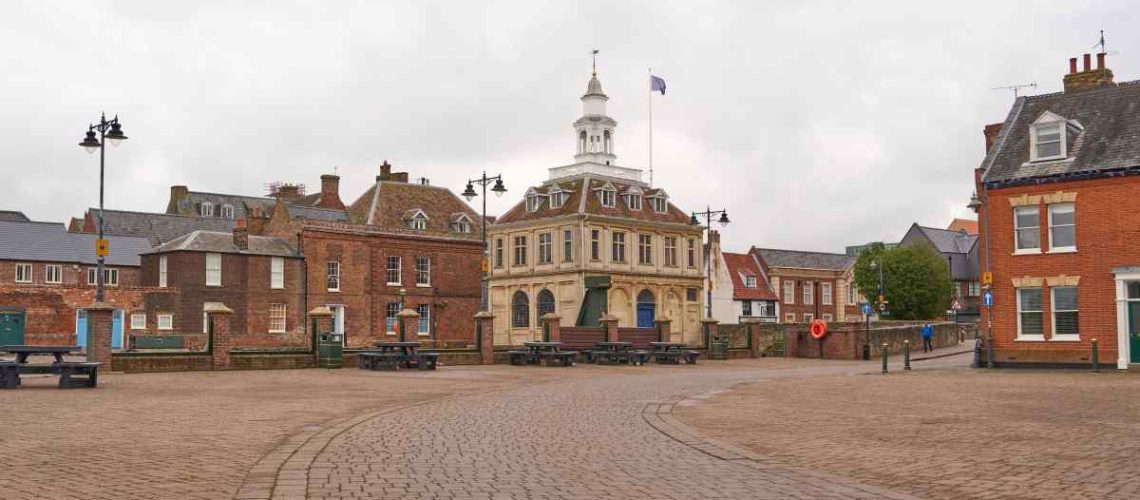
Norfolk’s built heritage is extraordinary in both scale and variety — from ancient round-tower flint churches and Hanseatic merchants’ townhouses to the grand Palladian estates of the north coast and the tightly preserved Georgian streetscapes of Holt and Fakenham. For conservation architects, building surveyors, and heritage contractors working across this richly layered county, the specification of authentic cast iron rainwater systems is rarely a matter of preference; it is a professional and regulatory obligation. We supply the full range of cast iron gutters, downpipes, and bespoke components to projects across Norfolk, providing the technical precision and material integrity that sensitive conservation work demands.
Norfolk is one of the most heritage-rich counties in England, and by any measure its listed building stock is remarkable. With over 540 Grade I listed buildings countywide — and several thousand more at Grade II* and Grade II — the county encompasses an extraordinary breadth of architectural periods and building traditions. Norwich alone contains more medieval churches per square mile than any city north of the Alps.
Beyond Norwich, the county’s heritage character is defined by its landscape of flint churches — Norfolk has the largest concentration of round-tower flint churches in the world, with over 120 surviving examples in various states of preservation. The estates of north Norfolk — Holkham, Houghton, Felbrigg, Blickling, and Sandringham — add a further layer of significance.
For all those working on heritage buildings in Norfolk, the implication is clear: this is a county where conservation standards are consistently high, and where material specification decisions are scrutinised with genuine rigour.
Any works to cast iron gutters, downpipes, and rainwater heads on a listed building in Norfolk require Listed Building Consent (LBC) where those works would affect the character or fabric of the structure.
The planning authorities responsible for listed building consent across Norfolk are broadly Norfolk County Council and the seven district councils: Norwich City, Broadland, North Norfolk, South Norfolk, Breckland, Great Yarmouth, and King’s Lynn and West Norfolk.
The pre-application advice process is strongly recommended before any replacement or alteration work is proposed, and specifications should be prepared with reference to Historic England guidance, particularly Practical Building Conservation: Metals and Roofing.
Norfolk’s building tradition is dominated by flint and carr stone. Flint is dense, impermeable where sound, but deeply sensitive to water penetration at joints. The consequence is that gutters, downpipes, and cast iron hopper heads must function precisely.
In the Georgian market towns, brick-built terraces carrying Ogee or half-round cast iron gutters are typical of the 1780–1850 period. Our cast iron as a building material page sets out in detail why no substitute material achieves the same result.
The north Norfolk coastal strip presents additional considerations. We recommend linseed oil paint finishes as the most durable and heritage-appropriate coating for exposed coastal locations.
St Mary the Virgin, Edgefield, North Norfolk — Grade I
A typical example of the round-tower tradition, St Mary the Virgin at Edgefield combines a late Saxon tower with extensive medieval nave additions finished in flint rubble with knapped flint dressings. A recent conservation programme identified failed joints and a section of profile no longer available from standard stock. We undertook a copy-cast exercise to replicate the original moulding, with new sections delivered within our standard 8–10 week bespoke lead time.
Holkham Hall, Wells-next-the-Sea, North Norfolk — Grade I*
William Kent’s great Palladian house, built for Thomas Coke between 1734 and 1764, presents a rainwater challenge of extraordinary scale. We have supplied matching square downpipe sections and cast iron rainwater heads to the estate’s specification, matching the profile of the original eighteenth-century ironwork.
Blickling Hall, Aylsham, Broadland — Grade I (National Trust)
Blickling Hall is one of the finest Jacobean houses in England, built between 1616 and 1627 and managed by the National Trust. We work closely with their building surveyors to ensure like-for-like supply of matching components with minimal disruption to programme.
The King’s Head Hotel, Market Place, Holt — Grade II*
When the hotel’s principal gutter run required replacement, the conservation officer was clear that only cast iron to the original ogee profile would be acceptable. We supplied the matching G46 Ogee profile from standard stock, available for prompt despatch.
Norwich Cathedral Close — Various Grade I and Grade II* Buildings
The Norwich Cathedral Close encompasses one of the most intact medieval and post-medieval institutional precincts in England. We have supplied components to several buildings within the close over the years, including bespoke copy-cast sections where standard profiles were insufficiently accurate for conservation officer approval.
We supply cast iron rainwater systems to projects across Norfolk, from straightforward stock replacements on Georgian terraces to complex bespoke programmes on scheduled monuments and Grade I listed country houses.
For projects involving damaged or non-standard components, we offer a full copy casting and pattern replication service. The lead time for bespoke and copy cast work is typically 8–10 weeks.
For complex projects, we strongly recommend commissioning a professional on-site survey before specification is finalised. Our site surveys are a chargeable service.
Standard stock items — including our full range of cast iron gutter profiles and cast iron rainwater heads — are available for prompt despatch. Please contact our team on 0333 987 4452 or visit tuscanfoundry.com to make an enquiry.