Established 1893 | BS 460:2002 Certified | UK & International Supply | Expert Technical Support | 0333 987 4452
Yorkshire is, by almost any measure, the most architecturally significant county in England. It contains more listed buildings than any other — somewhere in the region of 37,000 entries on the National Heritage List for England — and its heritage spans a breadth and depth that few counties anywhere in the United Kingdom can match.
Norman castles, Cistercian abbeys, Georgian market towns, Victorian mill complexes, and some of England’s finest medieval parish churches all sit within a county whose relationship with stone, iron, and traditional craft has shaped the built environment for over a thousand years.
For architects, conservation surveyors, and heritage contractors working in Yorkshire, that concentration of significance brings with it a corresponding level of responsibility. When works are required to be listed buildings and historic structures in the county — whether a Grade I abbey, a Grade II* Georgian town house, or a Victorian church in the West Riding — the materials specified for even utilitarian elements such as rainwater systems must be chosen with care. The wrong choice is not merely aesthetically inappropriate; on a building of significance, it can represent a conservation failure that takes years and considerable cost to rectify.
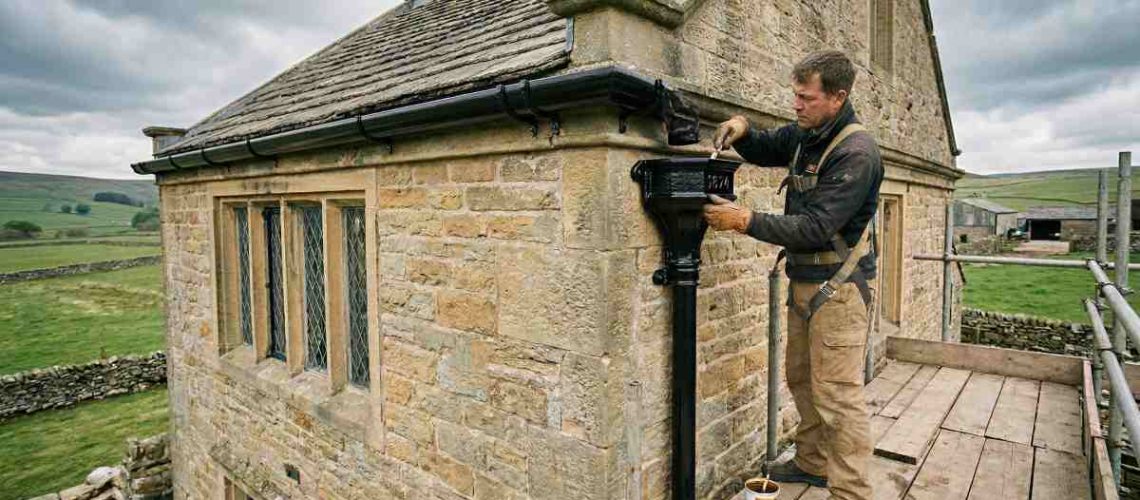
Yorkshire’s built heritage is inseparable from its relationship with cast iron. From the Georgian period onwards, cast iron became the material of choice for rainwater systems on significant buildings across the region. It offered the aesthetic weight and presence that architects of that era demanded, the durability to match the stone and masonry beneath, and the ability to be cast in profiles that reflected the architectural style of the building.
By the Victorian era, cast iron guttering and downpipes had become the norm across Yorkshire’s residential, commercial, and civic architecture. Those systems—many of which remain in place today, more than 150 years after installation—tell a story of craft, engineering, and architectural intention.
Heritage cast iron guttering in Yorkshire typically falls into several established profiles, each reflecting the architectural conventions of its era:
Georgian and Early Regency (c.1750–1820): Deep, simple ogee profiles dominate this period. These gutters sit proud of the fascia and are characterised by clean, geometric lines. They were typically installed on houses with pitched roofs and pronounced eaves.
Late Regency and Victorian (c.1820–1880): More elaborate profiles emerge in this period. The ogee becomes deeper, and decorative castings are more common. Gutters and downpipes feature moulded details, and brackets become visible architectural elements rather than merely functional supports.
Late Victorian and Edwardian (c.1880–1910): By the late Victorian period, cast iron guttering reaches its aesthetic peak. Complex mouldings, ornamental brackets, and cast shoes (elbows) with architectural detail are standard. Downpipes are often circular in section and frequently decorated with cast collars or bands.
When specifying cast iron rainwater systems for listed buildings in Yorkshire, technical accuracy matters as much as aesthetic fidelity.
Gutter sections should be hand-cast rather than machine-made where possible, allowing for the slight irregularities and patina that historical originals possess. Machine casting produces too-uniform profiles that stand out when installed alongside existing systems.
Joinery details are critical. Period systems used loose-joint or lead-welded connections; modern solvent-weld or push-fit joints read as anachronistic. For Grade I and Grade II* listings, conservation surveyors will often require traditional joining methods to be observed.
Paint specification is equally important. Cast iron guttering and downpipes on Yorkshire heritage buildings should be finished in authentic period colours—typically dark iron grey, chocolate brown, or black. Modern high-gloss paints and synthetic finishes look out of place on historic guttering.
A Grade II* Georgian town house in York required gutter replacement following water ingress and structural damage. The original system—installed c.1790—featured a deep ogee profile with ornamental cast brackets at 1.2m centres. Modern guttering solutions and plastic alternatives were considered but rejected by the conservation officer on the grounds that they would compromise the architectural integrity of the street elevation.
The solution: hand-cast replacement guttering to match the original profile exactly, fabricated from reclaimed cast iron where possible and new casting where necessary. Downpipes were replaced in matching profile, with original cast collars retained where serviceable. The system was installed using traditional lead welding for all joints.
Result: A repair indistinguishable from the original, maintaining the building’s architectural character while delivering 150+ years of serviceability—matching the lifespan of the Georgian originals still in place on neighbouring properties.
Yorkshire’s architectural heritage is not a backdrop to rainwater management—it is the very reason that rainwater management matters. For any building of significance in the county, the choice of guttering and downpipe system is a conservation decision that will be visible to every passerby for decades to come.
Cast iron remains the only choice for Grade I and Grade II* listed buildings, and for Grade II properties in conservation areas, it is almost always the expected solution. Its durability, its aesthetic integrity, and its proven track record across 250+ years of Yorkshire’s built environment make it not merely an alternative to modern materials, but the standard against which other solutions are judged.
When specifying cast iron rainwater systems for Yorkshire’s heritage buildings, the goal is not to produce something that looks old—it is to ensure that in 150 years, the system installed today will look as if it has always been there.
Yorkshire contains more listed buildings than any other county in England—approximately 37,000 entries on the National Heritage List. Its heritage spans Norman castles, Cistercian abbeys, Georgian market towns, Victorian mill complexes, and medieval parish churches, reflecting over a thousand years of architectural significance.
Cast iron offers the aesthetic weight, presence, and durability required for heritage buildings. It matches the stone and masonry beneath, can be cast in profiles reflecting the building’s architectural style, and has proven durability—many Victorian systems remain serviceable after 150+ years.
Georgian and Early Regency (c.1750–1820): deep, simple ogee profiles. Late Regency and Victorian (c.1820–1880): more elaborate profiles with decorative castings. Late Victorian and Edwardian (c.1880–1910): complex mouldings, ornamental brackets, and circular section downpipes with cast collars.
Hand-cast rather than machine-made sections, traditional loose-joint or lead-welded connections, period-appropriate paint colours (dark iron grey, chocolate brown, or black), and authentic joinery details all ensure the replacement is indistinguishable from the original.
When properly installed and maintained, cast iron rainwater systems can deliver 150+ years of serviceability, as evidenced by many Georgian and Victorian systems still functioning on Yorkshire heritage buildings today.
Yes. Grade I and Grade II* buildings require hand-cast replacement to match original profiles exactly, traditional joining methods such as lead welding, and original paint finishes retained where serviceable. Modern plastic or synthetic alternatives are rejected on conservation grounds.
The choice of guttering and downpipe system is a conservation decision visible to every passerby for decades. For Yorkshire’s Grade I and Grade II* listed buildings, cast iron is not merely an alternative—it is the standard against which other solutions are judged.