
Established 1893 | BS 460:2002 Certified | UK & International Supply | Expert Technical Support | 0333 987 4452
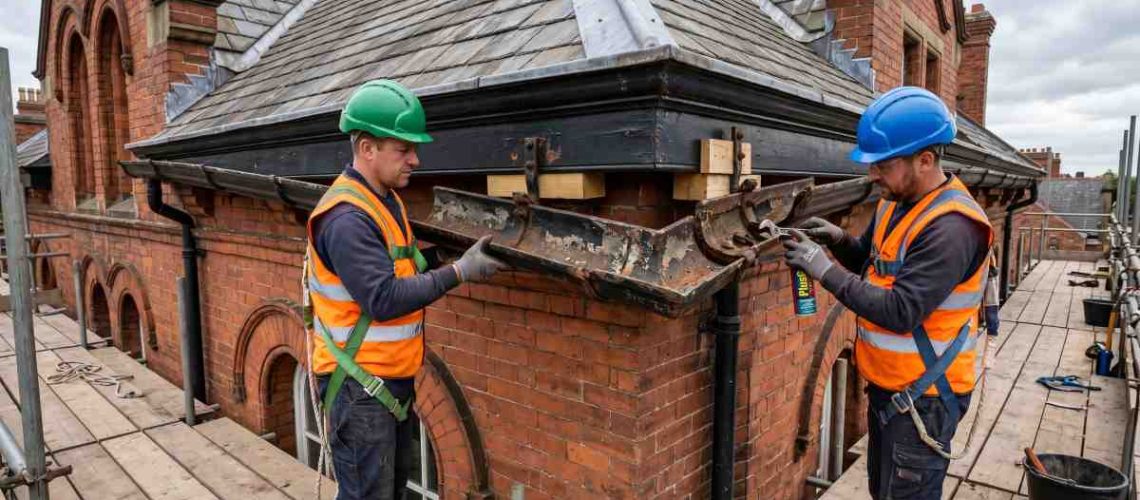
The removal of aged cast iron guttering is one of the most risk-laden stages of any heritage refurbishment programme. This guide covers safe working methods for freeing corroded fixings, managing casting failures, protecting the building fabric, and documenting condition as you go — practical guidance for contractors, surveyors, and conservation professionals.
Safe removal of cast iron gutters on a heritage building requires methodical preparation, realistic contingency planning, and an understanding of the specific failure modes that aged cast iron presents — because on an installation that has been in place for eighty or a hundred years, bolt shear, casting fracture, and unexpected structural weakness are not exceptional events: they are the norm.
This is not work that rewards haste. The physical weight of cast iron, the brittleness of aged sections, and the proximity of the work to valuable historic building fabric all demand a disciplined approach. Contractors who treat removal as a straightforward demolition task tend to encounter expensive surprises. Those who treat it as a structured, documented process — with contingency built into both the programme and the contract — generally complete the work cleanly.
At Tuscan Foundry Products, we work alongside conservation professionals and contractors on some of the most sensitive buildings in the UK. Our site survey service is specifically designed to identify what contractors are likely to encounter before removal begins — and the guidance in this article reflects the realities we see on sites every year.
The single most effective thing a contractor can do to reduce failures during cast iron gutter removal is to invest time in preparation before a single spanner is applied to a single bolt. The sequence matters: assess, plan, prepare, then act.
A walk-round condition inspection at ground level, supplemented by a closer inspection from scaffold or a mobile elevated work platform, should identify the sections most likely to present difficulty: those with visible casting cracks, heavy paint build-up obscuring joint detail, brackets that are pulling away from the wall, or joints where the bolt head has corroded flush with the casting surface.
Penetrating oil should be applied to every bolt head and nut at least 24 to 48 hours before removal is attempted — and ideally several days in advance on older or more corroded fixings. The oil requires time to migrate through the corrosion into the thread interface, and a single spray on the morning of removal is largely wasted effort. For particularly seized bolts, repeat applications over several days, combined with gentle vibration from a hammer tap on the bolt head, are significantly more effective than a single heavy treatment.
The programme should be planned section by section, working from the most accessible lengths first to allow operatives to develop a sense of what the installation will yield before moving to the more awkward or elevated sections. For listed building projects in particular, a pre-contract condition survey is the most effective way to identify where the programme risks lie before the contract is let.
Corroded bolt removal is the primary technical challenge on any aged cast iron installation, and the correct approach is escalation — beginning with the lowest-risk method and moving up the intervention scale only when the gentler approach has been given adequate time and opportunity to work.
The first intervention is always penetrating oil — applied generously, given time, and repeated if necessary. Quality penetrants are significantly more effective than general-purpose lubricants at migrating into corroded thread interfaces. The combination of soaking time and gentle mechanical vibration (tapping the bolt head with a ball-peen hammer) is the most reliable low-risk route to a free bolt. On installations where the bolts are of ferrous material — as is typical on pre-war cast iron guttering — corrosion will have bonded the thread to the surrounding casting; patience at this stage avoids the cascading damage that follows a sheared or broken bolt.
Where penetrating oil alone is insufficient, a nut splitter can be used to split and remove the nut without applying torque to the bolt — this is often the preferred method where the bolt thread is the primary concern and the nut is sacrificial. Bolt extractor sockets, which use reverse-tapered flutes to grip a damaged or corroded bolt head, are appropriate where the bolt head is still accessible but rounded or corroded. Both methods impose less torsional stress on the casting than conventional spanners used with excessive force.
When mechanical extraction is not viable, controlled cutting with an angle grinder fitted with a thin cutting disc is the next option. The key constraint is precision: the disc must remove the bolt head or nut without contacting the cast iron section itself. On narrow-flanged sections or where the bolt sits close to the casting body, this requires skill and care. Prolonged grinding in a single area generates heat that can exploit existing casting voids or weaknesses — work in short controlled passes and allow the metal to cool between passes.
A reciprocating saw with a bi-metal blade is an alternative to angle grinding in tighter spaces, and gives somewhat more control over the cut line. Whichever cutting method is used, any remaining bolt shaft in the casting should be carefully extracted or driven out before the section is moved — loose metal fragments in a joint complicate reassembly and can cause further casting damage.
Even with careful preparation and controlled technique, casting fractures will occur on aged Victorian and Edwardian guttering — and the contractor must be prepared to manage them without disrupting the programme. The question is not whether failures will happen, but how they are handled when they do.
Original sand-cast iron guttering produced in the nineteenth century routinely contains internal voids, cold shuts, and uneven wall thicknesses. These are invisible in service and undetectable without destructive investigation. They become apparent when the section is placed under stress — during bolt removal, during handling, or during cleaning. A fracture during removal should be documented immediately with photographs, the section marked and set aside, and the contractor’s records updated.
The contract for refurbishment work on aged cast iron should always include provisional sums and contingency allowances for section replacement. The size of the contingency should reflect the age and known condition of the installation — for a Victorian terrace where the guttering has not been disturbed in fifty years, a contingency of fifteen to twenty per cent of the section count is not unreasonable. Where matching replacement sections are needed — whether from our standard catalogue or via our copy casting service — the lead time of up to 8–10 weeks for bespoke castings must be factored into the programme from the outset. Discovering mid-programme that a non-standard profile is needed, with no contingency time in the programme, creates unnecessary pressure and cost.
Cast iron guttering is substantially heavier than any modern alternative, and this weight must be planned for at every stage of the removal operation. A standard 100mm half-round cast iron gutter section weighs approximately four to five kilograms per metre; deeper and wider profiles — moulded ogee, box gutters — are proportionally heavier.
A minimum of two operatives is required for any section being removed at height: one to control and support the weight of the section as fixings are released, and one positioned to receive the section safely and prevent it from dropping or swinging into the building fabric. For longer sections or those on tall or awkward elevations, three operatives is the appropriate minimum. The weight of a three-metre length of deeper-profile cast iron gutter, held at arm’s length above head height on a ladder, is not trivial.
Scaffold is strongly preferable to ladders for any systematic removal programme. Working from a ladder while managing the weight of a cast iron section, the tools required for bolt release, and the need to avoid damaging the building fabric simultaneously is a genuine manual handling and fall risk. The cost of proper scaffold provision is modest relative to the cost of a fall or a section dropped onto the building below.
The building fabric must be actively protected throughout the process. Fascia boards are particularly vulnerable — leverage applied to a bracket or joint bolt can split aged timber without warning. Protective padding between tools and building surfaces, and a clear awareness of where weight will transfer when a fixing releases, are basic precautions that experienced operatives should apply automatically. Any cast iron pipes and hoppers remaining in situ during gutter removal should be protected from dropped sections.
A systematic photographic and written condition record created during removal is one of the most valuable outputs of a refurbishment programme — and it costs very little to produce if the discipline is established from the outset.
Each section should be numbered to correspond with a simple location plan before removal begins. As each section is taken down, photographs should record: the condition of the casting surface, the state of the joint and bolt, any fractures, voids, or heavy corrosion, the condition of the brackets and wall fixings, and any unexpected findings. Where a section fails during removal, photographs should capture the nature of the failure before the section is moved.
This record serves several purposes. It supports the specification of replacement sections — if a section must be replicated via copy casting, accurate dimensions and condition photographs are the starting point. It provides documentary evidence for any contractual dispute about unforeseen conditions. On listed building projects, it demonstrates that the removal was conducted with appropriate care and that the historic fabric was treated with due regard.
For larger or more complex programmes, a simple spreadsheet logging each section’s number, location, condition grade, and outcome (reinstated, replaced, or repaired) allows the programme manager to track progress, monitor contingency consumption, and provide accurate information to the client and conservation officer throughout the works. This level of record-keeping is not bureaucracy for its own sake — it is the professional standard that heritage projects deserve.
Once guttering is removed, the eaves line and any open downpipe connections are temporarily exposed to rainfall — and on a listed building, any water entering the roof or wall junction during the works represents a risk to the historic fabric.
Where a removal programme will take more than a day or two, or where the weather forecast is uncertain, temporary protection to open downpipe connections and eaves details should be built into the programme. Proprietary temporary drainage solutions, or even carefully positioned hopper buckets with connections to ground-level containers, are a practical and low-cost measure that protects the building during the refurbishment window. The cost of temporary protection is invariably less than the cost of remedying water ingress damage to historic fabric.
When sections are removed and taken off site for cleaning, the timescale for their return and reinstatement should be confirmed before removal. Leaving a building exposed at eaves level for longer than anticipated — because a cleaning contractor has run over programme, or because replacement sections have been ordered late — creates avoidable risk. We recommend contacting our team at the planning stage to confirm stock availability and lead times before removal begins, so the programme can be sequenced with confidence.
Grade II Listed Regency Terrace, Cheltenham
A twelve-property terrace in Cheltenham’s conservation area required systematic removal of original Ogee cast iron guttering across all rear elevations. Pre-soaking of all bolt fixings was carried out three days in advance, allowing the removal programme to proceed with a very low bolt shear rate — only four bolts across the entire terrace required angle grinding. The contractor’s detailed condition photographs during removal identified two sections with hairline cracks that had not been visible from below, allowing replacement sections to be ordered before the sections were needed, maintaining programme.
Victorian Hospital, Glasgow (Category B Listed)
A large Victorian institutional building presented some of the most heavily corroded cast iron guttering our survey team had encountered — the installation had last been painted over thirty years previously and many bolt heads had corroded to stubs. Nut splitters were used as the primary method across the majority of the installation, supplemented by angle grinding where the nut had corroded entirely. Several sections fractured during removal despite careful handling; the provisional sum allowed for replacement from our Half Round stock range, which was supplied within three weeks of ordering.
Country House Estate, Herefordshire (Grade I Listed)
An extensive removal programme across a Grade I listed country house estate involved guttering of several different profiles and periods, requiring both standard catalogue supply and selective copy casting for replacements. The estate’s project manager established a section numbering system and condition log from day one, which proved invaluable when three sections of an unusual deep ogee profile fractured during removal. The condition photographs and dimensions recorded at removal gave us everything we needed to produce accurate copy castings within the 8–10 week window available.
Stone-Built Mill Conversion, West Yorkshire (Grade II Listed)
A mill conversion in West Yorkshire presented an unusual challenge: the original cast iron guttering had been fixed directly into stone corbels rather than timber fascia, and bracket removal carried a risk of spalling the dressed stone face. The removal contractor used a combination of penetrating oil and careful cold chiselling around brackets rather than direct extraction, protecting the stonework successfully. Where bolts passed through stone, a core drill was used to remove the bolt and surrounding corrosion product together, avoiding any shock loading on the historic masonry.
Grade II* Almshouses, Oxfordshire
A courtyard of Grade II* listed almshouses required removal of cast iron guttering on four elevations as part of a comprehensive conservation repair programme. The confined courtyard and proximity of the historic buildings to each other made section lowering a careful operation. A three-operative method was used throughout, with one operative on scaffold controlling the section, one receiving at scaffold level, and one at ground level managing the lowering line. No casting failures occurred during removal — attributed to the penetrating oil programme that had begun two weeks before works started.
At Tuscan Foundry Products, we understand that the removal stage is where refurbishment programmes most often encounter the unexpected — and that the quality of the specification and preparation work done beforehand determines how well those surprises are managed. Our chargeable site survey service gives contractors and specifiers an accurate picture of what they are likely to encounter before a programme begins, allowing contingency allowances and replacement section lead times to be built into the contract correctly.
Where removal reveals the need for replacement sections — whether from our standard catalogue or via our copy casting service — we can advise quickly on profile matching and lead times, and we stock a range of standard profiles for prompt despatch. If you are in the early stages of planning a cast iron gutter removal and refurbishment programme and would like our input, please contact us or call us directly on 0333 987 4452.
The most effective first step is to apply a penetrating oil directly to each bolt head and nut, allowing it to soak for a minimum of several hours and ideally overnight. Gentle vibration from a hammer tap on the bolt head after soaking helps the oil migrate deeper into the threads. For badly seized fixings, repeat applications over two or three days before attempting to turn the bolt.
When a bolt shears, assess whether the surrounding casting has been damaged. If intact, the sheared bolt shaft can often be removed with a screw extractor or left-hand drill bit. If the casting has cracked, set the section aside and assess whether it is repairable or must be replaced. Document all sheared bolt events with photographs as part of the condition record.
A minimum of two operatives should handle any section being removed at height — one to support and control the weight of the section, one to manage the scaffold position and receive the section safely. For longer sections or awkward locations, three operatives is often more appropriate. Cast iron guttering typically weighs four to six kilograms per metre for standard profiles.
Yes — fascia boards and soffits are particularly vulnerable, as leverage applied during bolt release can split or fracture aged timber. Protective padding between tools and building surfaces reduces the risk. Masonry and render should be protected from falling sections, and all fixings left in the wall after bracket removal should be assessed before extraction.
A systematic photographic record of each section as it is removed is the minimum standard. Each section should be numbered corresponding to a simple location plan, with photographs showing the casting condition, the state of each joint and bolt, and any fractures or voids observed. This record supports condition assessment, copy casting specification, and any contractual or insurance requirements.
Angle grinding can be used to cut off bolt heads that are completely seized, but it requires care on cast iron. The disc must not contact the casting itself, and heat must be managed to avoid thermal stress in aged castings. A nut splitter or bolt extractor is lower-risk and should be tried before resorting to angle grinding.
Removed sections should be laid flat on padded timber bearers and never stacked directly without protection. Sections awaiting cleaning should be labelled to match the site plan. If transported off site, sections should be individually wrapped or padded to prevent impact damage during transit.