
Choosing the right bracket and fixing material is one of the most consequential decisions in heritage rainwater system specification.
When specifying a cast iron rainwater system for a listed or historic building, a great deal of attention is rightly given to the gutter profile, pipe diameter, finish, and jointing method. What is frequently given far less consideration — and what can cause the most insidious long-term damage — is the choice of fixings: the brackets, bolts, screws, and ancillary hardware that hold the entire system in place against the building fabric.
At Tuscan Foundry, we have been supplying cast iron rainwater systems since 1893, and we have witnessed the consequences of poor fixing specification on some of Britain’s most significant heritage structures. A bracket that appears adequate on paper can, over a decade or two, generate electrochemical reactions that progressively destroy both itself and the ironwork it was supposed to protect. The most common culprit? Stainless steel.
This article addresses the science of galvanic, or bimetallic, corrosion as it applies to cast iron rainwater systems, explains why certain fixing materials are fundamentally incompatible with cast iron in external environments, and sets out the correct approach to bracket and fixing selection for conservation and heritage projects.
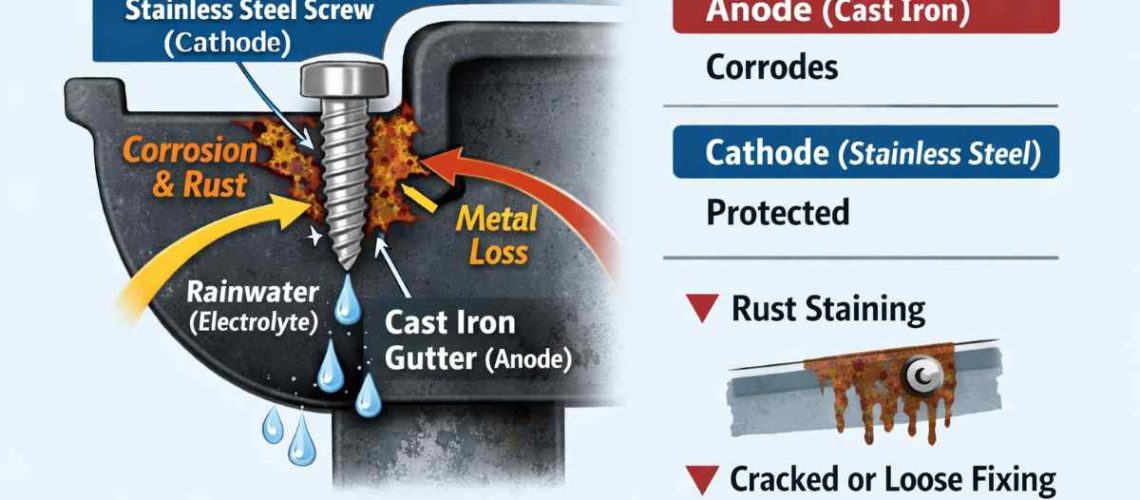
Galvanic corrosion — sometimes called bimetallic corrosion — occurs when two dissimilar metals are placed in electrical contact in the presence of an electrolyte. In the context of external rainwater goods on a heritage building, that electrolyte is everywhere: rainwater, condensation, sea spray, and atmospheric humidity all suffice to complete the circuit.
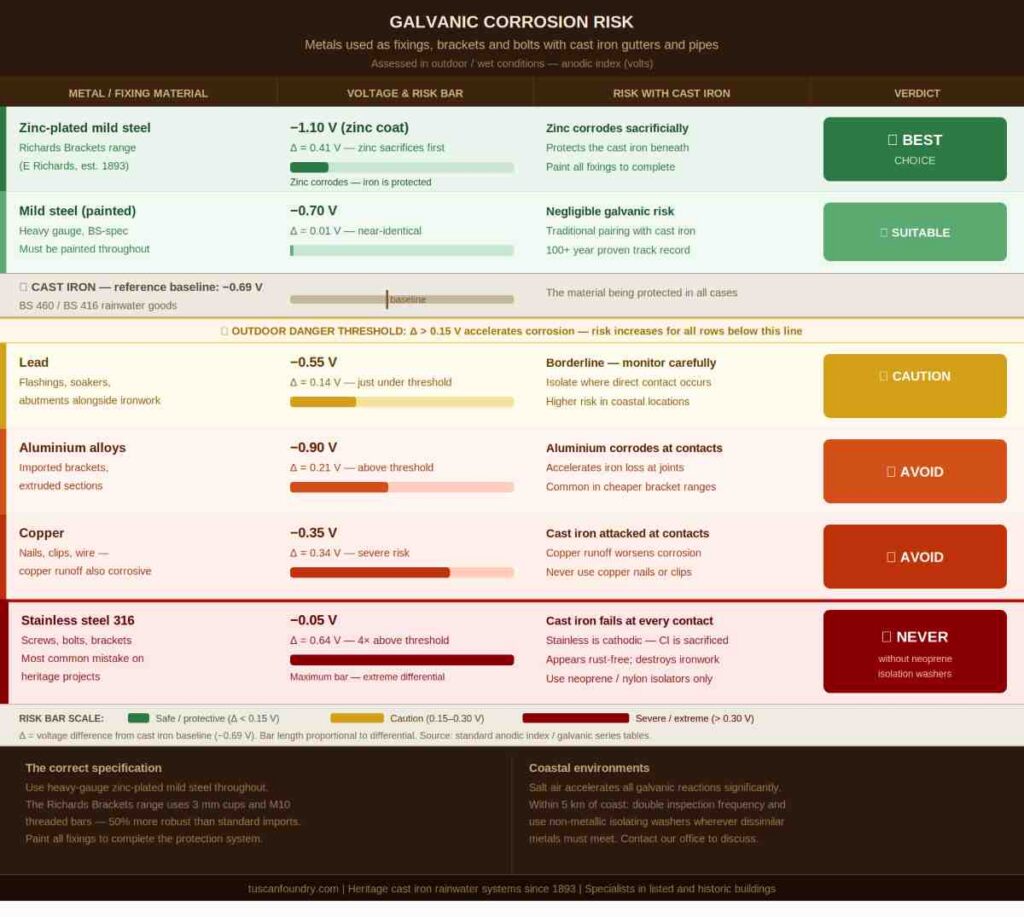
Metals can be ranked by their electrochemical potential — their position in the galvanic series. The less noble metal in any pairing (the anode) will corrode sacrificially to protect the more noble metal (the cathode). The greater the potential difference between the two metals, the faster and more aggressive the corrosion. In outdoor environments, a potential difference of just 0.15 volts is considered a significant risk for accelerated deterioration.
Cast iron sits at approximately -0.69V on the anodic index. Mild steel, at -0.70V, is almost identical, making it an excellent companion material and the reason that traditional, British-made steel gutter brackets have coexisted successfully with cast iron systems for over a century. Copper, at -0.35V, represents a 0.34V differential — already a concern. Passive stainless steel (316 grade), however, sits at approximately -0.05V. That is a differential of 0.64V against cast iron: more than four times the threshold for severe corrosion risk in a harsh external environment.
Stainless steel has become a default specification in many sectors because of its genuine corrosion resistance in isolation. The problem arises when it comes into contact with a less noble metal, such as cast iron, which is considerably less noble. In this pairing, the cast iron becomes the anode and will corrode preferentially. The rate of attack is further accelerated by the relative surface area effect: a large body of cathodic stainless steel drawing electrons from a small point of cast iron contact will cause localised corrosion at that contact point with alarming speed.
We are explicit in our guidance: avoid stainless steel fixings that come into direct metallic contact with cast iron rainwater components. This applies to brackets, bolts, screws, and holder bats alike. The use of stainless steel might appear to offer a modern, corrosion-resistant solution, but in practice it accelerates the very deterioration it is intended to prevent — at the expense of the irreplaceable cast iron.
The appropriate fixing material for cast iron rainwater systems is heavy-gauge mild steel with a zinc or hot-dip galvanised finish. Zinc sits at approximately -1.10V on the anodic index — more active than both mild steel and cast iron. This means that, where zinc coating is scratched or worn, the zinc itself corrodes sacrificially in preference to the underlying steel, providing a dual layer of protection: physical barrier first, sacrificial anode second.
Our Richards Brackets range — manufactured by E Richards, established 1893 — is produced from high-quality British mild steel with zinc plating as standard. The cup thickness is 3mm (compared with the 2mm found in many imported alternatives), and the rise-and-fall brackets use a 10mm threaded bar rather than the 8mm used in cheaper off-the-shelf products. These are not minor details: that additional millimetre of material represents a 50% increase in robustness, critical when supporting the substantial weight of cast iron in the demanding British climate.
Where stainless steel fixings must be used in coastal or marine environments — where chloride-induced pitting of other metals is a genuine concern — they should always be isolated from the cast iron using non-metallic barriers: nylon or neoprene washers and gaskets that break the galvanic circuit entirely.
Beyond material compatibility, the correct bracket type must be selected for each building’s structural and architectural context. We supply the full range of traditional fixing types, all manufactured in Britain to heritage-appropriate specifications.
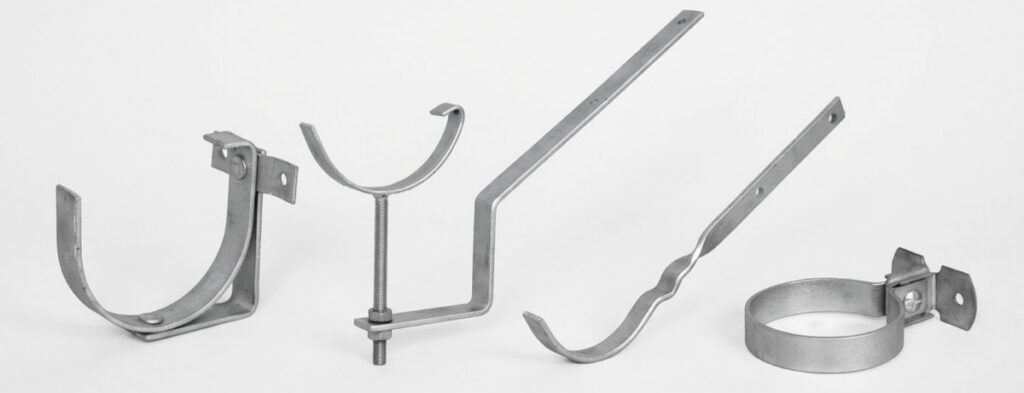
Where a timber fascia board is present at the eaves, fascia brackets should be spaced at no more than 915mm centres, with additional brackets within 150mm of every corner, outlet, and joint. The bracket must be of sufficient strength to carry the weight of cast iron — many modern brackets designed for lightweight plastic systems are wholly inadequate for this purpose.
For buildings without a fascia board — common across Georgian, Victorian, and rural vernacular architecture — rise and fall brackets provide the solution. A drive-in spike is set into the masonry, and the threaded rod allows the gutter fall to be adjusted precisely, accommodating settlement and uneven wall-heads, which are a feature of almost every historic building. The 10mm threaded bar on our Richards range is essential here: an 8mm bar can flex under load, compromising the fall and leading to the ponding that accelerates joint corrosion.
Where the fixing must be made directly to roof timbers — typically in regions with significant snow loading — top rafter or side rafter brackets are specified. These provide a more direct transfer of load to the building’s primary structure and are particularly common in Scotland, where they are known as Rhone brackets.
Cast iron downpipes require equally considered fixing. Eared sockets — where fixing lugs are cast integrally into the pipe — provide the most robust solution. Where holderbats (ear bands) are used, they should be set back from the masonry, allowing air circulation and preventing moisture accumulation behind the pipe — a primary cause of concealed decay in historic walls.
Designed by Cuthbert Brodrick and completed in 1858, Leeds Town Hall is one of the great Victorian civic monuments. Its extensive cast-iron rainwater system — encompassing deep ogee gutters and substantial downpipes — is supported by steel rise-and-fall brackets set into the sandstone cornice. The aggressive West Yorkshire climate, with high rainfall and temperature fluctuations, makes bracket specification critical. Any stainless steel fixing here would create a galvanic couple with both the cast iron above and the ferrous elements of the stone ironwork anchors below, accelerating deterioration. The correct approach has always been zinc-protected mild steel, kept to a strict painting and inspection regime.
Blenheim Palace presents some of the most demanding conservation challenges in the country. Its baroque roofscape — completed in 1722 — incorporates an intricate hierarchy of gutters, hoppers, and downpipes across a vast footprint. The absence of conventional fascias across much of the roof necessitates drive-in rise-and-fall brackets anchored directly into the stonework. Here, lime mortar compatibility is critical: Portland cement repointing around bracket spikes traps moisture and causes the very spalling it was meant to prevent. Our team regularly advises on bespoke bracket profiles for Blenheim, where like-for-like replacement of period fixings is a condition of works approval.
John Wood the Younger’s masterpiece of 1774 presents a challenge that is as much about uniformity as it is about conservation. The 30 terraced houses share a unified Bath stone façade, and any variation in gutter profile, downpipe alignment, or bracket type is immediately visible across the entire crescent. Rise-and-fall brackets are specified throughout and adjusted to accommodate decades of differential settlement across the terrace. Zinc-plated, British-made brackets, painted to match, are the only appropriate solution — imported alternatives with thinner-gauge steel fail to maintain the precise gutter alignment this Grade I setting demands.
As a medieval fortress on the Welsh coast, Harlech Castle presents the most extreme environmental challenge: salt-laden winds from Cardigan Bay, high annual rainfall, and the structural complexity of medieval masonry. Holderbat fixings for any downpipe work here require particular attention to galvanic risk — the marine atmosphere accelerates electrochemical reactions significantly, meaning that a 0.64V differential between stainless steel and cast iron, already dangerous in an inland setting, becomes actively destructive within months at a coastal site. Our recommendations for Harlech and comparable coastal heritage structures always include non-metallic isolating washers wherever dissimilar metals must meet.
Sir George Gilbert Scott’s Gothic Revival masterpiece, completed in 1876, underwent a major restoration in the early 2000s that included the reinstatement of its cast-iron rainwater system. The steep pitches, ornate hopper heads, and intricate bracket profiles required both standard stock and bespoke reproduction components. We can reproduce bracket profiles from drawings or surviving originals—a capability that was essential here, where every visible element is subject to Historic England approval. The fixing specification used zinc-plated rise-and-fall brackets throughout, with the gutter bolts matched to zinc-plated mild steel to eliminate any risk of bimetallic corrosion across a system of considerable complexity and value.
Even correctly specified zinc-plated steel brackets will fail eventually if their protective coating is compromised. All fixings should be painted to match the cast iron system — the paint provides the primary corrosion barrier, with the zinc serving as the sacrificial secondary defence.
For the highest level of conservation work, we strongly advocate the use of linseed oil paints across both the cast iron and its fixings. Unlike synthetic alkyd paints, linseed oil paint remains flexible, moves with the metal through thermal cycling, and saturates the surface rather than forming a rigid film. Cracking — the primary failure mode of synthetic paint on iron — allows moisture to ingress, leading to under-film corrosion. Linseed oil systems, by contrast, can be refreshed with a light coat every five to seven years without aggressive stripping, making them both more effective and more sustainable over the long life of a heritage building.
Standard factory-primed items should receive a full paint system before installation: wire-brush any compromised primer, apply a compatible metal primer, then two undercoats and a topcoat of a quality exterior paint. Our Premier Extra range offers a factory-applied three-coat system with a life expectancy of at least ten years under normal conditions, reducing on-site labour whilst ensuring a consistent, heritage-appropriate finish.
We strongly advise against it. Stainless steel and cast iron sit far apart on the galvanic series — a potential difference of approximately 0.64 volts in outdoor conditions — which creates a severe risk of accelerated corrosion at every point of contact. The cast iron will corrode preferentially. If stainless steel fixings are unavoidable (for example, in marine environments where other metals are also at risk), they must be isolated from the cast iron using non-metallic neoprene or nylon washers and gaskets to break the galvanic circuit.
Heavy-gauge mild steel with a zinc or hot-dip galvanised finish is the appropriate choice. Our Richards Brackets range uses 3mm mild steel cups and 10mm threaded bars — substantially more robust than imported alternatives — and is zinc-plated as standard. All brackets should subsequently be painted to complete the protective system.
Galvanic corrosion occurs when two dissimilar metals are in electrical contact in the presence of moisture. The less noble metal corrodes sacrificially. In cast iron rainwater systems, where the ironwork is expected to last 100 years or more with correct maintenance, introducing a more noble metal — such as copper or stainless steel — at any fixing point creates an electrochemical cell that progressively destroys the cast iron at that junction. In a heritage building, this can mean concealed, costly damage to irreplaceable fabric.
Many historic buildings lack a conventional timber fascia or have fascias that are not straight due to decades of settlement. Rise and fall brackets allow the gutter fall to be set precisely regardless of the irregularity of the wall-head or rafter line. This is particularly important with cast iron, which is far more rigid than plastic alternatives and cannot accommodate unevenness through flexion. Poor fall leads to ponding, which accelerates joint sealant failure and corrosion—the beginning of a systemic decline.
We recommend a thorough inspection at least twice annually — after the autumn leaf-fall and again in late spring. At each inspection, check that brackets are still firmly anchored in the masonry, that bolts and fixings show no active corrosion, that the paint system is intact (attending promptly to any blistering or chipping), and that gutters are flowing freely without ponding. In coastal environments, inspection frequency should be doubled, and any salt accumulation on sheltered surfaces should be washed away, as concentrated salt deposits corrode faster than exposed areas cleaned by rain.
Lime mortar, or specialist epoxy resins, are chemically compatible with porous historic substrates. Never Portland cement. Cement is harder than historic brick and stone, and its impermeability traps moisture behind the patch — leading to freeze-thaw spalling that can destabilise the very masonry holding the bracket spike. Lime mortar is sacrificial (softer than the surrounding stone or brick), breathable, and compatible with the movement of historic structures.
Yes. We maintain a catalogue of 19 gutter profiles and over 50 ornamental hopper heads, and our UK manufacturing capability allows us to produce bespoke bracket profiles from drawings, photographs, or surviving originals. Regional styles — from Norwich City Council’s double-fixing repair brackets to Scottish Rhone brackets — are well within our capability, and we regularly produce small quantities of bespoke components for high-status civic and listed buildings. Don’t hesitate to get in touch with our office to discuss specific requirements; bespoke items typically carry an 8–10 week lead time.
The long-term integrity of a cast iron rainwater system on a heritage or listed building is determined not only by the quality of the gutter and pipe but by the precision with which every fixing, bracket, and bolt is selected and installed. Galvanic corrosion — silent, progressive, and often invisible until it is too late — is one of the most preventable causes of system failure on historic buildings, and yet it continues to occur wherever stainless steel or other incompatible metals are introduced without adequate isolation.
The principles are straightforward: use zinc-plated British mild steel brackets of appropriate gauge; choose the correct bracket type for the structural and architectural context; anchor fixings with lime-compatible mortars or resins; protect every metal surface with a quality paint system, ideally linseed oil-based for the most demanding conservation settings; and inspect the whole system twice a year. Followed consistently, these principles will ensure that a cast iron rainwater system performs as it should — reliably, quietly, and without harming the historic fabric it exists to protect.

At Tuscan Foundry Products, we have been at the heart of heritage rainwater system specification since 1893. We supply the full range of cast iron gutters, pipes, hoppers, and associated fittings, together with our Richards Brackets range of British-made steel fixings — designed and manufactured specifically for the demands of cast iron on period and listed buildings. Our bespoke casting service allows us to reproduce profile-matched gutters, brackets, and ornamental components from drawings or surviving originals, with a typical lead time of 8–10 weeks. We also offer linseed oil paint finishes and comprehensive technical specification support for architects, surveyors, and conservation professionals working on some of the most significant and sensitive buildings in the United Kingdom and internationally. Whether you are specifying a straightforward replacement system or navigating the complexities of a Grade I listed restoration, we bring the depth of knowledge and the quality of product that heritage buildings deserve.