
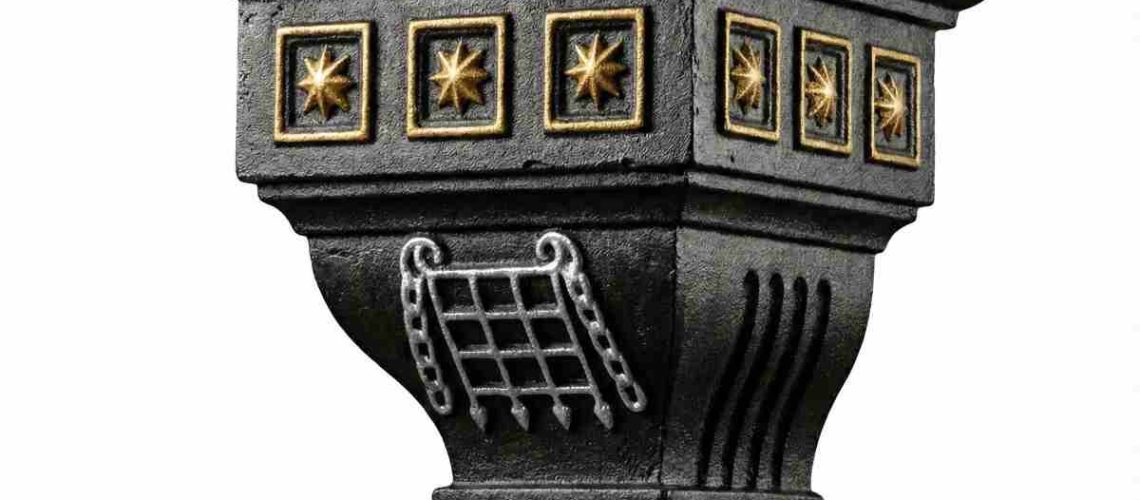
Walk the length of any Georgian terrace, pause outside a Victorian town hall, or look up at the guttered eaves of a country house stable block, and your eye will eventually settle on a small but revealing detail: the point at which the gutter ends and the downpipe begins. On a well-designed historic building, that transition is rarely a simple junction. It is marked by a cast iron rainwater head — what the trade calls a hopper head — and it is one of the most architecturally expressive components of the entire external envelope.
At Tuscan Foundry, we have been specifying, supplying, and producing bespoke cast iron rainwater systems for listed and historic buildings since 1893. In our experience, the rainwater head is the component most frequently underestimated during the specification process and the one most likely to betray a project that has otherwise been handled with care. A mismatched hopper on a listed building is the architectural equivalent of the wrong doorknob on a period interior — technically functional, but visible in all the wrong ways to anyone who knows what to look for.
This article explores the history, hydraulic function, and conservation specifications of cast iron hoppers and rainwater heads — drawing on a rich body of research to explain why these components deserve far more attention than they typically receive and what the best practices are when a project demands that they be handled correctly.
The management of rainwater has evolved through distinct phases of material science and architectural philosophy. The Romans introduced sophisticated concepts of rainwater collection during their occupation of Britain between 43 and 410 AD, but much of this technical knowledge was lost following their departure. The reintroduction of formal rainwater management came with the Normans after 1066. One of the earliest recorded uses of a downpipe dates to 1078 at the Tower of London, where lead — an expensive and high-status material — was used to manage flow from the royal structure. By 1240, Henry III had ordered the first documented downpipe specifically to protect the Tower’s newly whitewashed walls from the staining effects of uncontrolled surface runoff.
For several centuries, lead remained the dominant material for sophisticated rainwater systems. A pivotal moment in the supply of this material came in 1539, with the Dissolution of the Monasteries under Henry VIII, which released vast quantities of recycled lead into the general market. This surplus facilitated a surge in decorative lead hopper heads — many of which display heraldic devices, family crests, and date inscriptions — that remain among the finest surviving examples of the plumber’s craft. Eighteenth-century lead hoppers were formed from sheet lead with cast lead ornaments, hand-dressed around a wooden former-block. High-status examples featured gilt lettering, with heraldic colours picked out in paint or tinned finishes.
The technological innovations of the Industrial Revolution drove the transition to cast iron. The widespread adoption of coke-fired smelting from the 1760s onwards enabled the production of cast iron in far greater quantities and at significantly lower cost than earlier methods. Cast iron rainwater goods were introduced as a mass-produced alternative to lead in the late eighteenth century, and by the mid-nineteenth century, they had become the standard material for urban construction across Britain. The London Building Act of 1724 had already stimulated demand by requiring that the front elevations of houses should have downpipes — a legislative nudge that made the efficient hopper head a practical necessity rather than a luxury.
The following table summarises the principal periods in the evolution of the rainwater hopper head:
Era | Material | Method | Aesthetic Drivers | Key Reference |
Norman / Medieval (1066–1500) | Lead (High Status) | Hand-dressed | Protection of masonry; regal prestige | Tower of London, 1078 |
Tudor / Stuart (1500–1700) | Recycled Lead | Sand-cast / rolled | Heraldry; dates; monastery salvage | Post-Dissolution estates |
Georgian (1714–1830) | Lead to Cast Iron | Sand-cast | Symmetry; classical restraint; initials | Royal Crescent, Bath |
Victorian (1837–1901) | Cast Iron | Industrial sand-cast | Gothic; exuberant ornament; mass production | St Pancras; Royal Albert Hall |
Edwardian (1901–1910) | Cast Iron | Catalogue-based | Refined motifs; swags; medallions | Municipal and civic buildings |
Cast iron hopper heads serve as chronological markers, often bearing the property’s stamp through dates, emblems, or initials. These features are central to the architectural character of a historic building — providing a unique silhouette and a material narrative that no modern substitute can replicate.
Early cast iron hoppers from the late eighteenth and early nineteenth centuries frequently mimicked the smaller, more restrained forms of their lead predecessors — faceted or semi-circular designs whose decoration was focused on proportion rather than exuberant ornament. As the Regency period progressed, even greater restraint was applied. Between 1810 and 1850, a range of faceted designs appeared that remain in production today with only slight variations, a testament to the enduring logic of the original forms.
The Victorian era transformed the hopper into an architectural embellishment. The industrial capacity of the period’s great foundries enabled elaborate detailing to be incorporated into functional components at scale. Hopper heads found expression in Gothic Revival, Queen Anne, and Italianate styles. Common motifs included acanthus leaves and fleur-de-lis reflecting the period’s engagement with classical and natural ornament; lion’s masks integrated into ogee gutter runs; and heraldic crests that turned a drainage accessory into a statement of social position and identity. Homeowners used hopper heads to display their coat of arms or record the construction date — turning what might have been an anonymous component into a permanent signature on the face of their building.
The Edwardian period maintained Victorian design sensibilities but leaned towards cleaner lines and more restrained decoration. Swags, laurel wreaths, and oval medallions replaced the complex Gothic tracery of the previous generation. This era also saw the widespread adoption of standardised foundry catalogues, from which builders and architects could select appropriate hopper styles — the forerunner of the product ranges we offer today.
A rainwater head is the funnel-shaped or box-shaped collecting vessel fixed at the top of a downpipe, receiving water from one or more gutters and directing it into the vertical drainage run below. It is, in the most literal sense, the hydraulic node of the rainwater system — and its correct sizing is as important as its correct appearance. On historic buildings with large, complex roof planes, a single cast iron hopper may receive flow from multiple gutter runs simultaneously, including balcony drains and parapet gutters, making adequate capacity essential.
The hopper performs a function that is often underappreciated in specification: the reservoir effect. By providing a brief collecting volume before the water enters the narrower vertical downpipe, the hopper buffers the flow during heavy rainfall events, significantly reducing the risk of the system overflowing and discharging against the face of the building. Research into hydraulic performance suggests this reservoir function can meaningfully increase the volume of water a drainage system handles during peak flow, which is particularly relevant given the increasing intensity of rainfall events now experienced across the UK.
The open top of the hopper also facilitates air entry into the downpipe, preventing airlocks and ensuring efficient water movement. This is not a trivial matter: a blocked or incorrectly jointed downpipe can allow water to back up into the hopper and overflow at the gutter-hopper junction, directing water into the wall rather than away from it. Poorly maintained or incorrectly specified hoppers are a leading cause of damp penetration, timber rot, and — in severe cases — structural damage to historic masonry.
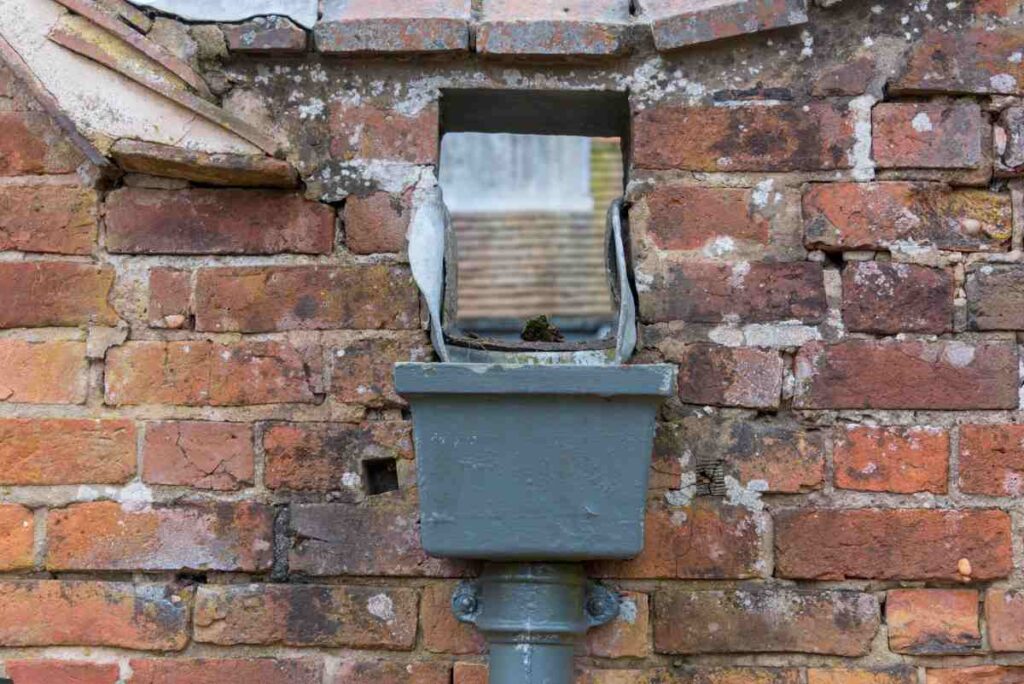
When selecting materials for historic buildings, the choice between traditional cast iron and modern alternatives involves considerations that go well beyond initial cost. Cast iron’s physical properties make it uniquely suited to the demands of historic building conservation.
Cast iron expands very little with temperature changes — its thermal expansion coefficient is broadly similar to that of masonry and structural steel, meaning that the building fabric and the rainwater system move together. This eliminates the need for expansion joints and simplifies the design of bracketing systems. By contrast, uPVC expands significantly with temperature change, requiring expansion collars at regular intervals and far more frequent bracket support — every four feet horizontally compared to approximately ten feet for cast iron. On a historic elevation, the visual noise of frequent bracket positions and expansion joints is both aesthetically unacceptable and practically difficult to detail sensitively.
Cast iron is also significantly stronger than thermoplastic materials — up to ten times stronger in some mechanical applications. Its ring stiffness means it does not deform under mechanical strain or the weight of ladder access; a practical consideration on maintenance-intensive historic buildings, where operatives inevitably lean against pipework during routine inspection. And cast iron is the quietest pipe material available: its density absorbs the sound of rushing water rather than transmitting it through the building fabric, unlike uPVC, which can produce audible drumming noises within adjacent rooms.
The sustainability case is equally compelling. Cast iron is fully recyclable and has a life expectancy that far exceeds that of modern alternatives. A correctly maintained cast iron rainwater system on a well-managed historic building will outlast several generations of uPVC replacement — and the embodied carbon of frequent replacement cycles must be weighed against the higher upfront cost of a material that, once installed, may never need replacing. This is a position endorsed by both Historic England and, in Wales, by Cadw, whose guidance states explicitly that uPVC and extruded aluminium are not suitable substitutes for cast iron on historic buildings.
For owners of listed buildings and properties in conservation areas, the management of rainwater goods is subject to specific legal requirements. Carrying out unauthorised works to a listed building is a criminal offence. While the repair of existing guttering is generally permitted without consent, replacing a component — even with a similar style — typically requires approval from the local planning authority. The replacement of traditional cast iron with uPVC is generally unacceptable on listed buildings due to its short lifespan and detrimental visual impact.
In England, Historic England’s technical guidance on resilient rainwater systems emphasises that any upgrades to accommodate increased rainfall must complement the building’s architecture and minimise impact on its significance. Their advice is clear: cast iron can last far longer than modern replacements if properly maintained, and its use represents not only historical authenticity but sound long-term building management. In Wales, Cadw’s guidance is equally direct — severely rusted or split sections must be replaced on a like-for-like basis, and cast iron should be redecorated on a three-to-four-year cycle. We have written in more detail about planning requirements and listed building consent for rainwater goods on our website, and we are always happy to provide technical supporting information for consent applications where required.
The importance of the rainwater head as an architectural component is best understood through example. Across Britain, some of our most celebrated historic buildings bear witness to the craft and care once invested in these details — and demonstrate what is lost when they are replaced without adequate thought.
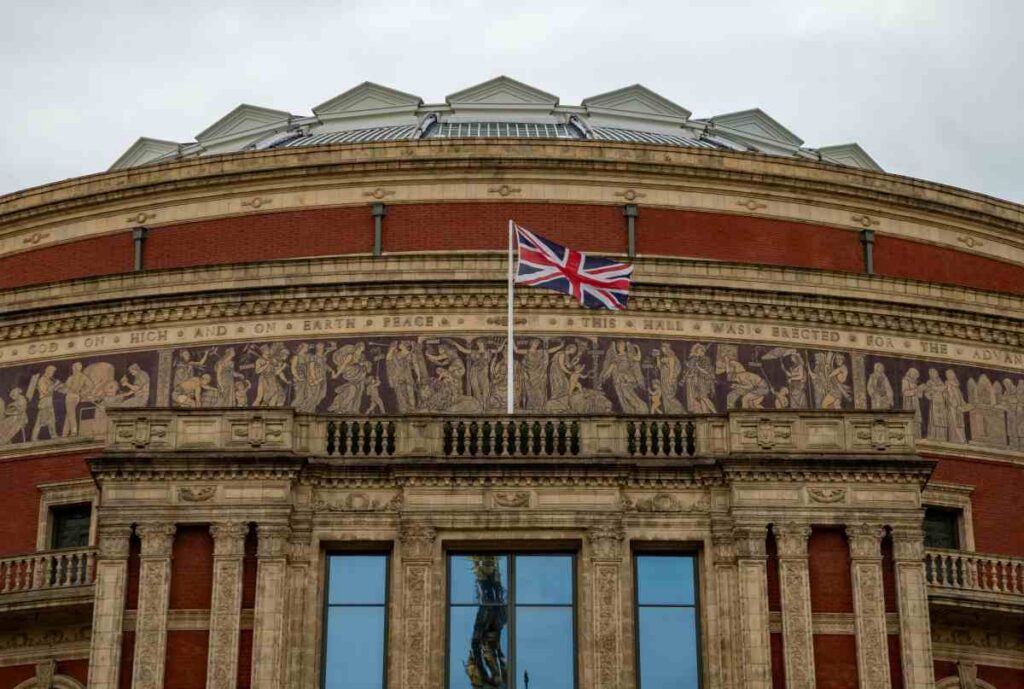
The Royal Albert Hall project stands as one of the most instructive contemporary examples of bespoke heritage hopper specification. The configuration at 30 points around the Drum was replaced to match the 150-year-old originals while simultaneously addressing a specific design deficiency in the original installation — water ingress caused by the original seating rails. The commission required the fabrication and installation of bespoke heritage cast iron rainwater hoppers and pipework that were visually indistinguishable from the originals, whilst incorporating a corrected hydraulic detail. This is exactly the kind of project that demonstrates what a specialist conservation foundry supplier can achieve: not simply replicating what was there before, but understanding why it was there and how it can be improved without compromising the architectural record.
John Wood the Younger’s Royal Crescent, completed in 1774, presents one of the most controlled and consistent historic streetscapes in Britain. The uniform stone façade is punctuated at regular intervals by cast iron downpipes and hoppers whose profiles were standardised across the entire sweep of the crescent to maintain the architectural unity Wood intended. Any deviation in profile, diameter, or surface detail on a replacement component is immediately visible against its neighbours. Bath & North East Somerset Council’s conservation team takes a rigorous approach to specification on this UNESCO World Heritage Site, and it is precisely the kind of project where profile-matching and a willingness to engage closely with conservation officers make a tangible difference to the outcome.
At The Lancasters — a Grade II listed stucco-fronted terrace overlooking Hyde Park — architects specified a heritage cast iron system to complement the Victorian architecture and meet the requirements of the listed building consent. The project required 18 lengths of 1.8-metre downpipe from ground level to the hopper heads, all finished in a bespoke white paint created specifically for the development. The system was chosen for its combination of traditional manufacture and modern quality control — a pairing that conservation projects frequently require and that only a specialist supplier can reliably deliver. The Lancasters demonstrate that heritage cast iron specification is not confined to the repair of damaged originals; it is equally the right choice for high-quality new installations within a historic context.
The reinstatement of Victorian hopper heads in Walthamstow High Street formed an integral part of an economic regeneration scheme aimed at restoring the historic character of the streetscape. The original hopper heads were found to be intact after shot blasting, and new moulds were hand-carved in wood to create accurate replicas — ensuring that the unique historic features of the high street were preserved for future generations rather than lost to the expediency of inappropriate modern substitutes. The Walthamstow project is a useful reminder that bespoke copy casting need not be confined to grand country houses; it is equally applicable to the repair and replication of modest but historically significant civic and commercial streetscapes.
The principal façades of Chatsworth, seat of the Dukes of Devonshire and one of England’s great baroque country houses, carry a rainwater system of considerable scale and historical interest. The lead hoppers on the older elevations bear ducal coronets and monograms — a reminder that even on the grandest buildings, the rainwater head was understood as an opportunity to assert identity and status. The cast ironwork on later service ranges and estate buildings echoes the same decorative vocabulary, maintaining visual coherence across a complex, multi-period site. The lesson for conservation specifiers is clear: on a building of this significance, a replacement hopper must be matched with the same precision as any other architectural element, and the case for a site survey before specification is finalised is overwhelming.
The restoration of historic hopper heads requires a sensitive methodology that prioritises the retention of original material wherever possible. Replacement should always be the last resort; repair and stabilisation come first.
Bi-annual inspections are recommended — ideally after autumn leaf fall and again in spring before the heavier rainfall months. Inspectors should look for staining or dampness on internal walls behind hopper positions, which can indicate leaks or overflows; blistering paint and rust in crevices and joints, which are early signs of active corrosion; and misaligned pipes or loose collars, which suggest that fixings have failed and water may be tracking behind the pipe rather than through it.
Where deterioration is identified, old paint and rust must be removed before the condition of the metal can be properly assessed. Appropriate techniques include water jetting for oil, rust, and loose paint; mechanical cleaning with needle guns and descaling chisels for heavier build-up; and shot blasting in a controlled environment for significant corrosion. Flame cleaning softens paint effectively but carries a risk of thermal shock in brittle iron, so it should be used with caution.
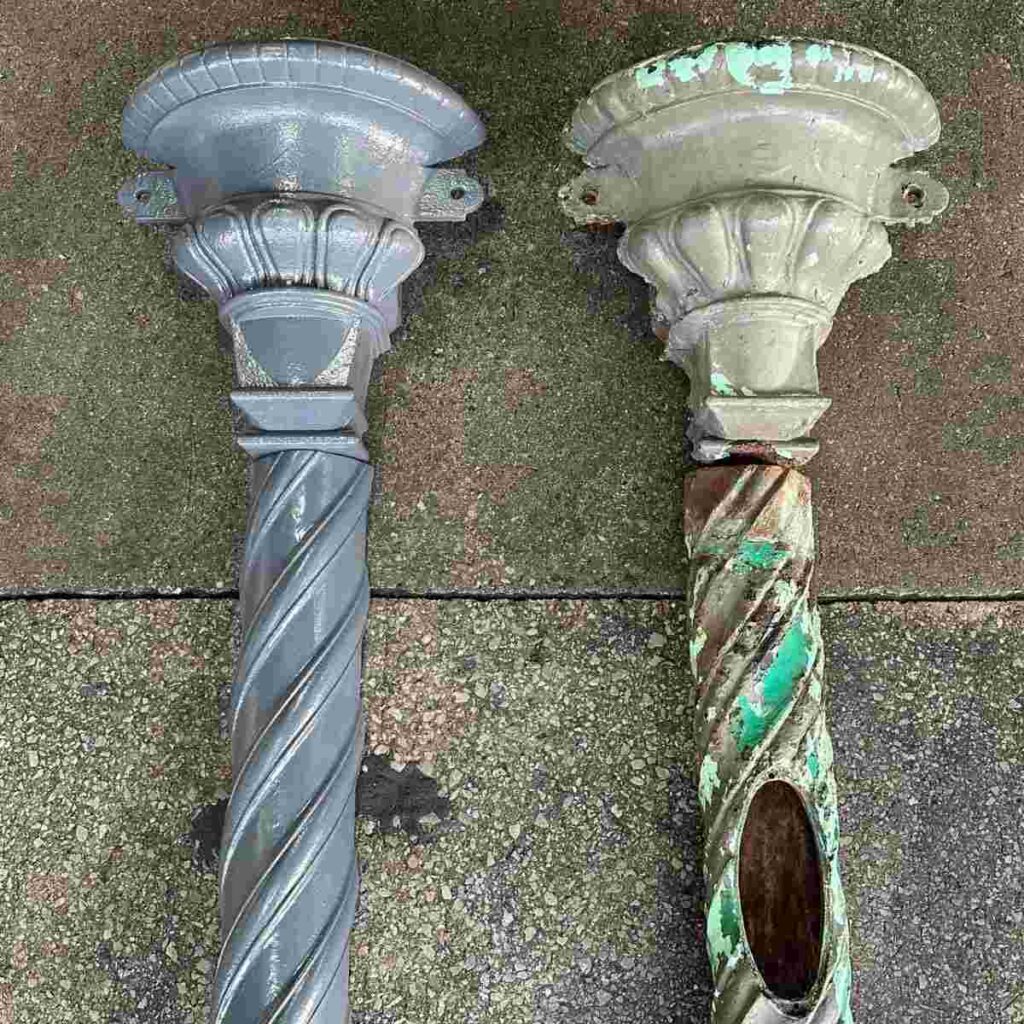
Where a hopper head is damaged, but the structure remains sound, several repair options are available before replacement is considered. Metal stitching is a traditional repair technique for fractures — holes drilled perpendicular to the crack are bridged with a steel key that holds the section together without welding. Cold repairs using two-pack epoxy resins and reinforcing plates are suitable for in-situ restoration. Where replacement is genuinely necessary, or where an original has been lost, bespoke replication from photographs, drawings, or surviving fragments is our core specialism. We commission patterns hand-carved in wood to the original profile, ensuring that every decorative detail aligns with the surviving evidence. Lead times for bespoke copy casting are typically 8–10 weeks — always factor this into the programme early.
We would also strongly recommend a site survey at the outset of any complex restoration or copy casting commission. It allows us to assess surviving evidence, measure existing downpipe diameters, identify hydraulic constraints, and advise on appropriate profiles before pattern-making begins — eliminating the risk of costly mismatches and ensuring that the specification is grounded in what the building actually needs.
The long-term performance of cast iron depends heavily on its protective coating. Cast iron has a different surface and microstructure from steel, and paint systems developed for steel may not provide the best protection. For heritage buildings, we consistently recommend a linseed oil paint system as the most historically authentic and technically appropriate finish.
Linseed oil paints are breathable, flexible, and exceptionally durable. Unlike hard, inflexible coatings such as epoxy, which cannot accommodate the metal’s natural thermal expansion and contraction and will eventually crack, trap moisture, and accelerate corrosion, linseed oil paint moves with the metal. Conservation officers widely accept it, and it is compatible with listed building consent conditions. It is available in a range of heritage colours, and custom colours can be formulated for projects requiring a specific match to surviving paintwork.
For bare metal, a zinc-based or traditional red lead primer should be applied before top coats. Micaceous iron oxide makes an effective undercoat, and the interiors of gutters and hopper heads should be finished with bitumastic paint to resist constant water exposure. Wooden spacers behind brackets are recommended to facilitate future redecoration and allow condensation to evaporate from behind the pipe. Silicone sealants at joints are a temporary measure only — traditional joints should be made using linseed oil putty, which remains the correct long-term solution for cast iron rainwater systems on historic buildings.
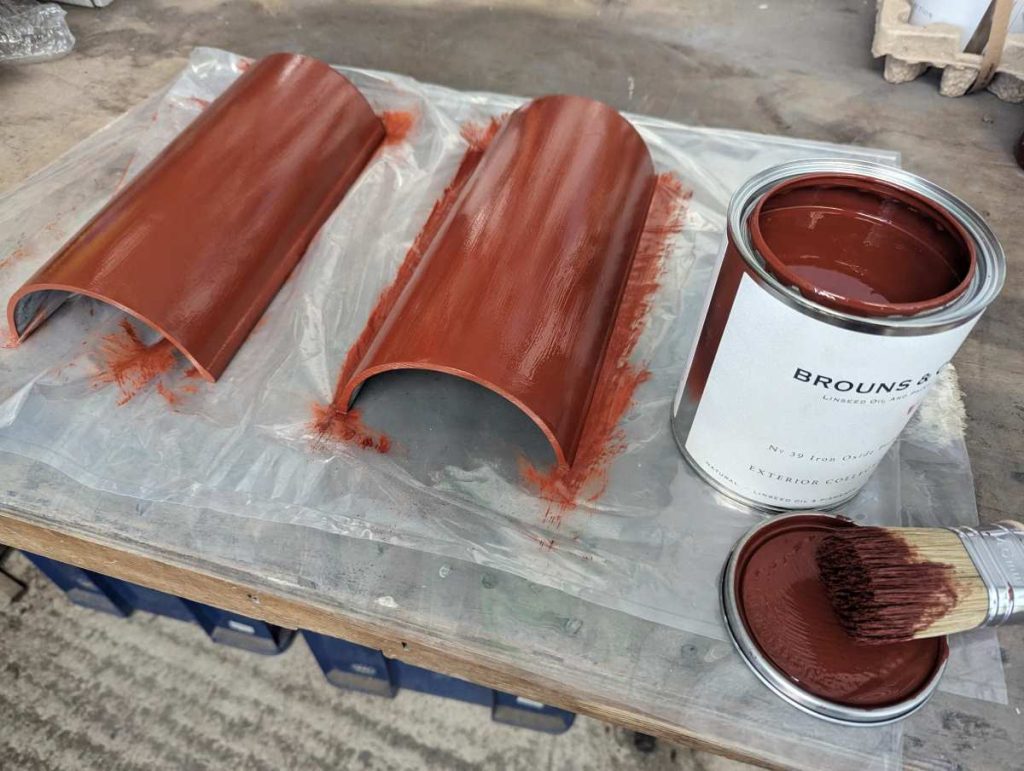
Cadw recommends a redecoration cycle of three to four years for cast iron rainwater goods on historic buildings. In practice, a well-applied linseed oil system on properly prepared metal can last considerably longer—but regular inspection and prompt attention to any areas of deterioration will always extend the life of the coating and the ironwork beneath it.
For architects and surveyors approaching a hopper specification on a listed or historic building, the following questions should guide the process from the outset:
In conservation work, quality is carefully measured. The rainwater head is a small component in the overall scale of a historic building — but it sits at eye level, is prominent on every significant elevation, and is the point where the engineering of the roof drainage system meets the decorative ambition of the architecture. From the heraldic lead hoppers of Tudor estates to the Gothic revival ironwork of a Victorian town hall, these components have always been understood by the best designers and artisans as more than plumbing fittings. They are part of the building’s architectural narrative, and they deserve to be treated as such. Our articles on swan necks and downpipe offsets, and on the preservation of cast iron rainwater systems, provide further technical context for professionals working on these details.

The terms are used interchangeably in the UK. A rainwater head, hopper head, or simply a hopper is the collecting vessel fixed at the top of a downpipe that receives water from one or more gutters and channels it into the pipe below. Historic buildings are typically cast in iron or lead, and on any building of quality, they are likely to feature decorative moulding appropriate to the architectural style and period. The distinction between a ‘plain’ hopper and a ‘decorative’ one is primarily aesthetic — both perform the same hydraulic function.
In most cases, yes. The rainwater system — including hoppers and downpipes — forms part of the historic fabric of a listed building, and replacing any component with a different material, profile, or decorative character is likely to constitute an alteration requiring consent from the local planning authority. We strongly recommend consulting your conservation officer before commencing any replacement works. We can assist with the technical specification and supporting information for consent applications. More guidance is available in our article on planning requirements for listed buildings.
Yes — copy casting from photographs, measured drawings, or physical samples is one of our core specialisms. We work with experienced pattern-makers who hand-carve wooden patterns from the surviving reference material, ensuring that every decorative detail of the original is faithfully reproduced in the casting. We are accustomed to working from limited or partial evidence, and we can advise on historically appropriate interpretations where the record is ambiguous. We recommend a site survey at the outset of any bespoke casting commission to ensure all relevant details are captured before pattern-making begins.
Bespoke and copy casting typically takes 8–10 weeks from the approval of the pattern. We always advise clients to factor this lead time into the project programme at the earliest opportunity — it is consistently the aspect of bespoke work that causes programme difficulties when it is not flagged early enough. Standard hoppers from our stock range are available for prompt dispatch. If you are uncertain whether a standard or bespoke item is appropriate for your project, our technical team is happy to advise.
We recommend a linseed oil paint system as the most historically authentic and technically appropriate finish for cast iron on listed buildings. Linseed oil paints are breathable, flexible, and durable — they move with the metal rather than cracking as it expands and contracts — and are widely accepted by conservation officers under listed building consents. They are available in a range of heritage colours. More information is available in our support and technical guidance section. Cadw recommends repainting cast iron rainwater goods on a three to four-year cycle to maintain protection.
In our experience, cast iron hoppers are more often repairable than they appear. Active corrosion, cracked sections, and deteriorated joints can all be addressed without full replacement in many cases. Metal stitching is effective for fractures in thicker sections; two-pack epoxy resins and reinforcing plates are suitable for in-situ repairs. The decision should be made after the existing paint and surface corrosion have been properly removed and the underlying metal assessed — which is why we recommend engaging a specialist before committing to replacement. Where replacement is genuinely necessary, like-for-like replication is almost always the correct approach.
Entirely so. Cast iron rainwater components are appropriate for new-build and contemporary projects wherever the design intention calls for traditional materials, or where a new building is being constructed within a sensitive historic context. Many conservation area developments and extensions to listed buildings specify cast iron as a condition of planning consent. We work with architects on new-build projects across a full range of scales, and we are always pleased to advise on appropriate profiles, finishes, and system design.
At Tuscan Foundry Products, we have been supplying heritage cast iron rainwater systems to conservation architects, building surveyors, and heritage contractors since 1893. From our base in Mid Wales, we work on some of the most significant listed and historic buildings in the UK and beyond — from individual listed townhouses to major civic and public buildings — offering a product range that extends from standard stock gutters and pipes to fully bespoke components produced to the most exacting conservation standards. We hold deep technical knowledge of the history, specifications, and long-term performance of cast iron rainwater goods, and we apply that knowledge to every project we are involved in, however large or small.
Where a project involves complex bespoke work, damaged or missing components, or a site with access challenges or limited surviving evidence, we offer a chargeable site survey service to assess the on-site position before any specification is finalised. In our experience, the cost of a site survey is invariably recovered many times over in avoided mistakes and mismatches. To discuss your project, please get in touch with our technical team—we are always pleased to hear from professionals working on buildings that deserve to be handled with care.