
Established 1893 | BS 460:2002 Certified | UK & International Supply | Expert Technical Support | 0333 987 4452
When existing cast iron rainwater goods can be saved, they should be. This guide covers the full refurbishment process — from safe removal and cleaning methods to matching replacement sections and recoating for the long term — with practical guidance on risk management, contractor pricing, and the role of professional surveys.
The refurbishment of existing cast iron gutters on heritage buildings is, in most cases, both achievable and preferable to wholesale replacement — but it demands careful planning, realistic risk assessment, and a clear understanding of what you are likely to find once the work begins. Gutters installed in the Victorian and Edwardian periods have often been in service for a century or more. They are heavy, degraded to varying degrees, and held together with bolts that may not have moved since they were first fixed. Before any contractor puts a spanner to the first joint, the sequence of decisions made at the specification and survey stage will determine whether the project runs smoothly or becomes a series of costly surprises.
At Tuscan Foundry Products, we supply cast iron rainwater goods to conservation professionals across the UK and internationally. We also offer a chargeable site survey service designed specifically to help specifiers understand what they have before they commit to a programme of work. The guidance in this article reflects the practical realities of refurbishment projects we see and support on a regular basis.
The single most important step in any cast iron gutter refurbishment is an honest, detailed assessment of the existing installation before any removal work begins. The condition of individual sections, joints, brackets, and fixings will determine what is repairable, what needs replacing, and where the genuine risks lie during removal.
Cast iron guttering produced in the nineteenth and early twentieth centuries was sand cast — an inherently variable process. Original castings often contain air pockets, uneven wall thicknesses, cold shuts (where molten iron cooled too quickly during pouring), and areas of internal voiding that are entirely invisible from the outside. A gutter that appears intact from below may be structurally compromised in ways that only reveal themselves under load — or during cleaning.
On larger or more complex projects, it is worth considering the involvement of a metallurgist or structural specialist to assess the integrity of key sections, particularly where the installation is of particular historic significance and the cost of failure is high. For most residential and institutional projects, a thorough professional site survey will identify the likely extent of deterioration and allow the specification to be drawn up with appropriate contingency.
Removing cast iron guttering that has been in place for sixty, eighty, or a hundred years is not a straightforward task. The bolts connecting gutter sections are almost always corroded — and corroded bolts on aged cast iron sections present a genuine risk of casting fracture when torque is applied.
Penetrating oil applied well in advance can help to free stubborn fixings, but it is no guarantee. Where bolts shear during removal, the surrounding casting may be damaged or lost entirely. Contractors who price this work on the assumption that every section will come away cleanly are setting themselves up for a difficult conversation with their client halfway through the programme.
The weight of cast iron is a further consideration. A standard length of cast iron guttering is considerably heavier than its modern alternatives — typically four to six kilograms per metre for a standard half-round section, and proportionally more for deeper profiles. Working at height with sections of this weight requires appropriate scaffold, plant, and a sufficient number of operatives. The building fabric itself — fascia boards, soffits, wall fixings, and masonry — must be protected throughout the removal process.
Contracts for this type of work should include explicit provisional sums and contingency allowances to cover for unforeseens: sheared bolts, sections too degraded to reinstate, unexpected casting failures during cleaning, and any remedial works to the structure required before refurbished or new sections can be fixed back. These are not exceptional events — on most aged installations, they are the norm.
The correct cleaning method for aged cast iron guttering depends on the structural condition of the casting, the nature and depth of the existing coatings, and the extent of corrosion present. There is no single universal solution — and the wrong choice can cause irreversible damage.
Hand wire brushing and power-tool cleaning using needle scalers, chipping guns, and cup brushes are the most controllable methods and are appropriate for surface rust and loosely adhering paint. They are labour-intensive but impose minimal mechanical stress on the casting. For sections with uneven wall thicknesses or known casting voids, this controlled approach reduces the risk of breakthrough. A needle scaler with a compressor can be highly effective and is a practical choice where the condition of the casting gives cause for caution.
Chemical stripping using proprietary paint remover solutions is well suited to castings with multiple accumulated paint layers and is particularly valuable where mechanical methods risk damaging fragile sections. Chemical methods impose no physical stress on the metal and, where the casting has internal voids or thin walls, represent the safest route to a clean surface. The key requirement is adequate ventilation and appropriate personal protective equipment. Chemical waste must be disposed of in accordance with current environmental regulations.
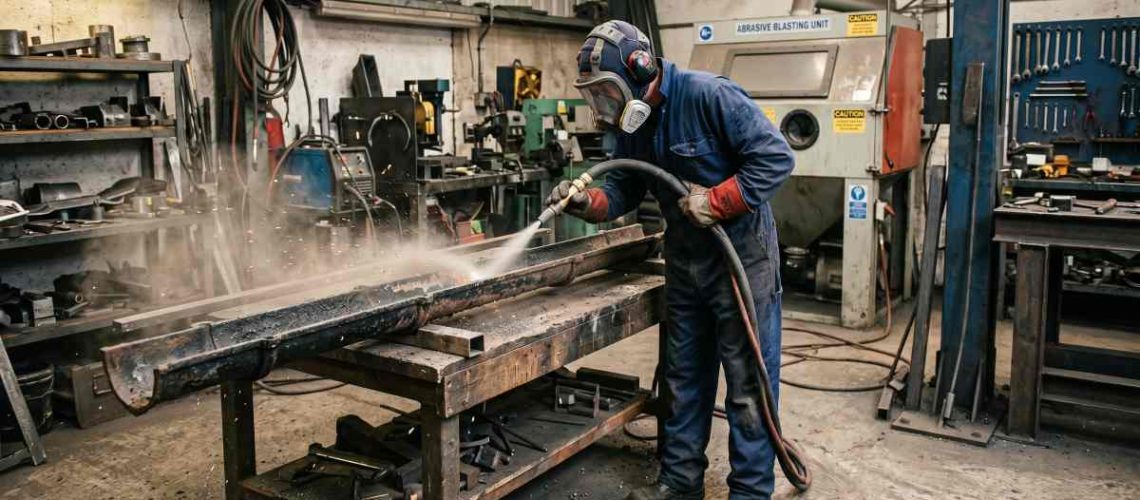
Shotblasting and grit blasting are efficient and produce an excellent surface profile for recoating — but they carry significant risks when applied to aged, used cast iron guttering. Original casting imperfections that are dormant in service can be exploited by high-pressure abrasive media, causing through-holes or sudden fracture. Practical evidence from the trade suggests that failure rates during shotblasting of reclaimed or aged guttering can be high, particularly where sections have been in service for many decades.
Where blasting is considered appropriate — typically for sections that have been assessed as structurally sound — low-pressure controlled grit blasting using a fine media is preferable to high-pressure shotblasting. The iron should be primed immediately after blasting to prevent flash rusting, which can occur within hours of exposure.
Flame cleaning using an oxy-acetylene or oxy-propane torch combined with wire brushing is occasionally used, particularly for removing thick paint systems from robust sections. It is effective but demands skill and experience — localised overheating can cause thermal stress in already weakened castings. It is not a method for inexperienced operatives and should not be used on thin-walled or visibly degraded sections.
Once cleaned back to bare metal, cast iron must be primed as quickly as possible — flash rusting can begin within hours on a freshly cleaned surface. A zinc-based rust-inhibiting primer provides the most effective base coat and is compatible with the range of topcoat systems appropriate for heritage cast iron.
For listed buildings and conservation projects, we consistently recommend a linseed oil paint system as the topcoat of choice. Linseed oil paint forms a flexible, penetrating, and breathable film that is uniquely well suited to the thermal movement characteristics of cast iron. It adheres and cures into the surface rather than forming a brittle skin over it, and its longevity — when properly applied and maintained — substantially exceeds that of conventional alkyd or water-based paints.
Linseed oil paint is also recognised by conservation bodies as the most appropriate finish for historic metalwork, and its use on listed buildings will be viewed positively by conservation officers. Application requires patience — each coat must be applied thinly and allowed to cure fully before the next — but the long-term performance justifies the additional care at the application stage.
Where individual sections or lengths are beyond refurbishment, the ability to match new cast iron precisely to the existing profile is critical. On a well-maintained Victorian terrace or a country house estate, a visually inconsistent repair is not acceptable — and on a listed building, it may not be permissible.
Many standard Victorian and Edwardian profiles are still represented in our current product catalogue, including Half Round, Ogee, and Moulded Ogee sections in a range of sizes. Where dimensions match, new sections can blend almost invisibly into an existing installation — the key variable is the quality and consistency of the finish applied to both old and new elements.
Where the existing profile is non-standard, bespoke, or sufficiently distinctive that a catalogue match is not achievable, our copy casting service offers the most reliable solution. Working from a surviving section, photographs, or measured drawings, we can reproduce a profile with a high degree of accuracy. The lead time for copy casting is typically 8 to 10 weeks, and this should be factored into the programme from the outset.
For any project involving matching or partial replacement, we encourage early contact — ideally with photographs and dimensions — so that we can advise on the most appropriate route before the specification is finalised. The contact our team page provides the easiest route to a direct technical discussion.
The repair of existing cast iron guttering on a listed building is generally permitted without formal consent — but the boundary between repair and alteration is not always clear, and the process of systematic removal, even for refurbishment, can attract scrutiny.
Before embarking on a programme of removal and reinstatement, consultation with the local authority conservation officer is strongly recommended. Where the work involves any change of profile, material, or configuration, Listed Building Consent will be required. Early engagement avoids programme delays and protects the interests of both the client and the contractor.
Grade II* Listed Country House, Shropshire
This mid-nineteenth century Italianate country house retained its original Moulded Ogee cast iron rainwater system on all principal elevations. A programme of refurbishment was specified following a comprehensive condition survey that identified significant bolt corrosion at every joint and several sections with casting voids. Chemical stripping was selected over abrasive blasting to avoid stress on compromised sections. Three lengths of an unusual wide-profile Moulded Ogee were beyond reinstatement; copy castings were produced from a surviving sample and reinstated seamlessly. The installation was recoated with a linseed oil paint system in traditional black.
Georgian Terrace, Edinburgh New Town (Category A Listed)
A ten-property terrace in Edinburgh’s World Heritage Site presented a programme of full gutter refurbishment across a continuous roofline. Individual sections had accumulated up to six layers of paint over 150 years of maintenance cycles. Chemical stripping was used throughout to manage paint removal without abrasive risk. All cast iron sections were found to be structurally sound following cleaning — a reminder that well-maintained installations can survive remarkably well. A small number of sections showing hairline fractures were replaced with matching Half Round profiles from our standard catalogue.
Parish Church, Norfolk (Grade I Listed)
An ecclesiastical refurbishment project on a Grade I listed flint church required the removal and reinstatement of original Victorian cast iron rainwater goods on the nave and chancel elevations. The removal process revealed extensive bolt shear across the majority of joints, and several sections fractured during disassembly. The programme had been priced with a provisional sum for section replacement, which proved to be well-judged. Profile matching from our Half Round standard range and a short copy casting run for two decorative hopper heads allowed the installation to be reinstated with full visual continuity.
Victorian Board School, Bristol (Grade II Listed)
A local authority conservation project on a large Victorian board school involved the refurbishment of box gutter sections and downpipes across a complex roof arrangement. The age and depth of corrosion on the downpipes warranted a needle scaler and controlled wire brush approach rather than blasting, given the known variability of original castings at this building type. A metallurgical assessment of two downpipe sections was commissioned following visible evidence of internal corrosion — one section was found to have a wall thickness significantly below the nominal original specification and was replaced. The remainder of the installation was successfully refurbished and recoated.
Walled Kitchen Garden Complex, North Yorkshire (Grade II Listed Estate)
A large historic estate undertook a rolling programme of cast iron gutter and downpipe refurbishment across its walled garden buildings and ancillary structures. The variety of profiles across the site — reflecting different phases of construction from the 1780s to the 1890s — meant that matching replacement sections required a combination of standard catalogue supply and selective copy casting. The estate’s building team worked with us to develop a condition-rated survey schedule that prioritised sections by urgency, enabling the programme to be phased over three years within a managed budget.
At Tuscan Foundry Products, we have been supplying cast iron rainwater goods to the conservation sector for over a century. Whether you are specifying a wholesale refurbishment of an important listed building, managing a rolling maintenance programme across an estate, or dealing with a single section that has failed and needs an exact replacement, we can provide the products, the technical advice, and the site survey support to help you get it right.
We supply from standard stock for prompt despatch, and our copy casting service offers heritage-accurate bespoke sections with a typical lead time of 8 to 10 weeks. If you are beginning to plan a refurbishment project and would like to discuss the profile, quantity, or condition issues involved, please contact us at your earliest convenience — ideally at the survey and specification stage, where our input can add the most value. You can also call us directly on 0333 987 4452.
In most cases, yes — provided the sections are structurally sound. Refurbishment involves careful removal, thorough cleaning back to bare metal, priming with a rust-inhibiting primer, and recoating with an appropriate heritage finish such as linseed oil paint. Where individual sections are beyond repair, we can supply matching replacements or copy cast new sections to the original profile. A condition survey prior to specification will establish which approach is most cost-effective.
Shotblasting can be highly effective on structurally sound cast iron, but aged guttering presents specific risks. Original sand casting processes were imperfect — air pockets, cold shuts, and uneven wall thicknesses are common in Victorian and Edwardian sections. High-pressure abrasive blasting can exploit these weaknesses, opening existing voids into through-holes or causing sudden fracture. On used guttering, failure rates during shotblasting can be significant. Lower-pressure grit blasting, chemical stripping, or controlled hand cleaning are generally safer options.
Pricing should carry explicit provisional sums and contingency allowances for unforeseen failures, including bolt shear, casting fractures, and sections that are too degraded to reinstate. We strongly recommend a pre-contract condition survey to identify the worst sections before work begins. Lead times for replacement sections or copy castings should be factored into the programme — typically 8 to 10 weeks for bespoke work. Contractors should also price for safe temporary protection of the building fabric during removal and re-fixing.
Many Victorian and Edwardian profiles — Half Round, Ogee, and Moulded Ogee — are represented in our standard catalogue. If you share photographs and dimensions of the existing section, we can advise on the closest current match. Where a profile is non-standard or highly ornate, copy casting from a surviving section or from drawings is the most reliable route to an accurate match. We are experienced in both approaches and can advise at enquiry stage.
The repair and restoration of existing gutters is generally permitted without consent, but removal — even temporarily — can fall within the scope of listed building works. We recommend consulting your local authority conservation officer before any programme of systematic removal begins. Where the work involves change of profile, material, or configuration, Listed Building Consent will almost certainly be required. Early consultation avoids delays and protects the contractor and client alike.
The choice of method depends on the condition of the casting and the extent of paint build-up. Wire brushing and mechanical needle scaling are suitable for surface corrosion and flaking coatings. Chemical stripping is effective for multiple paint layers and avoids physical stress on the metal. Controlled low-pressure grit blasting can be used with caution where castings are in good condition. Flame cleaning combined with wire brushing is occasionally used. The priority in every case is to assess casting integrity before committing to an aggressive method.
We recommend a linseed oil paint system as the most heritage-appropriate and durable finish for refurbished cast iron. Applied to a properly prepared and primed surface, linseed oil paint forms a flexible, penetrating, and breathable film that is uniquely well suited to the thermal movement characteristics of cast iron. It adheres and cures into the surface rather than forming a brittle skin over it, and its longevity substantially exceeds that of conventional alkyd or water-based paints. It is also recognised by conservation bodies as appropriate for historic metalwork.