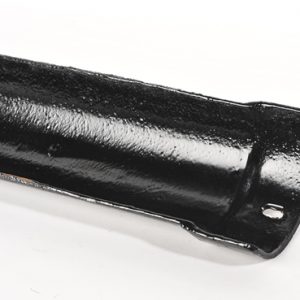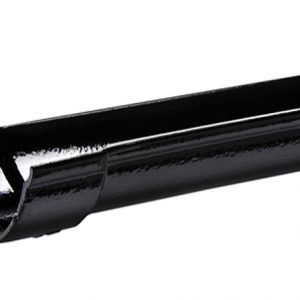
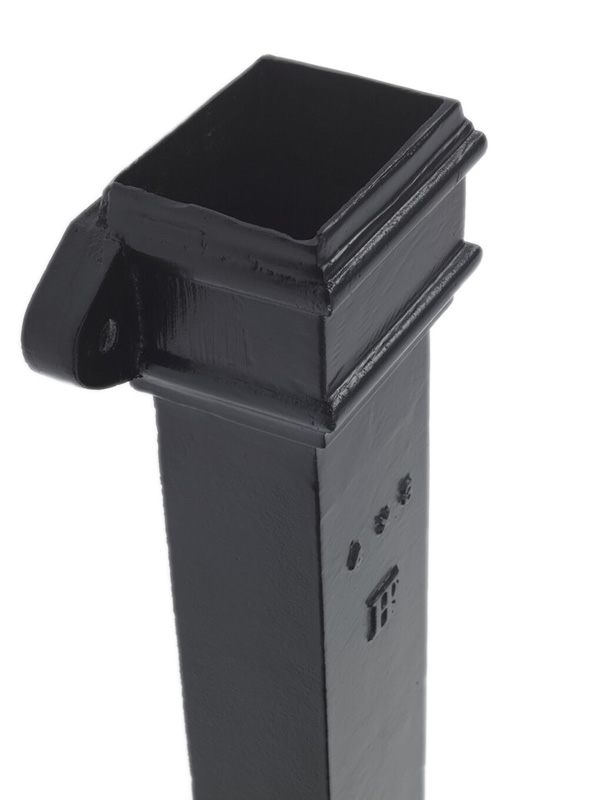
We do offer a range of Ogee patterned gutters in both straight and radius profiles. The straight profiles are much more common and as such cost less.
£391.00 – £656.00Price range: £391.00 through £656.00 +VAT
Size in mm 75×75 (3×3″) 100×100 (4×4″) 125×125 (5×5″) 100×75 (4×3″)125×70 (5×2.75″) 125×100 (5×4″) 150×100(6×4″)
A = Overall length 1829 1829 1829 1829 1829 1829 1829
B = Overall width (including ears) 174 193 223 205 223 230 255
C = Distance between fixing centres 135 154 185 163 187 192 215
D = Insertion depth of socket 75 75 75 75 75 75 75
E = Back of fixing to pipe centre 53 63 78.5 58 62 65 64
F = Internal width of socket 82 108 133 109 124 132 160
G = Thickness of ear 13 13 13 25 10 12 10
H = Outside pipe width 76 102 127 101 118 128 155
I = Outside pipe depth 76 102 127 74 74 100 100
| Size/Finish | Primer 100mm x 75mm, Primer 125mm x 70mm, Primer 125mm x 100mm, Primer 150mm x 100mm, Black 100mm x 75mm, Black 125mm x 70mm, Black 125mm x 100mm, Black 150mm x 100mm |
|---|
We do offer a range of Ogee patterned gutters in both straight and radius profiles. The straight profiles are much more common and as such cost less.
We manufacture a wide variety of brackets for many different cast iron gutter and pipe profiles. More common types are the rise and fall, top fix and side fix rafter and the holderbat or pipe clip.
We can also offer traditional drive brackets, repair brackets and fascia brackets in both steel and cast iron.
It is always advisable to replace like with like because quite often the brackets form and important part of the buildings architecture. Occasionally buildings have special decorative brackets and our UK manufacturing allows us to produce small quantities of bespoke brackets when required.
We are able to place dates and initials and insignia onto most of our flat faced rainwater hopper heads.
Cast iron radiators cost no more to run than modern steel or aluminium radiators. Cast iron is a very efficient material at emitting heat, thus you have items like le creuset cast iron pans. Cast iron holds it’s heat extremly well, which means that the radiators stay warm for longer.
Yes. Cast iron is the material required by most conservation officers and listed building consents for the replacement or replication of traditional rainwater goods. Our hopper heads are produced in solid cast iron and we can assist with specification notes or material statements for planning purposes if required.
The drainage and guttering market has matured considerably over the past 20 years and there are now many more product choices for consumers to consider.
Despite the influx of new materials it appears that the benchmark for rainwater systems is still cast iron. Cast iron rainwater goods were introduced in the late 18th Century as an alternative to lead. As well as being easier to produce, the material enabled eaves gutters to be installed more simply, since lead could only be used in this location as a lining for timber gutters.
Many modern materials focus on replicating the appearance of cast iron but those materials can vary rarely offer any of the benefits. Cast iron gutters and pipes offer great strength and durability, a proven history of long life, low noise operation and fire resistance. Most old buildings have cast iron rainwater systems that should be maintained and preserved however; these inherent benefits make cast iron an ideal choice for both traditional and modern installations.
It is not uncommon to see modern alternative products marketed with terms like low maintenance or easy to install and cost effective. It has even been said that ‘plastic guttering systems provide a way of achieving a traditional look with modern convenience’. These terms tend to refer to possible cost savings rather than any real product benefits. It is also difficult to quantify the benefits of modern convenience over traditional build quality.
It is worth remembering that all rainwater goods will require some element of maintaining to ensure they are unblocked by debris and remain functional. No rainwater system cleans itself. Today most suppliers of cast iron rainwater systems offer products in both primer or pre-painted with a 10 year protective coating. When describing modern materials, the term ‘cost effective’ is used rather than simply saying cheap. There is no doubt that the initial cost of many modern materials is less than cast iron but you might be surprised to know that over its lifespan, cast iron will cost around a third of plastic.
It is easy to forget about your rainwater system but it does need to be maintained and inspected at least twice a year regardless of the product material. It does not matter whether the property is hundreds of years old or brand new, the message is the same; ‘maintaining your rainwater system contributes to the external appearance of the building as well as keeping it free from damp and structural damage.
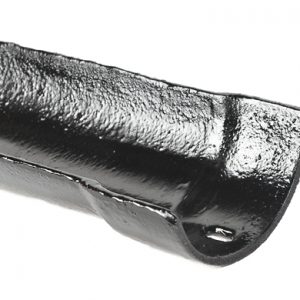
Casting of iron is an imperfect processs. It is possible with some cast iron radiators that you will get minor imperfections in the surface finish. When radiators are painted this will reduce and over the years every additional coat of paint applied will provide a smoother more equal finish.
The standards for our cast iron gutters and pipes have remained remarkably constant for many years. The physical properties of cast iron are sustained throughout its lifetime thus maintaining its effectiveness. Coupled with is durability and proper maintenance, we would expect our traditional cast iron rainwater products to last for over 50 years under normal conditions.
Our standard spike or sturt length is 300mm (12″). Other sizes are available upon request.
Our hopper heads are available with a wide range of pipe connections to suit round, square, and rectangular downpipes. The Calnethorpe No.11 accepts round 65mm, 75mm, and 100mm; square 75×75mm, 100×100mm, and 125×125mm; and rectangular 100×75mm, 125×100mm, and 150×100mm. Connection options vary by model — please contact us to confirm availability for your chosen hopper.