
Established 1893 | BS 460:2002 Certified | UK & International Supply | Expert Technical Support | 0333 987 4452
For British architects, contractors and owners working on historic buildings in France, and for French specifiers who read English. What a dauphin is, how French rainwater terms translate, and how to order an exact copy from the UK.
Version française : Dauphins en fonte et descentes d’eaux pluviales : guide pour les bâtiments anciens en France
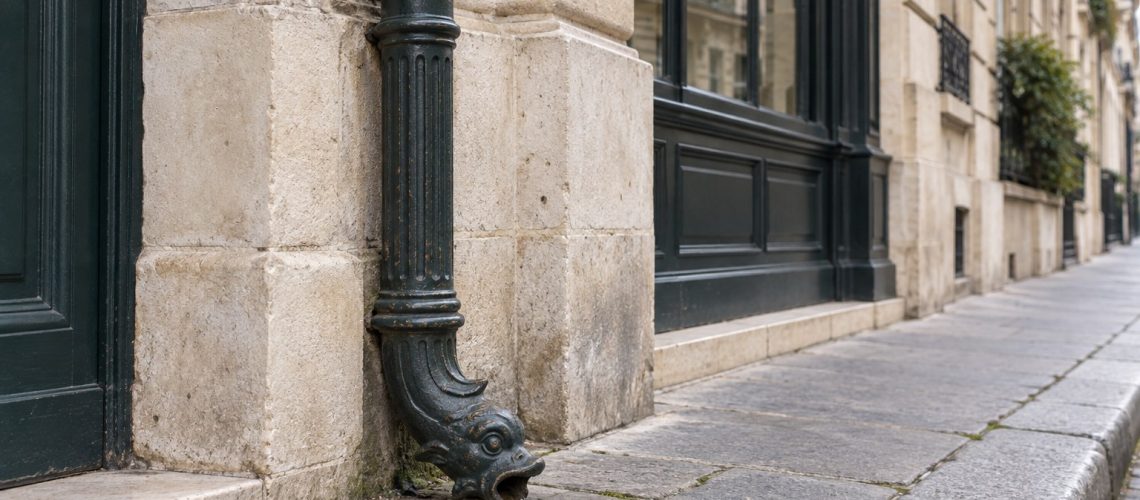
On historic French buildings, gutters and downpipes are traditionally zinc, sometimes copper. Cast iron appears mainly at the foot of the downpipe as the dauphin: a rigid section, often around a metre or more high, that protects the zinc pipe from impact and connects it to the drain. Old dauphins can be straight or bent, round or square, plain or fluted, and some end in a fish head. Many have been broken or replaced with plain modern sections. We copy cast dauphins from a surviving example, measured photographs or drawings, with a socket made to fit the existing zinc pipe. English-style villas may also take complete BS 460 cast iron systems. In protected areas, the Architecte des Bâtiments de France must agree changes to external appearance.
A dauphin is the cast iron bottom section of a French downpipe, built to resist impact where the zinc pipe is most exposed. The name comes from early patterns that ended in a fish head throwing water sideways, away from the wall.
Before downpipes were routinely connected to underground drains, the dauphin carried water clear of the foundations onto the pavement or into a gutter channel. Today it usually connects directly to an inspection chamber (regard) or buried drain. Its protective role remains: cast iron is far more rigid than zinc and survives knocks from bicycles, bins and vehicles. Examples survive across French towns and cities, including Paris, Strasbourg and Caen.
Britain has no exact equivalent. A British cast iron downpipe usually runs full height and ends in a shoe or a drain connector. In France, the rest of the pipe is zinc and only the base is cast iron.
Most French terms have a direct British equivalent; the dauphin is the exception. Use both terms on a schedule for a French project.
| French term | British term | Notes |
|---|---|---|
| Gouttière pendante | Eaves gutter | Profiles include demi-ronde (half round), havraise and à doucine (ogee). |
| Chéneau | Box gutter, parapet gutter | Built-in gutter behind a parapet or cornice. |
| Naissance | Running outlet | Connects the gutter to the downpipe. |
| Boîte à eau, cuvette | Hopper head | Collecting head at the top of a downpipe. |
| Tuyau de descente | Downpipe | Commonly 80 or 100 mm diameter in zinc. |
| Dauphin | No exact equivalent (nearest: shoe or drain connector) | Cast iron base section of the downpipe. |
| Coude | Bend, offset | |
| Collier | Pipe clip, holderbat | |
| Crochet | Bracket | |
| Talon | Stop end | |
| Regard | Inspection chamber, gully | Connection to the underground drain. |
| Couvreur-zingueur | Roofer / leadworker (zinc specialist) | The trade that installs French rainwater goods. |
| Maître d’ouvrage / maître d’œuvre | Client / architect or project manager | |
| Architecte des Bâtiments de France (ABF) | Conservation officer (nearest) | State architect whose agreement is required in protected areas. |
We reproduce dauphins by casting from a surviving example, measured photographs or drawings. The more complete the reference, the closer the copy.
Lead time is typically 12–14 weeks from pattern approval; linseed oil paint adds 6–7 weeks. Our guide to copy casting explains the process in more detail.
An identical replacement often needs no permission, but in protected areas any change to external appearance needs a déclaration préalable and the agreement of the Architecte des Bâtiments de France.
Orders to France are quoted individually and travel by pallet road freight, with courier for small items. Goods enter the EU through customs. Goods meeting the UK–EU rules of origin enter free of customs duty, but import VAT and clearance charges usually apply. UK VAT is zero-rated on exports with proof of export. See international supply and shipping for full details.
A dauphin is the cast iron bottom section of a rainwater downpipe on French buildings. It protects the zinc pipe above from impact and connects the downpipe to the drain. Early examples ended in a fish head that threw water away from the wall, which gave the fitting its name.
There is no exact British equivalent. The nearest terms are a cast iron shoe, where water discharges above ground, or a drain connector where the pipe runs into a below-ground drain. In French specifications, keep the word dauphin.
Rarely. French gutters and downpipes are traditionally zinc, sometimes copper. Cast iron appears mainly at the foot of the downpipe as the dauphin, and on some English-style villas built with British-pattern cast iron systems.
Yes. We copy cast dauphins from a surviving example, measured photographs or drawings, including fluted, square, bent and fish-head patterns. Allow typically 12–14 weeks from pattern approval, plus road freight.
Yes, if we have the outside diameter of the zinc pipe and the diameter of the connection to the drain. The zinc pipe sits inside the head of the dauphin, and we make the socket to the measured size.
An identical replacement often needs no permission. Within the surroundings of a historic monument or in a site patrimonial remarquable, changes to the external appearance need a déclaration préalable and the agreement of the Architecte des Bâtiments de France.
By pallet road freight, with courier for small items. Goods enter the EU through customs; goods meeting the UK–EU rules of origin enter free of duty, but import VAT and clearance charges usually apply.
Yes, where a building originally had them, such as English-style villas. Our half-round and ogee gutters, downpipes, hopper heads and pipe clips are made to BS 460.
In France, cast iron belongs mainly at the foot of the downpipe: the dauphin protects the zinc pipe, and its pattern is part of the character of the façade. A dauphin copied exactly, sized to the existing pipe and finished correctly, restores that detail. We copy cast dauphins to order and supply complete cast iron systems for English-style buildings. Send photographs and measurements through our contact page or call +44 333 987 4452.