
Established 1893 | BS 460:2002 Certified | UK & International Supply | Expert Technical Support | 0333 987 4452
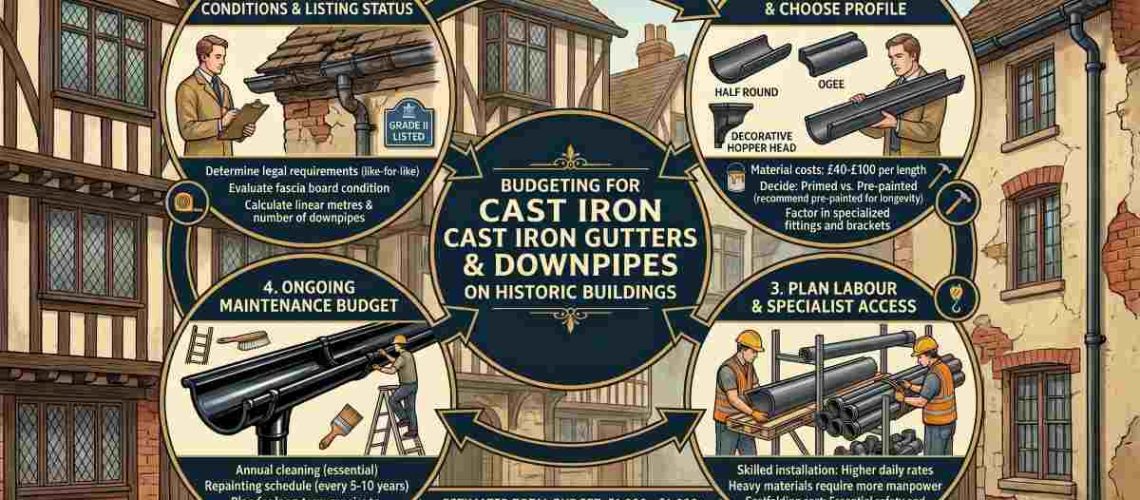
Whether you are replacing failing cast iron gutters on a Grade II listed terrace or specifying a complete rainwater system for a country house restoration, understanding the true cost of cast iron guttering helps you plan accurately and avoid expensive surprises. This guide sets out realistic supply and installation costs, explains the factors that drive price variation, and makes the case for whole-life value — the figure that matters most on historic buildings.
Cast iron guttering typically costs between £60 and £85 per metre for supply only, depending on the profile, size, and finish. Installed costs, including labour, fixings, and jointing compound, range from £80 to £130 per metre for a straightforward replacement on a standard property. Bespoke profiles, copy-cast sections to match a lost original, and radius guttering for curved or bay-windowed elevations carry a premium on top of this.
These figures are a starting point rather than a fixed quote. The actual cost of your project will depend on the profile you need, the total run length, the building’s complexity, access requirements, and whether any sections need to be cast to match an existing but discontinued pattern. What they do confirm is that cast iron sits at a modest premium over commodity plastic alternatives — a premium that disappears entirely when you account for lifespan, Listed Building Consent obligations, and the cost of getting the specification wrong.
Tuscan Foundry supplies cast iron guttering to conservation contractors, heritage architects, and property owners across the United Kingdom. The guidance below draws on that experience.
Before comparing prices, it is worth understanding the regulatory context governing material choices for heritage buildings. If your property is a listed building or sits within a conservation area, the choice of replacement rainwater goods is not merely aesthetic — it may be a legal matter.
Historic England’s guidance on gutters and downpipes is clear: cast iron is the preferred replacement material for like-for-like work on listed buildings. Installing uPVC without Listed Building Consent is a criminal offence, and enforcement notices requiring removal at the owner’s expense are not uncommon. The cost of an enforcement action — legal fees, removal, re-specification, and reinstallation of the correct material — will dwarf the modest saving made by choosing a cheaper product initially.
Conservation officers also look for continuity of profile, texture, and finish. A standard ogee or half-round moulding in plastic will rarely satisfy a planning condition requiring ‘like-for-like replacement in cast iron’. Our FAQ on listed buildings covers the consent process in detail. The short version: if in doubt, commission an on-site survey before specifying anything.
For unlisted properties in conservation areas, the same logic applies. Permitted development rights for alterations to rainwater goods are typically removed by an Article 4 Direction in many conservation areas. Cast iron is also simply the correct material for the architectural period of most pre-1950s properties: it was designed in, its weight and profile complement the masonry, and it weathers authentically.
The following figures reflect typical UK market pricing in 2025–26. Prices vary by region, supplier, and project complexity. All figures exclude VAT.
Supply-Only Costs (per metre, standard stock profiles)
Profile | Typical Supply Cost | Notes |
Half Round (100mm) | £60–£68/m | Most widely stocked; fastest delivery |
Ogee / Victorian Ogee (100–125mm) | £65–£75/m | Victorian staple; common on Georgian terraces |
Moulded Ogee (100–125mm) | £72–£85/m | Premium heritage profile; ecclesiastical and country house work |
Box / Square (100–115mm) | £65–£75/m | Arts & Crafts, Edwardian, inter-war housing |
Radius / Curved (bespoke) | POA | Cast to radius from drawing; 12–14 week lead time |
Copy-cast (matched to original) | POA | Pattern made from surviving section; 8–10 week lead time |
What Drives Cost Variation?
Several factors move the final price above or below the indicative ranges:
Bespoke or copy-cast sections: If the original profile is no longer manufactured and must be matched from a surviving piece, copy casting requires a new pattern to be made. This is a one-off cost that reduces significantly if the same profile is needed again in future.
Georgian Townhouse Row, Bath (Grade II Listed) A terrace of eight Georgian townhouses in central Bath required the full replacement of ogee cast-iron guttering following a condition survey. The properties fell within the Bath World Heritage Site buffer zone, making material compliance non-negotiable. The conservation officer specified a like-for-like in cast iron ogee to match the surviving original sections on the adjacent unlisted terrace. Supply cost for the 180-metre run was approximately £12,200 (£68/m average); the total installed cost, including scaffold, was £28,500. The work was completed without planning complications, and all properties retained their LBC compliance. |
Victorian Parish Church, Lincolnshire (Grade II*) The Church of St Peter needed the replacement of 120 metres of cast-iron guttering along both nave aisles and the north transept. The original moulded ogee profile was intact on the south elevation, allowing our team to take dimensions for a copy-cast pattern match on the damaged northern runs. The total supply cost for standard moulded ogee sections and four copy-cast corner pieces was £10,400. The church’s quinquennial inspector noted the work as a model of material-appropriate repair. The lead time from order to delivery was 9 weeks for the bespoke sections. |
Arts and Crafts Manor House, Herefordshire (Grade II Listed) A substantial late-Victorian manor in the Herefordshire countryside required replacement of the box gutter profile on the principal elevation. The 70-metre run had been partially replaced with uPVC in the 1990s, which the local planning authority required to be rectified as a condition of consent for broader restoration works. Box-section cast iron was supplied at £68 per metre, restoring consistency across the elevation. The project architect noted that the weight and shadow line of the cast iron made an immediate visual improvement even before painting. |
Curved Bay Windows, Edwardian Semi-Detached, London (Conservation Area) A row of Edwardian semi-detached properties in a south London conservation area featured curved bay-window elevations, requiring radiused cast-iron guttering. The Article 4 Direction in force precluded the use of plastic alternatives. We manufactured radius guttering to the architect’s drawings, with each section cast to the precise curvature of the bay. Supply cost for the radius sections was agreed at £280 per unit (12 units across six properties). The standard half-round on the remainder of each property cost £62 per metre. Delivery was 13 weeks from drawing approval. |
Country House Estate, Perthshire (Category A Listed) A Scottish Category A listed country house (equivalent to Grade I in England) required the complete renewal of its rainwater system following a period of deferred maintenance. The specification called for large-bore 150mm half-round cast iron to cope with the steep pitches and lead valley gutters. The contractors’ usual supplier did not hold standard 150mm stock; Tuscan Foundry was able to supply from stock with prompt dispatch. The total supply cost for 240 metres at the 150mm bore was £18,200. The estate factor commented that the lead time was shorter than anticipated and the quality was consistent with Historic Environment Scotland’s guidance on authentic materials. |
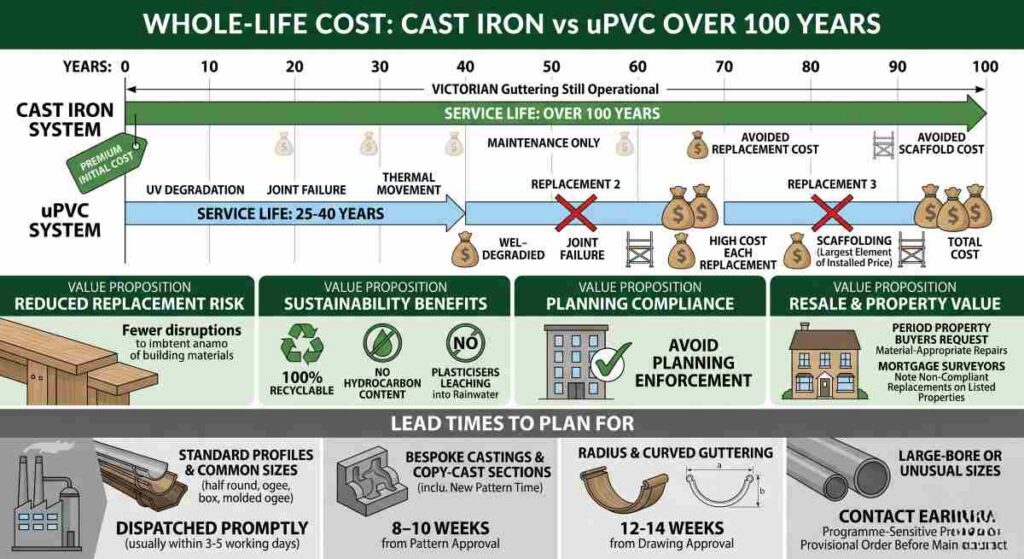
A well-maintained cast-iron rainwater system will outlast the building’s occupants. Cast iron guttering installed in the Victorian era is still doing its job on tens of thousands of properties across the United Kingdom. uPVC, by contrast, has a realistic service life of 25–40 years before UV degradation, joint failure, or thermal movement causes problems. Over a 100-year horizon, a plastic system requires replacement two or three times. Each replacement carries its own scaffold cost, which — as noted above — is the largest single element of the installed price.
The whole-life cost case for cast iron as a building material is compelling even before you account for the avoided risk of planning enforcement. Factor in the sustainability and environmental benefits — cast iron is 100% recyclable, has no hydrocarbon content, and does not leach plasticisers into rainwater — and the value proposition strengthens further.
For residential clients, specifying cast iron is also a defensible position for resale. Period property buyers increasingly request material-appropriate repairs as a condition of purchase, and mortgage surveyors note non-compliant replacements on listed properties.
Lead Times to Plan For
Our standard stock profiles — half round, ogee, box, and moulded ogee in the common sizes — are held in stock and dispatched promptly, usually within 3–5 working days. Plan the following lead times for non-standard work:
We understand that budgets are real and every project has limits. Our approach is to help you spend wisely rather than spend. That usually means helping you identify which sections are genuinely beyond repair (and need replacement) and which need cleaning, re-jointing, or repainting rather than replacement outright. A site survey produces a condition schedule that typically reduces the volume of replacement material needed by 20–40% on older properties where the iron is sound, but the joints and fixings have failed.
For residential period homes through to large estate and ecclesiastical contracts, we supply the full range of cast iron rainwater products from our product catalogue. Our technical team is available to advise on profile selection, finish options, and installation details. We also maintain relationships with approved conservation contractors if you need help finding an experienced installer in your region.
Call us on 0333 987 4452 or contact us for a quote with your run lengths and profile requirements. For anything complex, send a photograph, and we will advise on the most cost-effective approach before you commit to a specification.
Question | Answer |
How much does it cost to replace cast-iron guttering on a three-bedroom Victorian house? | For a typical three-bedroom Victorian semi-detached with approximately 25–30 metres of guttering, expect to pay £1,500–£2,000 for supply (using half-round or ogee at standard sizes). The installed cost, including scaffold, will typically range from £5,000 to £8,000, depending on access complexity and the local labour rate. |
Is cast iron guttering more expensive than uPVC? | Supply-only cast iron costs roughly 4–6 times as much as equivalent uPVC. However, cast iron has a service life of 80–100+ years, compared with 25–40 years for uPVC, meaning it requires fewer replacements over the life of the building. When scaffold costs are included in each replacement cycle, the whole-life cost difference narrows considerably. |
Do I need Listed Building Consent to replace cast iron guttering? | If you are replacing like-for-like in cast iron on a listed building, many local authorities treat this as permitted development that does not require LBC. However, if you change the material, profile, or colour, you will likely need consent. We always recommend checking with your local conservation officer before starting work. Our listed buildings FAQ covers this in more detail. |
How long does cast iron guttering last? | Cast iron guttering installed and maintained correctly has a service life of 80 to 100 years or more. Much of the Victorian cast iron in service today is well over a century old. The key maintenance requirements are periodic painting (every 8–12 years using an appropriate paint such as linseed oil paint) and re-jointing of failed sections as required. |
Can I get a price per metre without visiting the property? | Yes — for standard stock profiles, we can provide accurate supply pricing based on run length and a profile description alone. For bespoke, copy-cast, or radius work, we will need dimensions or drawings. For complex buildings, we recommend a site survey to produce a reliable bill of materials before pricing. |
How long does bespoke or copy-cast cast iron guttering take to deliver? | Bespoke castings and copy-cast sections matched to an existing profile require 8–10 weeks from the date of pattern approval. Radius and curved guttering takes 12–14 weeks from drawing approval. Standard stock profiles are available for prompt dispatch, usually within 3–5 working days. |
What is the best paint for cast iron guttering? | For heritage properties, we recommend linseed oil paint. It is vapour-permeable, bonds well to cast iron, and is appropriate for listed building work where conservation officers often object to modern synthetic coatings. Conventional oil-based metal paints are also suitable. Acrylic masonry paints should be avoided on cast iron as they trap moisture and accelerate rust from the inside. |

Tuscan Foundry Products supplies cast iron guttering, downpipes, hopper heads, and bespoke rainwater goods to conservation contractors, heritage architects, and property owners throughout the United Kingdom. We stock the full range of standard profiles and offer a comprehensive bespoke and copy-casting service for profiles that must match original, discontinued patterns. Our team works directly with specifiers and contractors on everything from single-property replacements to large-scale estate contracts. Call us on 0333 987 4452, visit tuscanfoundry.com, or contact us for a quote — we will help you specify correctly and budget accurately for your project.