Why Bespoke Cast Iron Copy Casting is Essential for Listed Buildings
Cast iron copy casting is the process of replicating an original or historic rainwater component — gutter, downpipe, hopper head, or bespoke fitting — using sand-casting techniques to produce an exact reproduction that meets both heritage conservation requirements and modern performance standards. The UK’s historic built environment contains thousands of buildings whose rainwater systems were manufactured by regional Victorian and Edwardian foundries, many of which no longer exist. When these components fail, there is no catalogue equivalent. Only precision copy casting can restore what was lost.
At Tuscan Foundry, we have been supplying heritage cast iron rainwater goods since 1893. Our
copy casting and bespoke casting service draws on over a century of foundry expertise to deliver components that are indistinguishable from the originals they replace — in profile, texture, weight, and finish.
For Grade I, Grade II*, and Grade II listed buildings,
Listed Building Consent (LBC) requires that any intervention uses like-for-like materials and profiles. Conservation officers at Historic England, Cadw, and Historic Environment Scotland consistently reject substitution with modern alternatives.
Regional foundries of the eighteenth and nineteenth centuries produced an extraordinary diversity of gutter profiles and hopper head designs — many unique to specific counties, estates, or building commissions. A Tuscan Foundry survey of our
heritage building clients regularly encounters profiles with no surviving catalogue equivalent. Copy casting from surviving sections, photographs, or measured drawings is the only viable path to full conservation compliance.
Even in conservation areas without listed status, Article 4 Directions frequently remove permitted development rights for rainwater goods, making access to an expert
bespoke casting service essential for building owners and their professional advisers.
The Copy Casting Process: From Site Survey to Finished Component
Stage One — Forensic Site Survey and Documentation
Every successful copy casting commission begins with accurate documentation of the existing system. Our
on-site survey service (offered as a chargeable service) is the single most important investment a building owner or project architect can make at the outset of a restoration programme. We capture not only the nominal dimensions of surviving components but also the as-built irregularities of the building — non-standard angles, settlement curves, and bracket spacings. For complex or high-value projects, 3D laser scanning can produce a digital point cloud of the existing system.
Stage Two — Pattern Making and the Contraction Rule
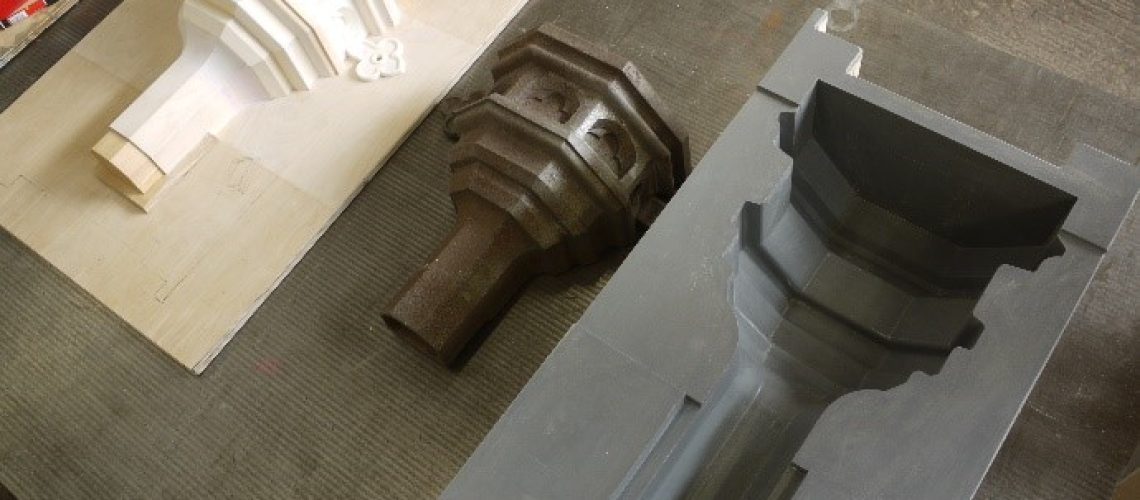
The most critical technical challenge in copy casting is accounting for the thermal contraction of molten iron as it cools. Cast iron contracts by approximately 1% as it solidifies. Over a standard 1.8-metre gutter length, this represents an 18mm shortfall — enough to misalign brackets, create leaking joints, and compromise the entire installation. To compensate, our pattern makers use specialised contraction rules — scaling tools that produce a master pattern approximately 101% of the required final dimension, traditionally hand-carved from stable hardwoods such as mahogany.
Stage Three — Green Sand Moulding and the Pour
Bespoke cast iron components are almost exclusively produced using the traditional green sand moulding process — largely unchanged since the Victorian era and the gold standard for heritage-accurate castings. A mixture of sand and bentonite clay is packed around the pattern; the term green refers to the moisture content, which gives the mould sufficient cohesion during the pour. Once cooled, the sand mould is broken away to reveal a casting with the authentic granular surface texture that is the hallmark of genuine cast iron.
Stage Four — Fettling, Finishing, and Protective Coatings
After casting, each component undergoes fettling — careful removal of casting flash and dressing of surface imperfections. For conservation-grade projects, we strongly recommend finishing with our
linseed oil paint system — a breathable, period-appropriate coating consistent with the values of SPAB, Historic England, and Cadw. Bespoke and copy cast components carry an
8 to 10 week lead time from confirmed commission.
Scope of Bespoke Casting: What We Can Replicate
Non-Standard and Regional Gutter Profiles
Our
cast iron gutter catalogue lists over 28 special profiles in addition to our standard eight. Where the required profile is not among these, we manufacture a new pattern from client-supplied samples, drawings, or accurate photographs. Victorian and Edwardian foundries produced an extraordinary variety of profiles — deep and shallow Ogee, moulded Ogee, bead-fronted half round, bold roll, and many regional variants.
Radius and Curved Guttering
For buildings with bay windows, circular towers, oast houses, or curved rooflines,
radius cast iron guttering must be cast to a precise arc. We use the chord-and-rise method to calculate the exact radius and craft the sand mould template accordingly. Radius gutters typically carry a
12 to 14 week lead time.
Ornate Hopper Heads and Rainwater Heads
Our
bespoke cast iron hopper heads service can replicate heraldic devices, family crests, civic arms, construction dates, and decorative motifs from photographs, surviving fragments, or historic drawings.
Bespoke Downpipes, Collars, and Fixings
Non-standard downpipe diameters, square and rectangular profiles, twisted or relief-decorated pipes, and bespoke eared pipe collars with integral fixing lugs — all can be replicated to match surviving examples. Where original holderbat brackets or period fixings have survived, these too can be copy-cast.
Technical Standards and Material Specification
All bespoke and copy-cast components conform to BS 460:2002. Understanding
cast iron as a building material is essential: grey iron offers excellent castability, good corrosion resistance when properly painted, and the authentic surface texture characteristic of sand casting. A correctly specified and maintained cast iron system has a service life in excess of one hundred years, making it the most financially and environmentally responsible choice for those managing
long-term sustainability strategies.
Historic Building Case Studies
Chatsworth House, Derbyshire — Grade I Listed Country House
One of England’s most celebrated aristocratic estates, Chatsworth House presented a classic copy casting challenge: ornate hopper heads incorporating the Cavendish family crest and a distinctive deep-ogee gutter profile with no catalogue equivalent. New patterns were produced at 101% scale to compensate for casting contraction, and replica components were finished in linseed oil paint to achieve a patina consistent with the adjacent surviving ironwork.
The Royal Crescent, Bath — UNESCO World Heritage Site, Grade I Listed
Bath’s incomparable Georgian terraces present one of the most demanding conservation contexts in England. The Royal Crescent’s parapet gutter system required bespoke replication of a profile unique to its eighteenth-century foundry of origin. Copy-cast components finished with linseed oil paint were the only acceptable solution compatible with the soft Bath stone substrate.
Manchester Town Hall, Greater Manchester — Grade I Listed Gothic Revival
Alfred Waterhouse’s magnificent Gothic revival town hall required comprehensive rainwater system restoration. The building’s bespoke ironwork — including twisted barley twist round pipes, relief-decorated square downpipes, and heraldic hopper heads — was replicated using green sand moulding from pattern maker’s drawings derived from the surviving originals.
Powis Castle, Montgomeryshire — Grade I Listed Medieval Fortified House (Cadw)
Powis Castle’s curved towers required guttering cast to a specific arc for which no standard section existed. Using the chord-and-rise measurement method, curved gutter sections were produced to match the masonry profile of each tower elevation, along with replica hopper heads replicating motifs from the original seventeenth-century ironwork programme.
Lincoln Cathedral, Lincolnshire — Grade I Listed, Scheduled Ancient Monument
A programme of phased replacement at Lincoln Cathedral identified several downpipe runs and hopper head positions where original profiles were unique to the Victorian restoration programme of the 1860s. Bespoke copy-cast replacements were produced in grey iron, finished with linseed oil paint, and installed with traditional caulked lead joints.
Conclusion: Why Copy Casting Matters for Heritage Conservation
Britain’s listed buildings and heritage structures are irreplaceable. The cast iron rainwater systems that protect them from water ingress are as much a part of that irreplaceability as the stonework and glazing they serve. When those systems fail and no standard replacement exists, copy casting is not a luxury — it is the conservation imperative.
At Tuscan Foundry, every component we produce for a heritage building carries a responsibility — to the building, to the conservation profession, and to the generations who will inherit these structures. Our copy casting and bespoke casting service is built on over a century of foundry expertise and an absolute commitment to dimensional and material accuracy.
To discuss your project, request a technical consultation, or arrange a
site survey, please
contact our team on 0333 987 4452 or visit tuscanfoundry.com. Bespoke and copy cast components carry an 10 to 12 week lead time from confirmed commission.
Frequently Asked Questions
What is cast iron copy casting and when is it needed?
Copy casting is the process of replicating a historic or non-standard cast iron component — gutter, hopper head, downpipe, or fitting — using the surviving original or client-supplied reference material as the basis for a new sand-cast reproduction. It is required when a component fails or is missing and no standard catalogue equivalent exists, which is common on listed buildings, estate properties, and buildings of architectural significance where the original ironwork was produced by regional foundries no longer in operation.
Do I need Listed Building Consent to replace cast iron gutters with copy-cast replicas on a Grade II listed building?
This depends on the extent and nature of the works and on the policy of your local planning authority. In many cases, like-for-like replacement using identical materials and profiles can be carried out without full LBC under permitted development, but it is always advisable to consult your conservation officer before commencing any works on a listed building. We are happy to provide supporting technical documentation to assist with any consent application.
How long does bespoke cast iron copy casting take from enquiry to delivery?
For bespoke and copy-cast components requiring new pattern creation, the standard lead time is 8-10 weeks from confirmed commission and drawing approval. This accounts for site survey and documentation, pattern making, casting and cooling, fettling, and painting. Radius gutter projects typically require 12-14 weeks. We strongly recommend engaging us as early as possible in the project programme to avoid delays.
What reference material do I need to provide for a copy casting commission?
The more reference material you can provide, the more accurate and cost-efficient the commission will be. Ideally, we need a surviving physical section of the original component, or accurate measured drawings with full profile dimensions. Good quality photographs with a scale reference are often sufficient for hopper heads and decorative components. Where no reference material survives, a site survey by our team is the recommended first step.
Can Tuscan Foundry replicate ornate hopper heads with heraldic devices or inscriptions?
Yes. Replicating decorative hopper heads — including those bearing family crests, civic arms, construction dates, and inscribed motifs — is one of our core specialisms. Our pattern makers work from photographs, surviving fragments, or historic drawings to reproduce these features in full detail. All ornate and bespoke hopper heads are manufactured to order.
What is the best paint finish for bespoke copy-cast components on a historic building?
For conservation-grade projects, we recommend finishing with linseed oil paint — a breathable, period-appropriate coating that bonds sympathetically with the iron surface and does not chip or peel in the manner of modern synthetic finishes. It is consistent with the conservation guidance of Historic England, Cadw, and SPAB. Standard supply includes a grey oxide transit primer; high-performance epoxy-phosphate systems and C4-rated coastal specifications are also available.
How does copy casting differ from standard cast iron replacement, and is it more expensive?
Standard replacement uses an existing catalogue product; copy casting creates a new pattern and moulds a component from scratch. The initial cost of bespoke work is higher — reflecting the pattern maker’s time, the tooling, and the small production run — but the whole-life cost is often lower because cast iron, properly maintained, has a service life exceeding one hundred years. For buildings subject to listed building or conservation area controls, copy casting is also frequently the only compliant option available.