Established 1893 | BS 460:2002 Certified | UK & International Supply | Expert Technical Support | 0333 987 4452
£84.74 +VAT
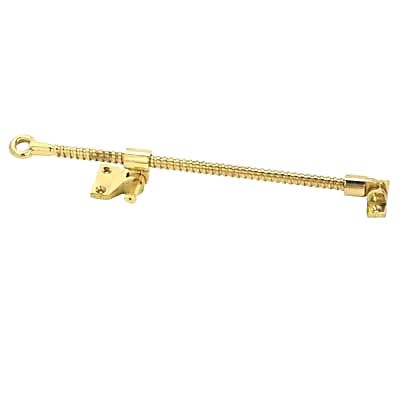
The Brass Rooflight Pole Winder Opener – 300mm is a screw-jack rooflight stay finished in polished brass, designed for manual operation of timber-framed rooflights and skylights. At 300mm in length with a 250mm throw, it provides a reliable and controlled opening movement suitable for a wide range of rooflight sizes and frame configurations.
The unit features a threaded screw-jack barrel, wall-mounted pivot bracket, and rooflight-fixing bracket, all in polished brass. The mechanism locks the rooflight securely at the desired opening position without requiring additional stays or restraints. Application is to timber frames; finish group is Brass.
Once almost exclusively associated with traditional conservatories, the screw-jack rooflight stay is now widely used across a broader range of building types, including Victorian and Edwardian extensions, heritage orangeries, barn conversions, and period houses where brass-finish ironmongery is consistent with the building’s character. It is a practical, long-lasting fitting that does not require maintenance beyond occasional light cleaning.
For advice on sizing, compatibility, or to discuss your project, call 0333 987 4452 or use the contact form on our website.
Prices are shown on the product pages at tuscanfoundry.com. For volume orders or project pricing, please call 0333 987 4452 or use the contact form on our website.
All of our cast iron radiators are availbale as standard with a 1/2″ BSP (15mm) connection. We are though also able to supply many of our radiators and valves with 3/4″ BSP connections. Due to the size proportions of some radiators and valves 3/4″ connections may be more suitable.
Casting of iron is an imperfect processs. It is possible with some cast iron radiators that you will get minor imperfections in the surface finish. When radiators are painted this will reduce and over the years every additional coat of paint applied will provide a smoother more equal finish.
Yes. Cast iron rainwater goods are widely accepted by conservation officers and historic environment bodies as the appropriate material for listed buildings. Tuscan Foundry's hopper heads are manufactured in solid cast iron to BS 460 specification and are suitable for all listed building grades. A linseed oil paint finish is also available, which is particularly appropriate for conservation projects.
BTU stand’s for British Thermal Units. This was the old (Imperial) measurement for heat in connection with plumbing. Although BTU’s is a term still commonly used within the heating and plumbing, the industry is now going over to KW’s Kilowatts.
The Strayton H42A accepts round, square, and rectangular pipe connections. Round: 65mm, 75mm, and 100mm. Square: 75×75mm, 100×100mm, and 125×125mm. Rectangular: 100×75mm, 125×100mm, and 150×100mm. Please specify your required connection size when ordering.
The Antique Black finish is cast iron with a blackened surface — the most historically accurate finish for cast iron ironwork and the most appropriate for the majority of heritage applications. Polished Lacquered is cast iron with a bright polished surface sealed with clear lacquer, suited to interiors and sheltered locations where polished ironwork is the specification. Polished Brass is solid polished brass throughout — the correct choice where existing building fittings are in brass or where a warm metal tone is required.
The H1 is available to accept round pipe connections in 65mm, 75mm, 100mm, and 150mm diameters. The 65mm and 75mm variants measure 305mm wide by 197mm deep and 210mm high. The 100mm variant measures 355mm wide by 230mm deep and 240mm high. A 150mm connection option is also available — please contact the team for dimensions.
Most old buildings have cast iron rainwater systems that should be maintained and preserved however; these inherent benefits make cast iron an ideal choice for both traditional and modern installations. It is not uncommon to see modern alternative products marketed with terms like low maintenance or easy to install and cost effective. It has even been said that ‘plastic guttering systems provide a way of achieving a traditional look with modern convenience
As well as being easier to produce, the material enabled eaves gutters to be installed more simply, since lead could only be used in this location as a lining for timber gutters. Many modern materials focus on replicating the appearance of cast iron but those materials can vary rarely offer any of the benefits. Cast iron gutters and pipes offer great strength and durability, a proven history of long life, low noise operation and fire resistance.
Most old buildings have cast iron rainwater systems that should be maintained and preserved however; these inherent benefits make cast iron an ideal choice for both traditional and modern installations. It is not uncommon to see modern alternative products marketed with terms like low maintenance or easy to install and cost effective. It has even been said that ‘plastic guttering systems provide a way of achieving a traditional look with modern convenience’.
These terms tend to refer to possible cost savings rather than any real product benefits. It is also difficult to quantify the benefits of modern convenience over traditional build quality. It is worth remembering that all rainwater goods will require some element of maintaining to ensure they are unblocked by debris and remain functional. No rainwater system cleans itself.
Today most suppliers of cast iron rainwater systems offer products in both primer or pre-painted with a 10 year protective coating. When describing modern materials, the term ‘cost effective’ is used rather than simply saying cheap. There is no doubt that the initial cost of many modern materials is less than cast iron but you might be surprised to know that over its lifespan, cast iron will cost around a third of plastic.
The School Board Airbrick suits Victorian and Edwardian institutional, civic, and residential buildings where the square-grid airbrick pattern was standard — including school buildings, civic halls, estate housing, terrace houses, and warehouses. It is also appropriate on listed buildings and conservation area properties as a like-for-like replacement for worn square-grid cast iron vents.