Hopper heads are supplied in red oxide primer ready for on-site painting, or pre-finished in black. A full range of Heritage Colours in traditional linseed oil paint is also available on request — please contact us for the swatch chart.
Established 1893 | BS 460:2002 Certified | UK & International Supply | Expert Technical Support | 0333 987 4452
£128.26 – £242.61Price range: £128.26 through £242.61 +VAT
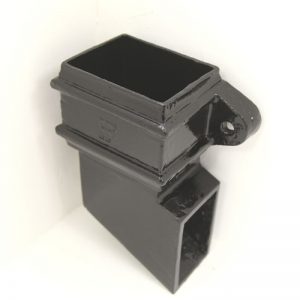
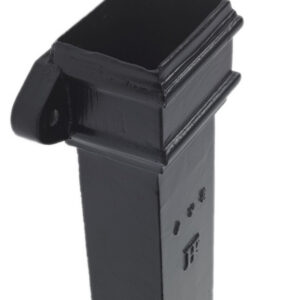
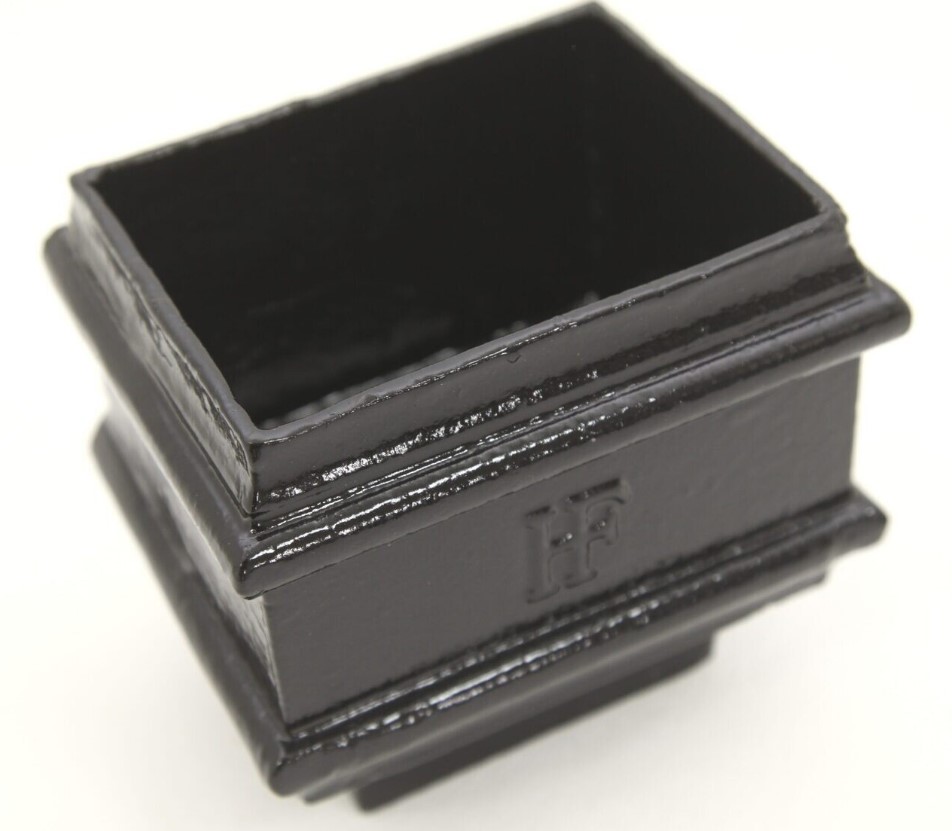
The Rectangular Pipe Socket Plain is a separate cast iron socket fitting that provides a plain jointing collar at any point in a rectangular downpipe run without integral ears. Used where a plain pipe needs to be joined to another plain pipe, or where a socket is needed at a position independent of wall fixing requirements. The plain socket is fixed using a separate holderbat or bracket at the appropriate wall position.
Available in the standard range of rectangular pipe sizes. Manufactured in cast iron to BS 460:2002. For specification support, call 0333 987 4452.
| Size/Finish | Primer 100mm x 75mm, Primer 125mm x 75mm, Primer 125mm x 100mm, Primer 150mm x 100mm |
|---|
Hopper heads are supplied in red oxide primer ready for on-site painting, or pre-finished in black. A full range of Heritage Colours in traditional linseed oil paint is also available on request — please contact us for the swatch chart.
Our cast iron hopper heads are available with 65mm, 75mm and 100mm round outlets, 75mm, 100mm and 125mm square outlets, and 100x75mm, 125x100mm and 150x125mm rectangular outlets, to match the downpipe already on site or specified for the project.
Prices are shown on the product pages at tuscanfoundry.com. For project or volume enquiries, please call 0333 987 4452 or use the contact form on our website.
Yes. Cast iron hopper heads are the historically correct choice for listed and period buildings, and a like-for-like cast iron replacement is generally accepted without objection by conservation officers. We manufacture to BS 460 for genuine heritage character and durability.
Yes. Cast iron airbricks are frequently specified for listed buildings and conservation area properties precisely because they replicate the material and pattern of the original Victorian and Edwardian ventilation grilles. Local conservation officers and building control typically accept like-for-like cast iron replacements without objection. We can provide product specifications and material datasheets to support applications.
Hopper heads are supplied in red oxide primer ready for on-site painting, or pre-finished in black. A full range of Heritage Colours in traditional linseed oil paint is also available on request — please contact us for the swatch chart.
Our cast iron hopper heads are available in a standard primed and black-painted finish, ready for on-site topcoats. Heritage colour finishes and factory-applied linseed oil paint are available on request. Linseed oil paint is a vapour-permeable, period-appropriate finish particularly well suited to listed buildings and conservation area properties.
The Regent H1 is well suited to Victorian and Edwardian terraces, listed commercial buildings, civic and institutional properties, and ecclesiastical buildings where a traditional funnel-form hopper is architecturally appropriate. Its multi-faceted tapering body reads as period-accurate on Gothic and classical building types alike, and it is a commonly specified choice for conservation and listed building projects across the UK.
Our cast iron hopper heads are available with 65mm, 75mm and 100mm round outlets, 75mm, 100mm and 125mm square outlets, and 100x75mm, 125x100mm and 150x125mm rectangular outlets, to match the downpipe already on site or specified for the project.
Half round gutter has a simple semicircular profile and is the most widely used pattern across all building types and periods. Ogee (OG) gutter has an S-shaped decorative profile, historically associated with Victorian and Edwardian properties. Moulded ogee profiles, such as the G46 and Regent No.16, have a more elaborate cross-section with additional mouldings and are typically found on larger or more architecturally significant buildings. The correct choice depends on what is already present on the building and any requirements set by a conservation officer.