Hopper heads are supplied in red oxide primer ready for on-site painting, or pre-finished in black. A full range of Heritage Colours in traditional linseed oil paint is also available on request — please contact us for the swatch chart.
Established 1893 | BS 460:2002 Certified | UK & International Supply | Expert Technical Support | 0333 987 4452
£90.17 – £1,248.94Price range: £90.17 through £1,248.94 +VAT
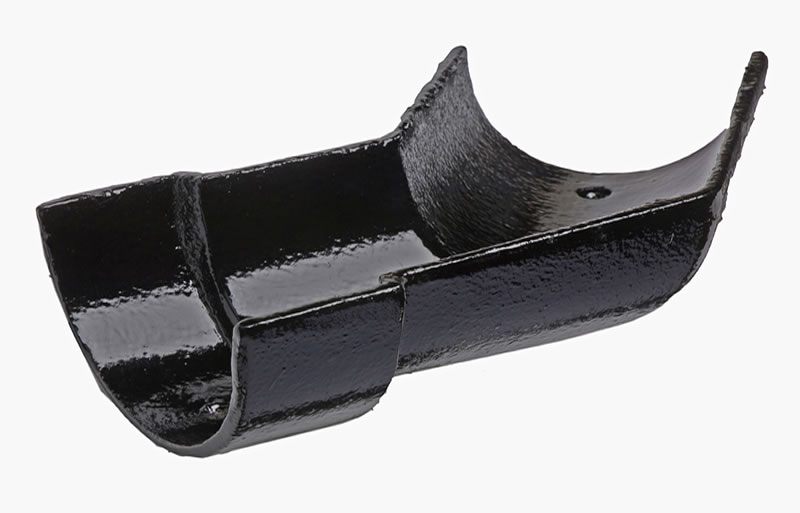
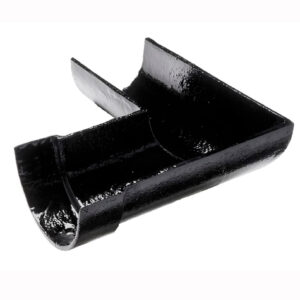
Our plain deep half round 135 degree angle for cast iron gutter and deep gutter system
are suited to most period property renovations. Cast iron deep half round gutter is
available in primed and black as standard.
Sizes Available:
100 x 75mm
125 x 75mm
Plain deep half round 135 degree angle for cast iron gutter (left hand): DH4312, DH5312, XDH4312, XDH5312
Plain deep half round 135 degree angle for cast iron gutter (right hand): DH4313, DH5313, XDH4313, XDH5313
A genuine cast iron rainwater system with the traditional deep flow gutter.
Plain Deep Half Round 135 Degree Angle
A genuine cast iron rainwater pattern the deep half round is available in two profile sizes. The profile is a larger version of the more traditional half round pattern and offers increased capacity.
Cast iron gutters and pipes offer great strength and durability, a proven history of long life, low noise operation and fire resistance. Most old buildings have cast iron rainwater systems that should be maintained and preserved however; these inherent benefits make a cast iron rainwater system an ideal choice for both traditional and modern installations.
| Size/Finish | Primer 100mm x 75mm, Primer 125mm x 75mm, Black 100mm x 75mm, Black 125mm x 75mm |
|---|---|
| Socket | Internal, External |
Hopper heads are supplied in red oxide primer ready for on-site painting, or pre-finished in black. A full range of Heritage Colours in traditional linseed oil paint is also available on request — please contact us for the swatch chart.
The H529 measures 430mm wide x 290mm deep x 540mm high, making it well suited to multi-storey Georgian and Victorian townhouses with a longer fall to the outlet.
Please call 0333 987 4452 or use the contact form with the size, quantity and connection details, and we'll provide a quotation.
The Polished Lacquered finish suits buildings where period ironwork was finished bright rather than painted — formal entrance elevations, listed properties, and settings where the grille contributes to the decorative programme of the facade. It is appropriate for conservation specifications and high-specification heritage new build.
Yes. Churches and ecclesiastical buildings are one of our most common project types. We regularly supply large sand cast gutters, rectangular and square downpipes, and bespoke hopper heads for church restorations. Many churches have non-standard profiles that require copy casting. We work directly with architects, church fabric advisors, and quinquennial inspection surveyors. Historic England and many Diocesan Advisory Committees specify cast iron as the appropriate material for listed ecclesiastical buildings.
Hopper heads are supplied in red oxide primer ready for on-site painting, or pre-finished in black. A full range of Heritage Colours in traditional linseed oil paint is also available on request — please contact us for the swatch chart.
The Polished Brass finish suits buildings where brass metalwork was standard — formal Victorian terrace housing, civic and institutional buildings, and high-quality estate architecture. It is appropriate on listed buildings and conservation properties where the wider ironmongery specification is in brass and a matching material is required.
Most old buildings have cast iron rainwater systems that should be maintained and preserved however; these inherent benefits make cast iron an ideal choice for both traditional and modern installations. It is not uncommon to see modern alternative products marketed with terms like low maintenance or easy to install and cost effective. It has even been said that ‘plastic guttering systems provide a way of achieving a traditional look with modern convenience
As well as being easier to produce, the material enabled eaves gutters to be installed more simply, since lead could only be used in this location as a lining for timber gutters. Many modern materials focus on replicating the appearance of cast iron but those materials can vary rarely offer any of the benefits. Cast iron gutters and pipes offer great strength and durability, a proven history of long life, low noise operation and fire resistance.
Most old buildings have cast iron rainwater systems that should be maintained and preserved however; these inherent benefits make cast iron an ideal choice for both traditional and modern installations. It is not uncommon to see modern alternative products marketed with terms like low maintenance or easy to install and cost effective. It has even been said that ‘plastic guttering systems provide a way of achieving a traditional look with modern convenience’.
These terms tend to refer to possible cost savings rather than any real product benefits. It is also difficult to quantify the benefits of modern convenience over traditional build quality. It is worth remembering that all rainwater goods will require some element of maintaining to ensure they are unblocked by debris and remain functional. No rainwater system cleans itself.
Today most suppliers of cast iron rainwater systems offer products in both primer or pre-painted with a 10 year protective coating. When describing modern materials, the term ‘cost effective’ is used rather than simply saying cheap. There is no doubt that the initial cost of many modern materials is less than cast iron but you might be surprised to know that over its lifespan, cast iron will cost around a third of plastic.

The Antique Black finish suits Victorian, Edwardian, and inter-war buildings where ventilation ironwork was painted rather than polished — estate houses, terrace housing, civic buildings, and rural properties. It is also correct for listed buildings and conservation area properties requiring like-for-like replacement of original ornamental cast iron vents.
Victorian properties most commonly used Ogee (OG) gutter profiles, including the standard Cast Iron Ogee and the G46 Moulded Ogee. Half Round guttering was also widely used, particularly in the later Victorian period. The correct profile depends on what is already present on the building — we recommend inspecting any surviving sections and matching the profile, size, and socket direction exactly. We supply 19 standard gutter profiles and can copy-cast any non-standard profile from a drawing, photograph, or physical sample.