The satin chrome telescopic rooflight hand winder opener is available to order at tuscanfoundry.com. For project or volume enquiries, call 0333 987 4452 or use the contact form on our website.
Established 1893 | BS 460:2002 Certified | UK & International Supply | Expert Technical Support | 0333 987 4452
£26.50 +VAT
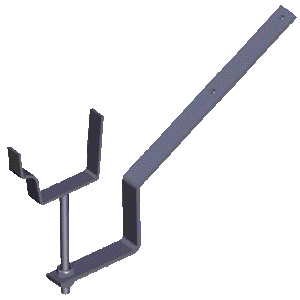
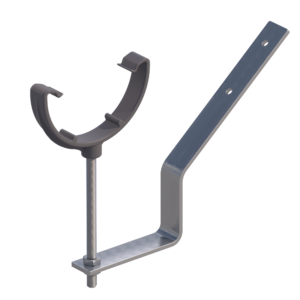
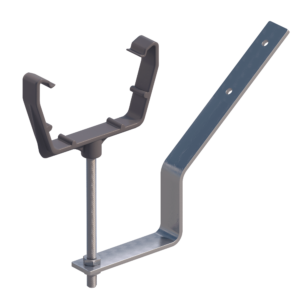
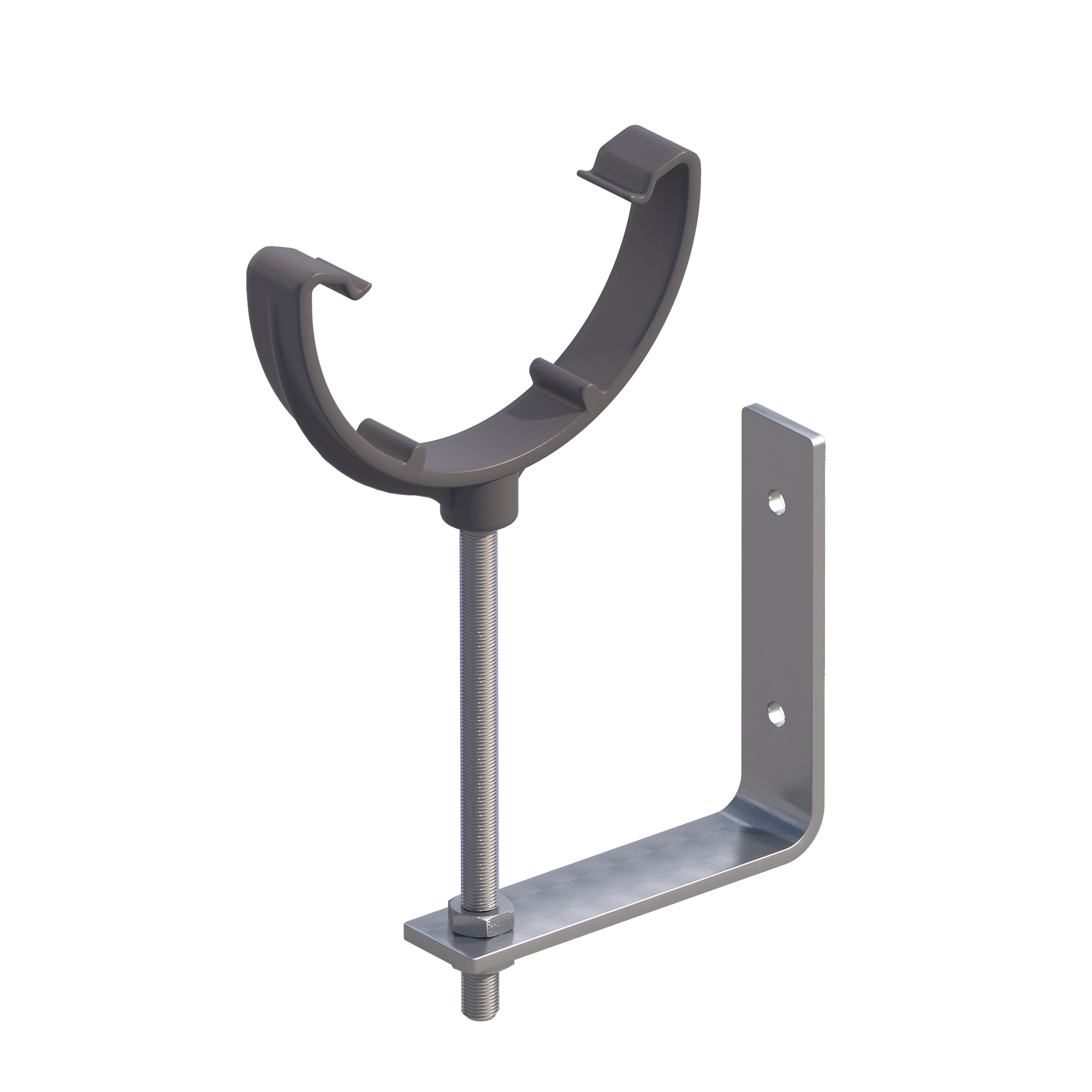
Wavin Osma Roundline adjustable gutter brackets. Our bespoke fascia rise and fall gutter bracket is designed to suit the Osma Roundline system, and is available with black, white, brown, and grey riser cups. (galvanised thread and fascia plate)
Osma Roundline guttering bracket, adjustable rise, and fall, fascia
Osma Roundline OT914 Rise and Fall Bow and Pin Bracket
Bespoke made – 10 – 14 days.
The OSRL-FRF is a bespoke fascia-mounted rise and fall gutter bracket, manufactured to suit the Wavin Osma Roundline half-round PVC guttering system. Where precise fall control is required along the gutter run — particularly on longer runs, older or irregular fascias, or where the gutter fall cannot be derived from the fascia line itself — the adjustable riser bracket allows the gutter to be set at the correct gradient at each fixing point.
The bracket features a galvanised steel fascia plate with pre-drilled fixing holes and a threaded steel riser column, topped with a half-round bow-and-pin gutter cup compatible with the Roundline system. The riser height adjusts to set fall independently of the fascia plane, without packing or shimming. Available in black or grey riser cup options to match the existing installation.
Suited to new-build and refurbishment projects using Wavin Osma Roundline guttering, and to maintenance work where fall correction is required without replacing the fascia. Used on residential and light commercial properties.
Manufactured to order in black or grey. Lead time 10–14 working days from order confirmation.
System compatibility: Wavin Osma Roundline half-round PVC guttering system. For specification queries, call 0333 987 4452.
| Colour | Black, White, Brown, Grey |
|---|
The satin chrome telescopic rooflight hand winder opener is available to order at tuscanfoundry.com. For project or volume enquiries, call 0333 987 4452 or use the contact form on our website.
The Ornamental Airbrick is most appropriate on Victorian Gothic buildings — churches, chapels, vicarages, almshouses, collegiate buildings, and high-specification estate architecture — where decorative ironwork was part of the original design. It suits listed building replacements in kind and heritage new build where period accuracy in detailing is expected.
The louvre face provides directional airflow and offers some resistance to driven rain entering the subfloor void, making it a practical choice for exposed elevations or properties in areas with significant prevailing wind and rainfall. The square-grid (school board) pattern offers a larger open ventilation area but less weather protection.
For rooflights directly above a worktop or sink, a telescopic screw-jack hand winder is the most practical choice. Available in polished brass, satin chrome, and polished chrome, these openers allow controlled ventilation from a fixed handle position without requiring a pole. The 150mm or 250mm size is typically appropriate for standard-height kitchen rooflights.
Prices for rooflight openers are shown on the product pages at tuscanfoundry.com. For volume orders, project pricing, or compatibility queries, please call 0333 987 4452 or use the contact form on our website.
Most old buildings have cast iron rainwater systems that should be maintained and preserved however; these inherent benefits make cast iron an ideal choice for both traditional and modern installations. It is not uncommon to see modern alternative products marketed with terms like low maintenance or easy to install and cost effective. It has even been said that ‘plastic guttering systems provide a way of achieving a traditional look with modern convenience
As well as being easier to produce, the material enabled eaves gutters to be installed more simply, since lead could only be used in this location as a lining for timber gutters. Many modern materials focus on replicating the appearance of cast iron but those materials can vary rarely offer any of the benefits. Cast iron gutters and pipes offer great strength and durability, a proven history of long life, low noise operation and fire resistance.
Most old buildings have cast iron rainwater systems that should be maintained and preserved however; these inherent benefits make cast iron an ideal choice for both traditional and modern installations. It is not uncommon to see modern alternative products marketed with terms like low maintenance or easy to install and cost effective. It has even been said that ‘plastic guttering systems provide a way of achieving a traditional look with modern convenience’.
These terms tend to refer to possible cost savings rather than any real product benefits. It is also difficult to quantify the benefits of modern convenience over traditional build quality. It is worth remembering that all rainwater goods will require some element of maintaining to ensure they are unblocked by debris and remain functional. No rainwater system cleans itself.
Today most suppliers of cast iron rainwater systems offer products in both primer or pre-painted with a 10 year protective coating. When describing modern materials, the term ‘cost effective’ is used rather than simply saying cheap. There is no doubt that the initial cost of many modern materials is less than cast iron but you might be surprised to know that over its lifespan, cast iron will cost around a third of plastic.
This opener is particularly well suited to period and heritage properties — Georgian and Victorian terraces, conservation area houses, traditional orangeries, and listed buildings where a brass finish is required to complement existing ironmongery. It is compatible with Lumen Rooflights and most timber-framed skylights.
The School Board Airbrick (F020801AFC) is available in three standard sizes: 225mm × 75mm, 225mm × 150mm, and 225mm × 225mm. These correspond to one-, two-, and three-brick-course heights and allow ventilation requirements to be met across a range of subfloor and wall opening sizes.
BTU stand’s for British Thermal Units. This was the old (Imperial) measurement for heat in connection with plumbing. Although BTU’s is a term still commonly used within the heating and plumbing, the industry is now going over to KW’s Kilowatts.
Prices are shown on the product pages at tuscanfoundry.com. For project or volume enquiries, please call 0333 987 4452 or use the contact form on our website.