Established 1893 | BS 460:2002 Certified | UK & International Supply | Expert Technical Support | 0333 987 4452
£84.30 ex VAT (£101.16 inc VAT)
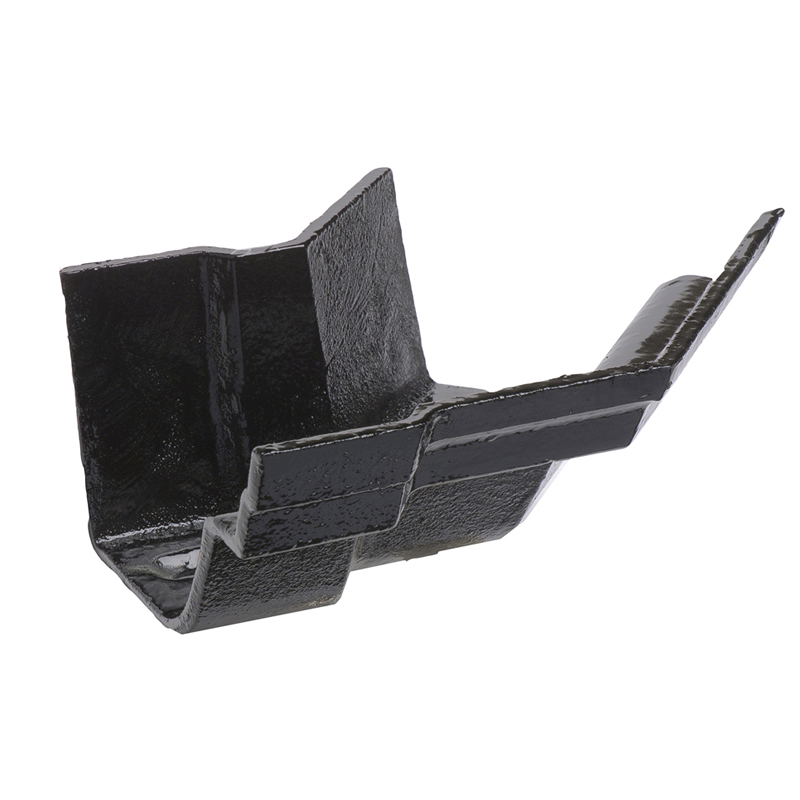
A genuine cast iron rainwater pattern orignally used in and around Nottingham, hence Notts Ogee. The profile is only available in the one size (4.5″) and has a flat base unlike the more traditional ogee (OG) curved pattern.
UK delivery from £30. Fittings are despatched boxed. See delivery rates.
The cast iron Notts OG 135 degree angle provides an obtuse corner fitting for the Notts Ogee profile, handling bay windows, canted elevations, and building corners that require an obtuse turn. The asymmetric front face of the Notts OG is maintained through the fitting, preserving the profile’s character throughout the run on Nottingham and East Midlands period properties.
As with all Notts OG fittings, the 135 degree angle is handed — internal and external variants exist, and the asymmetric profile means fittings cannot be reversed to suit a different configuration. Identify the correct internal or external type for your application before ordering.
Manufactured in solid cast iron to BS 460:2002. Single size 115mm (4.5″). Supplied in primed or factory black finish. Commonly specified on Victorian bay-fronted terraces, villa-style houses, and civic buildings throughout Nottinghamshire, Derbyshire, Leicestershire, and the wider East Midlands where the Notts OG is the original and historically correct profile.
Compatibility: Notts OG cast iron gutter 115mm (4.5″) only. For specification support, call 0333 987 4452.
| Socket | Internal, External |
|---|
Prices are shown on the product page. For project quantities, specification support, or a formal quotation, call 0333 987 4452 or use the contact form.
Hopper heads are supplied in red oxide primer ready for on-site painting, or pre-finished in black. A full range of Heritage Colours in traditional linseed oil paint is also available on request — please contact us for the swatch chart.
The H1 is available to accept round pipe connections in 65mm, 75mm, 100mm, and 150mm diameters. The 65mm and 75mm variants measure 305mm wide by 197mm deep and 210mm high. The 100mm variant measures 355mm wide by 230mm deep and 240mm high. A 150mm connection option is also available — please contact the team for dimensions.
Yes. The polished chrome telescopic rooflight hand winder opener is compatible with Lumen Rooflights and most timber-framed skylights. Call 0333 987 4452 to confirm compatibility with a specific rooflight model.
Tuscan Foundry's cast iron hopper heads are available in Standard Black and Heritage Colour finishes. A linseed oil paint finish is also offered — a sustainable, vapour-permeable option particularly appropriate for listed buildings and conservation projects. Heritage colour swatches are available from the team on request.
Our cast iron hopper heads are available with 65mm, 75mm and 100mm round outlets, 75mm, 100mm and 125mm square outlets, and 100x75mm, 125x100mm and 150x125mm rectangular outlets, to match the downpipe already on site or specified for the project.
Hopper heads are supplied in red oxide primer ready for on-site painting, or pre-finished in black. A full range of Heritage Colours in traditional linseed oil paint is also available on request — please contact us for the swatch chart.
Rooflight opener handles can be ordered directly through tuscanfoundry.com. For volume orders or project-specific queries, please call 0333 987 4452 or use the contact form on our website.
Please call 0333 987 4452 or use the contact form with the size, quantity and connection details, and we'll provide a quotation.
The Iron Works Patterned Hit & Miss Vents are available in two sizes: 225mm × 82mm (single-course, suitable for standard airbrick positions) and 225mm × 150mm (double-course format). Both sizes are available in all three finishes: Antique Black, Polished Lacquered, and Polished Brass.