Established 1893 | BS 460:2002 Certified | UK & International Supply | Expert Technical Support | 0333 987 4452
£83.08 – £146.50Price range: £83.08 through £146.50 +VAT
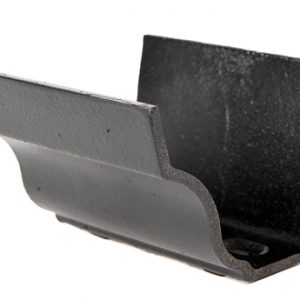
A genuine cast iron rainwater pattern the G46 or No.46 is available in two profile sizes. The profile is a larger version of the more traditional ogee (OG) curved pattern and offers increased capacity.
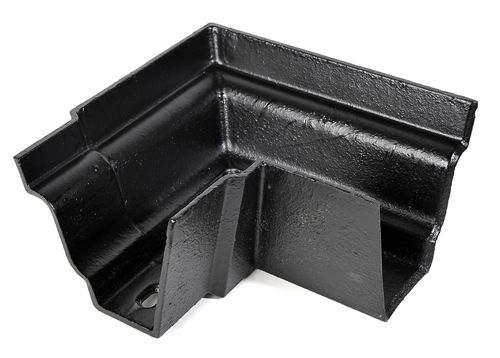
The cast iron G46 moulded gutter 90 degree angle provides a square corner fitting for the G46 pattern — the larger and more decorative Victorian ogee profile found on country houses, civic buildings, and substantial period properties across England and Wales. The full moulded cross-section is maintained through the angle, preserving the visual weight and character of the G46 profile at every change of direction on the building.
Manufactured in solid cast iron to BS 460:2002. Available in both G46 profile sizes: 125mm (5″) and 150mm (6″). Supplied in primed or factory black finish. Important: the G46 90 degree angle is not interchangeable with common ogee angle fittings — all fittings must be sourced from the G46 range to ensure correct fit and profile match.
Specified on listed buildings and heritage restoration projects where the G46 is the historically correct pattern. Accepted by conservation officers as the appropriate fitting for period rainwater work on substantial Victorian and Edwardian properties.
Compatibility: G46 moulded cast iron gutter 125mm and 150mm only. For specification support, call 0333 987 4452.
| Size/Finish | Primer 100mm x 75mm, Primer 125mm x 100mm, Black 100mm x 75mm, Black 125mm x 100mm |
|---|---|
| Socket | Internal, External |
Prices are shown on each product page. For project quantities, conservation specifications, or to discuss suitability for a listed building, call 0333 987 4452 or use the contact form.
The drainage and guttering market has matured considerably over the past 20 years and there are now many more product choices for consumers to consider.
Despite the influx of new materials it appears that the benchmark for rainwater systems is still cast iron. Cast iron rainwater goods were introduced in the late 18th Century as an alternative to lead. As well as being easier to produce, the material enabled eaves gutters to be installed more simply, since lead could only be used in this location as a lining for timber gutters.
Many modern materials focus on replicating the appearance of cast iron but those materials can vary rarely offer any of the benefits. Cast iron gutters and pipes offer great strength and durability, a proven history of long life, low noise operation and fire resistance. Most old buildings have cast iron rainwater systems that should be maintained and preserved however; these inherent benefits make cast iron an ideal choice for both traditional and modern installations.
It is not uncommon to see modern alternative products marketed with terms like low maintenance or easy to install and cost effective. It has even been said that ‘plastic guttering systems provide a way of achieving a traditional look with modern convenience’. These terms tend to refer to possible cost savings rather than any real product benefits. It is also difficult to quantify the benefits of modern convenience over traditional build quality.
It is worth remembering that all rainwater goods will require some element of maintaining to ensure they are unblocked by debris and remain functional. No rainwater system cleans itself. Today most suppliers of cast iron rainwater systems offer products in both primer or pre-painted with a 10 year protective coating. When describing modern materials, the term ‘cost effective’ is used rather than simply saying cheap. There is no doubt that the initial cost of many modern materials is less than cast iron but you might be surprised to know that over its lifespan, cast iron will cost around a third of plastic.
It is easy to forget about your rainwater system but it does need to be maintained and inspected at least twice a year regardless of the product material. It does not matter whether the property is hundreds of years old or brand new, the message is the same; ‘maintaining your rainwater system contributes to the external appearance of the building as well as keeping it free from damp and structural damage.
Yes. Our telescopic screw-jack openers and pole-operated handles are compatible with Lumen Rooflight systems. They are also suitable for use with other timber-framed rooflights and skylights fitted with appropriate catches or stays. If you are unsure of compatibility, call us on 0333 987 4452 and we can advise.
A pole winder opener has a fixed-length arm, making it suited to standard rooflight positions with a consistent throw. A telescopic opener has an adjustable shaft, allowing it to accommodate varying rooflight positions and throw requirements. For guidance on which suits your project, call 0333 987 4452.
The Iron Works Patterned Hit & Miss Vents are available in two sizes: 225mm × 82mm (single-course, suitable for standard airbrick positions) and 225mm × 150mm (double-course format). Both sizes are available in all three finishes: Antique Black, Polished Lacquered, and Polished Brass.
The School Board Airbrick (F020801AFC) is available in three standard sizes: 225mm × 75mm, 225mm × 150mm, and 225mm × 225mm. These correspond to one-, two-, and three-brick-course heights and allow ventilation requirements to be met across a range of subfloor and wall opening sizes.
Prices are shown on the product page. For project quantities, multiple pattern orders, or a formal quotation, call 0333 987 4452 or use the contact form.
The Ornamental Airbrick is suited to Victorian villas, bay-fronted terraces, Gothic Revival institutional buildings, church halls, and civic buildings where decorative ironwork is part of the architectural language. It is also appropriate for listed buildings and conservation area properties where the airbrick is on a prominent elevation and the ventilation grille is expected to carry decorative character.
Our cast iron hopper heads are available in a standard primed and black-painted finish, ready for on-site topcoats. Heritage colour finishes and factory-applied linseed oil paint are available on request. Linseed oil paint is a vapour-permeable, period-appropriate finish particularly well suited to listed buildings and conservation area properties.
Cast iron radiators cost no more to run than modern steel or aluminium radiators. Cast iron is a very efficient material at emitting heat, thus you have items like le creuset cast iron pans. Cast iron holds it’s heat extremly well, which means that the radiators stay warm for longer.