Linseed oil paint has been the finish of choice for cast iron rainwater goods for well over two centuries. Before synthetic coatings existed, craftsmen and specifiers trusted linseed oil to protect ironwork on the grandest civic buildings, country houses, and Victorian terraces in Britain. Today, that trust is well-founded for the same reasons it always was — linseed oil paint bonds deeply into iron, moves with the substrate as it expands and contracts, and breathes rather than trapping moisture beneath a brittle film.
For architects, specifiers, and heritage property owners working with cast iron gutters, downpipes, and hoppers, this guide covers everything needed to specify and apply linseed oil paint correctly — from initial surface preparation through to final topcoats and cure times.
Cast iron is a demanding substrate. It is heavy, prone to surface rust, and expands and contracts significantly with temperature change. Synthetic paints — including many modern water-based products — form a hard film on the surface that can crack and lift as the iron moves, allowing moisture to creep beneath the coating and accelerate corrosion from below.
Linseed oil paint behaves differently. The oil polymerises slowly as it cures, forming a semi-flexible film that remains slightly elastic throughout its life. This means it accommodates the natural movement of cast iron without cracking. It also penetrates the surface rather than sitting on top of it, providing genuine corrosion protection rather than a purely cosmetic barrier.
For traditional and heritage buildings — where cast iron rainwater systems are often specified to match the original appearance — linseed oil paint is also the most historically accurate choice. Its depth of colour, slight sheen, and the way it weathers naturally over time are qualities that modern synthetic finishes rarely replicate convincingly.
Proper surface preparation is the single most important factor in the longevity of any paint system. With linseed oil paint on cast iron, this is especially true — the paint is only as good as the surface beneath it.
New cast iron arrives from the foundry with a sand-cast surface that may carry light release agent, foundry sand, or mill scale. All of this must be removed before painting. Wire brushing or abrasive blasting (to Sa 2 or Sa 2.5 standard where accessible) removes contamination and provides the fine surface profile that helps the primer key. After mechanical preparation, degrease the surface with a suitable solvent or degreaser and allow to dry fully before applying any primer.
Existing cast iron with sound paintwork in good condition can be prepared by light abrasion to provide a key, followed by degreasing. Any areas of loose, flaking, or blistering paint must be taken back to bare metal. Rust should be treated mechanically (wire brushing, grinding, or needle-gunning) to remove all loose corrosion. Surface rust that remains tightly adherent can be treated with a phosphoric acid rust converter, following the manufacturer’s instructions, before priming. Never apply linseed oil paint over active, loose rust.
Joints and fixings warrant special attention. Cast iron sections are joined with socket and spigot connections sealed with mastic or hemp and lead. Ensure joints are sound and sealed before painting — painting over failing joints will simply conceal a problem that will shorten the life of the system.
The primer coat performs two functions: it protects bare metal from oxidation before topcoats are applied, and it establishes the foundation for adhesion. For linseed oil systems, the primer should be compatible with the finish — ideally a linseed oil primer, sometimes called a boiled linseed oil primer or an iron oxide primer in a linseed oil base.
Apply the first primer coat thinly and work it well into the surface, paying particular attention to any surface irregularities, recesses, and moulding details where moisture is most likely to collect. Linseed oil primer should be applied at a spread rate that ensures full coverage without runs or sags — two thin coats are always preferable to one heavy coat.
Allow the primer to cure between coats. In favourable conditions (dry weather, 15–20°C, good air circulation), a linseed oil primer coat will be touch-dry in 24 to 48 hours. It should be left for a minimum of 48 hours — and ideally 72 hours — before the next coat is applied. Applying subsequent coats too quickly prevents the previous coat from fully oxidising, which can lead to wrinkling, softening, and poor adhesion.
Two primer coats are standard for new cast iron. For previously painted surfaces with sound existing paintwork, a single primer coat is typically sufficient before topcoats.
Linseed oil topcoats are available in a wide range of colours, including the traditional black that is standard for most cast iron rainwater systems in the UK. On heritage and listed buildings, colour should be confirmed against any relevant conservation requirements — in some cases specific shades are specified to match original historic finishes.
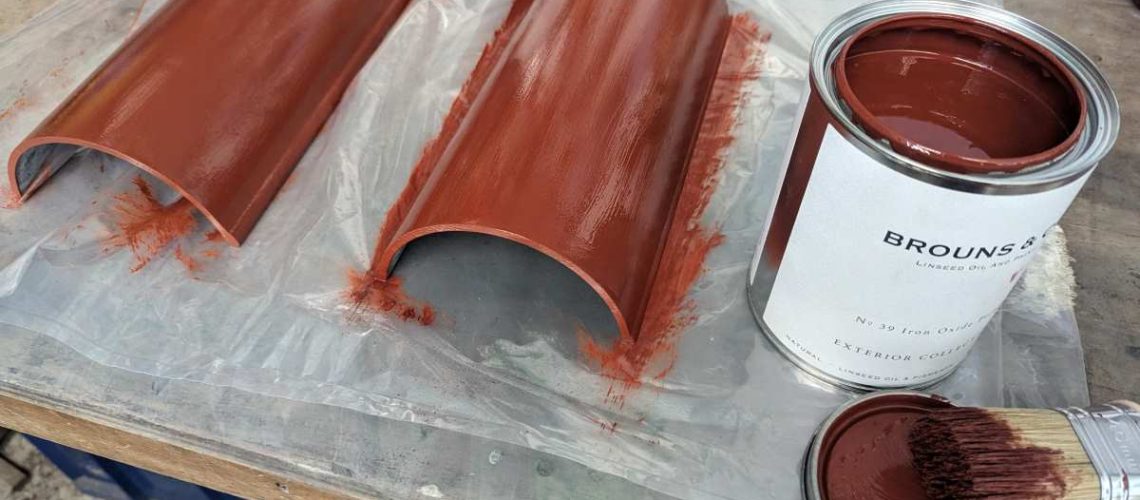
Apply topcoats in the same manner as primer: thinly, worked into the surface, and in consistent passes to avoid lap marks. For cast iron rainwater goods with their moulded profiles and surface texture, a brush is almost always preferable to a roller — it ensures full coverage into recesses and avoids paint bridging across fine detail.
A standard specification for cast iron rainwater goods is two topcoats over two primer coats, giving a four-coat system overall. In more exposed locations — coastal environments, north-facing elevations with limited drying — a three-topcoat system may be appropriate. Allow the same 48–72 hour cure window between topcoats as between primer coats.
Do not apply linseed oil paint in temperatures below 5°C, in wet conditions, or when rain is forecast within four to six hours of application. The oil requires oxygen to polymerise and moisture on the surface during curing will prevent proper adhesion. Ideal application conditions are dry, mild, and slightly breezy.
Linseed oil paint cures by oxidative polymerisation — exposure to oxygen in the air causes the oil to harden progressively. Unlike solvent-based or water-based paints that dry primarily through evaporation, linseed oil systems continue to cure and harden for weeks after application.
As a guide in typical UK conditions (15°C, moderate humidity, good air circulation):
Touch dry: 24–48 hours per coat
Recoatable: 48–72 hours per coat (minimum — always test by feel before applying the next coat)
Through-hardened: 2–4 weeks after final topcoat
Fully cured and maximum hardness: 4–8 weeks
In cold weather, cure times extend significantly. Below 10°C, curing slows dramatically and it is generally not advisable to apply linseed oil paint. In warm, sunny conditions, cure times can be shorter. The paint should not be wetted or subjected to heavy loading until it is through-hardened.
One of the practical advantages of linseed oil paint over synthetic systems is the ease of maintenance. Because the film remains semi-flexible and weathers gradually rather than peeling, maintenance coats can be applied over sound existing linseed oil paintwork without full strip-back.
Inspect cast iron rainwater goods annually — ideally in spring before the wetter months. Look for any areas where the paint film has worn thin, where surface rust is beginning to show through, or where physical damage has exposed bare metal. Address these areas promptly: localised preparation back to bare metal, a primer coat, and a topcoat will extend the life of the system significantly.
A full maintenance repaint — surface clean, light abrasion, and two topcoats over the entire system — is typically required every 8 to 12 years, depending on exposure. This is considerably longer than the maintenance cycle for many synthetic paint systems on cast iron.