Yorkshire is, by almost any measure, the most architecturally significant county in England. It contains more listed buildings than any other — somewhere in the region of 37,000 entries on the National Heritage List for England — and its heritage spans a breadth and depth that few counties anywhere in the United Kingdom can match. Norman castles, Cistercian abbeys, Georgian market towns, Victorian mill complexes, and some of England’s finest medieval parish churches all sit within a county whose relationship with stone, iron, and traditional craft has shaped the built environment for over a thousand years.
For architects, conservation surveyors, and heritage contractors working in Yorkshire, that concentration of significance brings with it a corresponding level of responsibility. When works are required to be listed buildings and historic structures in the county — whether a Grade I abbey, a Grade II* Georgian town house, or a Victorian church in the West Riding — the materials specified for even utilitarian elements such as rainwater systems must be chosen with care. The wrong choice is not merely aesthetically inappropriate; on a building of significance, it can represent a conservation failure that takes years and considerable cost to rectify.
At Tuscan Foundry, we have supplied cast iron gutters, downpipes, hoppers, and fittings to conservation projects across Yorkshire for many years. We understand the buildings, the planning context, and the expectations of the conservation officers, architects, and church architects working across the county’s five historic ridings. This article draws on that experience to set out what makes Yorkshire’s heritage buildings distinctive, why cast iron rainwater systems remain the correct specification for the great majority of listed and historic properties in the county, and what architects and surveyors should bear in mind when approaching a conservation project here.
Yorkshire’s planning landscape is administered by many local planning authorities, each with its own conservation team and approach to assessing Listed Building Consent applications. The City of York — one of the most historically significant urban environments in northern Europe — operates a particularly rigorous conservation framework, with specialist officers experienced in the full range of issues that arise in works to its extraordinary concentration of listed structures. Across the county more broadly, the heritage departments of North Yorkshire Council, West Yorkshire Combined Authority, and the East Riding of Yorkshire Council all bring substantial expertise to bear on conservation applications.
In our experience, Yorkshire’s conservation officers are consistent on many key points regarding rainwater goods. First, they expect materials to match the original — cast iron, as used originally. Second, they expect profiles to be accurate—not merely ‘similar to’ the original, but correctly proportioned and detailed. Third, they expect finishes to be appropriate — and this increasingly means questioning the use of conventional paints in favour of traditional alternatives.
On complex projects — particularly those involving buildings with unusual gutter profiles, ornate hopper heads, or curved elevations requiring radius gutters — conservation officers will often require evidence that the proposed specification has been carefully considered. This is one of several reasons why we recommend, on more complex Yorkshire projects, that specification is preceded by a professional site survey. A survey-informed specification is far more likely to satisfy a conservation officer’s requirements at first submission — and far less likely to lead to costly amendments later in the process.
Yorkshire’s historic buildings span enough periods and styles that there is no single gutter profile that can be described as the county’s standard. In the Georgian and Regency terraces of Harrogate, York, and the smarter parts of Leeds and Hull, the Ogee profile was predominant — its flowing S-curve perfectly suited to the classical proportions of the architecture it served. In the Victorian and Edwardian civic and ecclesiastical buildings that represent the most substantial phase of Yorkshire’s building history, half-round gutters in heavier sections were common on major structures, while moulded and beaded profiles appear on the better-quality domestic and commercial stock.
On Yorkshire’s industrial heritage — the mill complexes of Bradford, Halifax, Huddersfield, and Leeds that are increasingly subject to sensitive conversion and conservation — the original cast iron rainwater goods were often of substantial section, designed to cope with the large roofed areas of single-storey weaving sheds, spinning mills, and engine houses. Matching or replicating these profiles requires foundry expertise and, in many cases, copy casting from surviving original sections. This is a service we provide regularly on Yorkshire mill and industrial conversion projects.
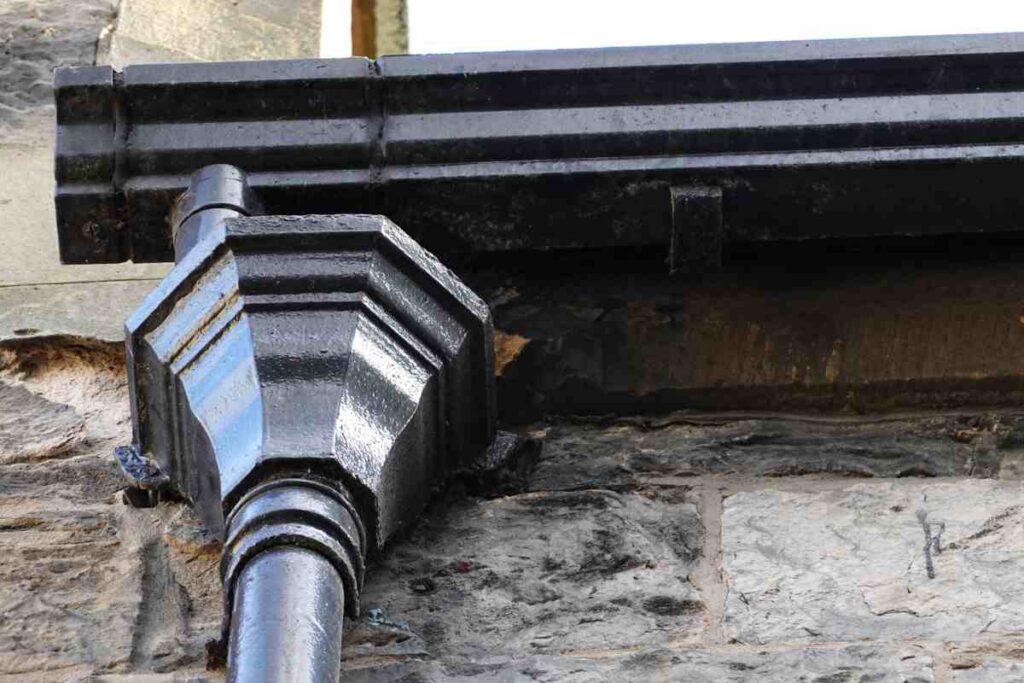
For Yorkshire’s churches — from the great medieval minster churches at York, Beverley, and Ripon to the thousands of Victorian Gothic parish churches that punctuate the county’s towns and villages — cast iron soil pipes and rainwater goods are almost always the correct specification. The combination of cast iron’s durability, its visual compatibility with stone, and its capacity for maintenance over multi-decade cycles makes it the material of choice for church architects and PCC buildings surveyors working to English Heritage and Church of England conservation guidance.
Fountains Abbey — the most complete Cistercian abbey ruin in England and part of a UNESCO World Heritage Site shared with Studley Royal Water Garden — sits at the apex of Yorkshire’s heritage. The abbey’s associated structures, including the remarkably intact Fountains Hall of 1611, carry extensive cast-iron rainwater goods that serve both practical and conservation functions. Works to the Hall and the estate’s ancillary buildings, managed by the National Trust under a rigorous conservation management plan approved by Historic England, consistently require cast iron rainwater goods specified and finished to the highest conservation standards. The exposure of the North Yorkshire site makes material quality and finish durability non-negotiable considerations in any specification.
As the largest Gothic cathedral in northern Europe, York Minster presents rainwater challenges of an altogether different order from most heritage buildings. Its lead-clad roofs, extensive parapets, and complex internal drainage systems discharge through cast iron rainwater goods that have been maintained under the oversight of the Dean and Chapter’s works team for generations. The Minster’s conservation framework — one of the most developed of any building in England — places cast iron and linseed oil paint finishes firmly at the centre of its rainwater maintenance philosophy, reflecting a deep understanding of how breathable, traditional finishes outperform modern alternatives over the long maintenance cycles that a building of this significance demands.
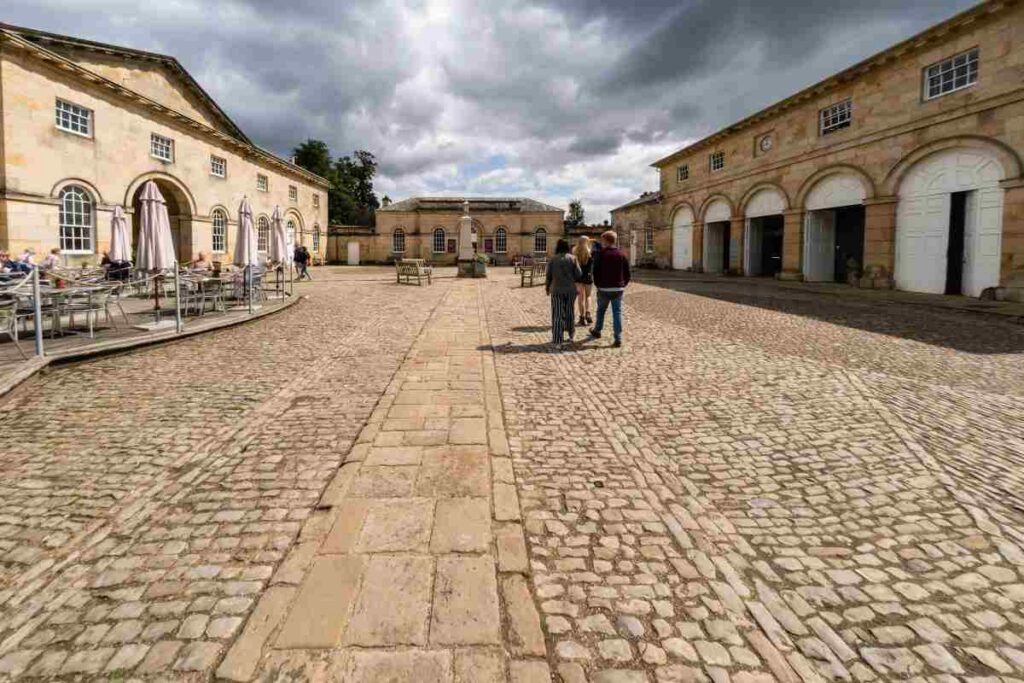
Sir John Vanbrugh’s baroque masterpiece — arguably the finest country house in England — presents its conservation team with the challenge of maintaining cast iron rainwater systems across an extraordinary roofscape of domes, parapets, and service ranges. Castle Howard’s estate management, operating under Historic England oversight and subject to one of the most detailed conservation management plans of any privately owned historic property in the country, requires that all rainwater goods replacements and repairs be specified in cast iron with period-accurate profiles. The scale and complexity of the roofscape — and the variety of building periods represented across the house and its ancillary structures — means that bespoke and copy casting capability is frequently required to achieve accurate Matching.
Sir Titus Salt’s model industrial village — built between 1851 and 1876 and designated a UNESCO World Heritage Site in 2001 — represents one of the most coherent Victorian planned environments in the world. The visual unity of Saltaire’s Italianate streets depends substantially on the consistent treatment of its external ironwork, including the cast-iron rainwater goods serving its 850 workers’ houses, mill buildings, institute, and congregational church. Maintaining that coherence through conservation-compliant materials is an obligation under the World Heritage Management Plan: the Bradford Metropolitan District Council’s conservation team expects like-for-like cast iron reinstatement where original goods have been lost or damaged, and scrutinises any specification that departs from the original village’s material palette.
Robert Adam’s neoclassical masterpiece at Harewood — remodelled by Charles Barry in the 1840s to add its Italianate south terrace — carries one of the most architecturally refined roofscapes in Yorkshire. The house’s extensive gutters and downpipes, serving a complex arrangement of roofs across the principal block and wings, have been maintained under the Harewood House Trust’s conservation programme, with a consistent commitment to cast-iron specification and traditional finishes. The Trust’s approach exemplifies the best practice that English Heritage and the Historic Houses Association promote across the private heritage sector: a long-term maintenance philosophy built on the understanding that the cost of correct specification over decades is invariably lower than the cost of correcting inappropriate material choices.
Yorkshire projects bring their own characteristic set of specification challenges — some arising from the particular building types common in the county, others from the planning context, and others from site conditions.
In Victorian mill and industrial conversions, the most frequent issue is the need to match or replicate heavy-section gutters and downpipes, for which no standard profile is available in the current catalogue. This almost always requires a copy casting commission, ideally supported by a surviving sample of the original casting or a measured survey drawing. We would ask anyone facing this situation to contact us at an early stage — copy casting typically carries an 8–10 week lead time, and leaving this until late in a programme can cause real difficulties on site.
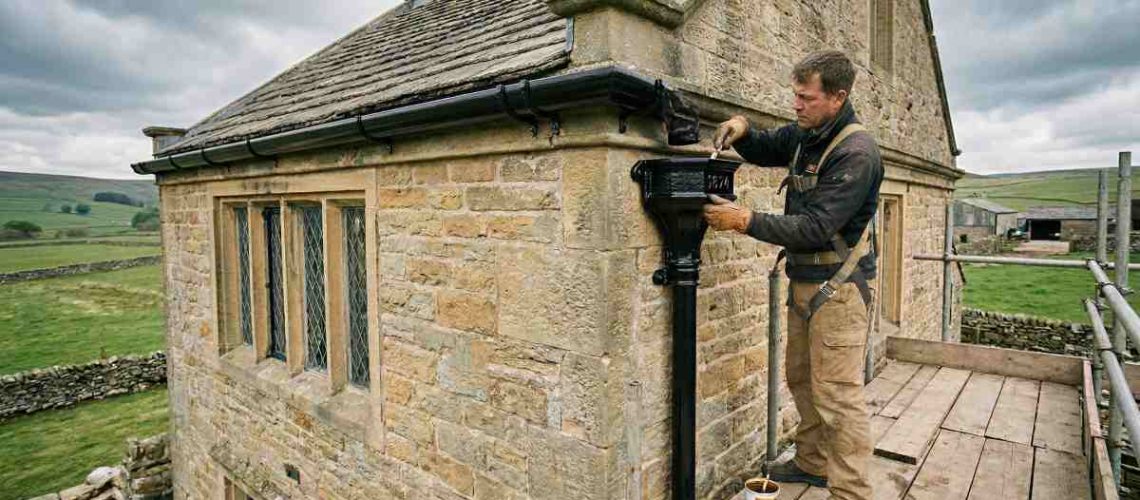
On Yorkshire’s Dales and moorland farmhouses — many of which are Grade II listed and subject to the scrutiny of North Yorkshire Council’s conservation team — the challenge is often access. Buildings in remote locations with limited scaffold access pose particular difficulties when assessing the condition of an existing rainwater system before specification. This is precisely the scenario for which our site survey service is most valuable. A survey visit before specification prevents the kind of surprises — hidden deterioration, non-standard junctions, unusual fixing details — that create cost and programme overruns on remote sites.
On Yorkshire’s churches, the most consistently encountered issue is the failure of previously applied conventional paint finishes. We regularly receive enquiries from churchwardens and church architects in which the use of an inappropriate coating has rendered a cast iron system that was in fundamentally sound structural condition an expensive problem. The correct answer — specifying linseed oil paint from the outset — is the single most effective step any specifier can take to reduce the long-term maintenance liability of a cast iron rainwater system on a Yorkshire church or listed building.
We are not a volume supplier, and Yorkshire’s conservation sector does not need one. What it needs — and what we provide — is a specialist with the depth of knowledge to support complex specifications, the manufacturing capability to supply both standard stock and bespoke castings, and the willingness to engage with the particular demands of individual projects and buildings.
Our full catalogue covers the standard gutter profiles and pipe diameters required for the great majority of Yorkshire listed building projects, with stock items available for prompt dispatch. For projects requiring profiles outside the standard range — whether a Victorian industrial section, an unusual Edwardian moulding, or a Georgian hopper head in need of precise replication — our bespoke casting service provides the solution. Our team is experienced in working from photographs, drawings, and physical samples, and we are accustomed to the level of accuracy that conservation-compliant specification demands.
Suppose you are working on a listed building in Yorkshire and would like to discuss the specification for a cast iron rainwater system — whether a straightforward replacement or a complex bespoke commission. Please get in touch with us or call 0333 987 4452. We are always happy to talk through a project at any stage.
In most cases, yes — where the original rainwater goods were cast iron, conservation officers will expect like-for-like replacement in cast iron. This applies across Yorkshire’s various local planning authorities. However, the strictness with which it is enforced can vary depending on the listing grade, the element’s visibility, and the local conservation team’s policies. For Grade I and Grade II* listed buildings, cast iron reinstatement is almost always required. For Grade II listed buildings, the expectation is strong, but there may be limited circumstances in which a conservation officer would consider alternatives. We would always recommend establishing the position with the relevant conservation officer before specification is finalised.
Yes — this is one of the more frequent commissions we receive from Yorkshire. Victorian industrial buildings often have heavy-section or non-standard profiles that do not correspond to any current standard catalogue. Where a surviving sample or measured drawing of the original casting is available, we can produce an accurate replica through our copy casting service. Please allow 8–10 weeks for bespoke castings, and contact us at the earliest possible stage in the programme.
We recommend linseed oil paint over a suitable iron oxide primer for all cast iron rainwater goods on listed buildings. Linseed oil paint is breathable, flexible, historically appropriate, and consistent with Historic England and SPAB guidance on finishes for traditional metalwork. It significantly outperforms conventional gloss paints in long-term durability on cast iron in exposed conditions, which is precisely what a Yorkshire building, subject to the county’s considerable rainfall and temperature variation, requires.
For straightforward replacement of a standard profile on an accessible building, a site survey may not be essential. For anything more complex — unusual profiles, difficult access, curved elevations, buildings with a history of water ingress, or listed churches where the condition of the existing system is unclear — a site survey before finalising the specification will almost always save time and cost. Our survey service is chargeable, and we are transparent about costs when discussing whether a visit is appropriate for a given project.
Standard stock items are available for prompt dispatch. Bespoke and copy casting — including profile replication for Victorian mill buildings, unusual hopper heads, and non-standard gutter sections — typically carries an 8–10 week lead time from pattern approval. We ask that all clients flag bespoke requirements as early as possible in the programme, as this lead time is fixed by the manufacturing process and cannot easily be compressed without compromising quality.
In conservation terms, repair is almost always preferable to replacement where the original material can be retained. For cast iron gutters with failing paint, isolated cracks, or deteriorated joints, repair — proper surface preparation, joint rectification, and the application of a correct linseed oil paint system — will extend the life of the original material and is consistent with conservation best practice. Wholesale replacement with new cast iron is appropriate where sections are broken, heavily corroded, or missing entirely. We are happy to advise on the correct approach for a specific situation.
We supply a full range of project types — from private listed residences in the Yorkshire Dales and North York Moors to major institutional buildings, churches, and industrial heritage structures. Many of our Yorkshire enquiries come from owners of Grade II listed farmhouses, Georgian townhouses, and Victorian terraced properties who need to replace a section of cast-iron rainwater goods and are finding it difficult to obtain the correct profile from general builders’ merchants. Our catalogue covers the standard profiles, and we are always happy to discuss bespoke Matching for smaller residential projects.
Yorkshire’s built heritage is exceptional in its scale and significance. From the wind-scoured abbeys of the Dales to the ornate Victorian civic buildings of its great industrial cities, the county’s historic stock represents an irreplaceable part of England’s architectural identity. Maintaining it correctly — specifying materials that are appropriate, durable, and compatible with the values of conservation — is a responsibility that falls on every professional who works on these buildings.
Cast iron rainwater goods, specified in the correct profile and finished with linseed oil paint, are the baseline standard for that work in Yorkshire. They were the material of the original builders, and they remain the material best suited to the long-term care of buildings that have stood for centuries and must stand for centuries more.

Established in 1893, Tuscan Foundry Products is one of the UK’s leading specialist suppliers of cast iron rainwater systems, soil pipes, and heritage fittings for listed buildings, churches, and historic properties across the UK and internationally. We supply a comprehensive range of standard cast iron gutters and downpipes — available for prompt dispatch — alongside a full bespoke and copy casting service for projects requiring matched or replicated profiles. Our site survey service supports architects and conservation professionals at every stage of the specification process. Based in Mid Wales, we bring more than 130 years of foundry expertise to projects across Yorkshire and beyond. Please get in touch with us or call 0333 987 4452 to discuss your project.