Our standard spike or sturt length is 300mm (12″). Other sizes are available upon request.
Established 1893 | BS 460:2002 Certified | UK & International Supply | Expert Technical Support | 0333 987 4452
£26.50 – £28.50Price range: £26.50 through £28.50 +VAT
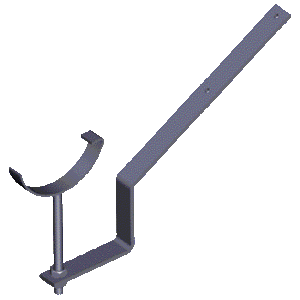
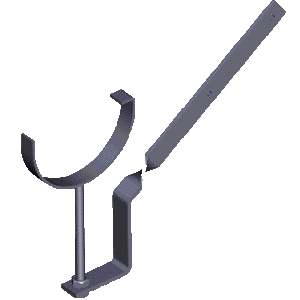
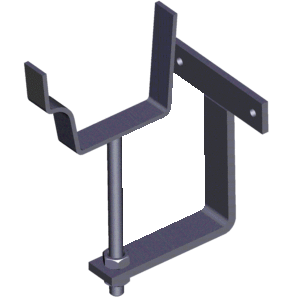
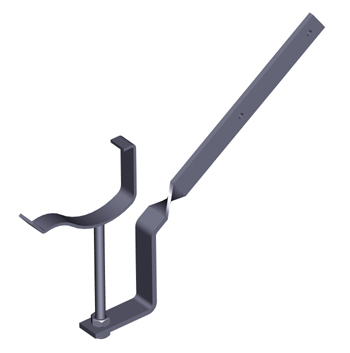
Side rafter rise and fall bracket for common Og cast iron gutter.
Sizes available:
100mm (4″)
115mm (4.5″)
125mm (5″)
We also manufacture side rafter rise and fall brackets for common Og guttering made by: Osma, Marley, Hunter and Lindab
The RB501COG is a side rafter rise and fall bracket for the common ogee cast iron gutter. Where there is no fascia board — on open eaves, or where the rafter face is the only available fixing point — the RB501COG mounts directly to the side face of the rafter and provides adjustable support at the correct height for the common OG gutter run. The bracket cup is shaped for the ogee S-curve profile.
The threaded rise and fall cup allows precise fall setting at each bracket position independently of the rafter pitch, eliminating shimming and packing on long runs or where the roof line is uneven. Available in three sizes to suit the standard common ogee range: 100mm (4″), 115mm (4.5″), and 125mm (5″).
Also compatible with common ogee guttering manufactured by Osma, Marley, Hunter, and Lindab, making it a practical bracket solution on mixed or partial replacement installations. Specified on listed buildings, heritage conservation projects, and period properties across England and Wales where the common ogee is the correct profile.
Compatibility: Common ogee gutter 100mm, 115mm, 125mm. Also suits Osma, Marley, Hunter, and Lindab common OG. For specification support, call 0333 987 4452.
| Size | -F- 100mm, -G- 115mm, -K- 125mm |
|---|
Our standard spike or sturt length is 300mm (12″). Other sizes are available upon request.
Yes. Cast iron airbricks are frequently specified for listed buildings and conservation area properties precisely because they replicate the material and pattern of the original Victorian and Edwardian ventilation grilles. Local conservation officers and building control typically accept like-for-like cast iron replacements without objection. We can provide product specifications and material datasheets to support applications.
Yes. Cast iron is the material required by most conservation officers and listed building consents for the replacement or replication of traditional rainwater goods. Our hopper heads are produced in solid cast iron and we can assist with specification notes or material statements for planning purposes if required.
The Regent H1 is well suited to Victorian and Edwardian terraces, listed commercial buildings, civic and institutional properties, and ecclesiastical buildings where a traditional funnel-form hopper is architecturally appropriate. Its multi-faceted tapering body reads as period-accurate on Gothic and classical building types alike, and it is a commonly specified choice for conservation and listed building projects across the UK.
Yes. Cast iron rainwater goods are widely accepted by conservation officers and historic environment bodies as the appropriate material for listed buildings. Tuscan Foundry's hopper heads are manufactured in solid cast iron to BS 460 specification and are suitable for all listed building grades. A linseed oil paint finish is also available, which is particularly appropriate for conservation projects.
The Antique Black finish is cast iron with a blackened surface — the most historically accurate finish for cast iron ironwork and the most appropriate for the majority of heritage applications. Polished Lacquered is cast iron with a bright polished surface sealed with clear lacquer, suited to interiors and sheltered locations where polished ironwork is the specification. Polished Brass is solid polished brass throughout — the correct choice where existing building fittings are in brass or where a warm metal tone is required.
Casting of iron is an imperfect processs. It is possible with some cast iron radiators that you will get minor imperfections in the surface finish. When radiators are painted this will reduce and over the years every additional coat of paint applied will provide a smoother more equal finish.
Yes. The ornamental foliate pattern was widely used in Victorian construction and is appropriate for Grade II listed buildings and conservation area properties. Its decorative character is often preferable to a plain pattern on prominent or formal elevations. We recommend confirming the pattern with your conservation officer as part of any listed building consent application.
The polished chrome telescopic rooflight hand winder opener is available in multiple sizes. The telescopic mechanism adjusts to accommodate varying rooflight positions and throw requirements. For a full list of available sizes, visit tuscanfoundry.com or call 0333 987 4452.
Rooflight opener handles can be ordered directly through tuscanfoundry.com. For volume orders or project-specific queries, please call 0333 987 4452 or use the contact form on our website.