Yes. Polished brass is a historically appropriate finish for period and listed buildings and is generally acceptable to conservation officers. If your project requires specific confirmation, we are happy to advise — call 0333 987 4452.
Established 1893 | BS 460:2002 Certified | UK & International Supply | Expert Technical Support | 0333 987 4452
£84.66 +VAT
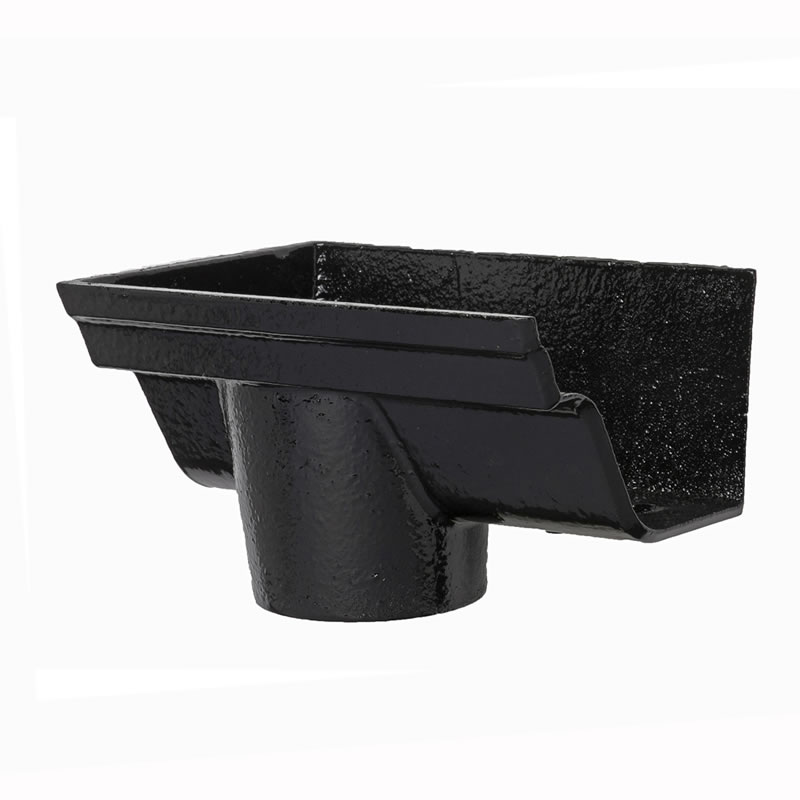
A genuine cast iron rainwater pattern orignally used in and around Nottingham, hence Notts Ogee. The profile is only available in the one size (4.5″) and has a flat base unlike the more traditional ogee (OG) curved pattern.
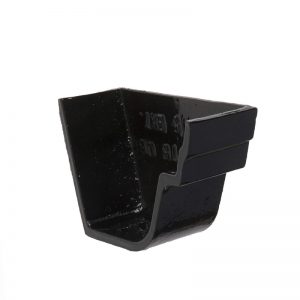
The cast iron Notts OG drop end provides a downpipe outlet at the end of a Notts Ogee gutter run, used where the run terminates and drainage drops to a downpipe from the end section rather than a central nozzle outlet. The asymmetric front face of the Notts OG is maintained through the fitting, completing the installation consistently on period properties in Nottinghamshire and the East Midlands.
As with all Notts OG fittings, the drop end is handed — internal and external variants exist, and the asymmetric profile cannot be reversed or flipped to suit a different configuration. Always confirm the correct variant before ordering.
Manufactured in solid cast iron to BS 460:2002. Single size 115mm (4.5″). Supplied in primed or factory black finish. Specified on listed buildings and heritage restoration projects throughout Nottinghamshire, Derbyshire, and the wider East Midlands where the Notts OG is the historically correct profile.
Compatibility: Notts OG cast iron gutter 115mm (4.5″) only. For specification support, call 0333 987 4452.
| Size | 65mm, 75mm |
|---|---|
| Socket | Internal, External |
Yes. Polished brass is a historically appropriate finish for period and listed buildings and is generally acceptable to conservation officers. If your project requires specific confirmation, we are happy to advise — call 0333 987 4452.
Our hopper heads are available with a wide range of pipe connections to suit round, square, and rectangular downpipes. The Calnethorpe No.11 accepts round 65mm, 75mm, and 100mm; square 75×75mm, 100×100mm, and 125×125mm; and rectangular 100×75mm, 125×100mm, and 150×100mm. Connection options vary by model — please contact us to confirm availability for your chosen hopper.
The satin chrome telescopic rooflight hand winder opener is available to order at tuscanfoundry.com. For project or volume enquiries, call 0333 987 4452 or use the contact form on our website.
The Cast Iron Louvre Airbrick suits Victorian, Edwardian, and inter-war residential and commercial properties where the louvre-pattern vent was the standard specification. It is the correct like-for-like replacement on listed buildings and conservation area properties, and suits new heritage-style construction requiring an authentic period ventilation grille.
The Paxton H82 accepts round, square, and rectangular pipe connections. Round: 65mm, 75mm, and 100mm. Square: 75×75mm, 100×100mm, and 125×125mm. Rectangular: 100×75mm, 125×100mm, and 150×100mm. Bespoke adaptations including double pipe connections are also available on request. Please confirm your required connection type when ordering.
The satin chrome telescopic rooflight hand winder is well suited to contemporary and transitional interiors where a brushed chrome finish complements modern or minimal ironmongery. It is compatible with Lumen Rooflights and timber-framed skylights.
The Iron Works Patterned Hit & Miss Vent suits Victorian and Edwardian buildings where decorative cast iron or brass ventilation grilles were part of the original specification — including terrace houses, civic buildings, churches, entrance halls, and estate properties. It is appropriate on listed buildings and conservation area properties as a like-for-like decorative vent replacement, and on new heritage-quality construction where period detailing is required.
The School Board Airbrick suits Victorian and Edwardian institutional, civic, and residential buildings where the square-grid airbrick pattern was standard — including school buildings, civic halls, estate housing, terrace houses, and warehouses. It is also appropriate on listed buildings and conservation area properties as a like-for-like replacement for worn square-grid cast iron vents.
Yes. Decorative cast iron and brass ventilation grilles of this pattern were widely used in Victorian and Edwardian buildings, and like-for-like replacements are generally accepted by conservation officers for listed building works. We can provide product specifications and material details to support listed building consent applications if required.
The Ornamental Airbrick is most appropriate on Victorian Gothic buildings — churches, chapels, vicarages, almshouses, collegiate buildings, and high-specification estate architecture — where decorative ironwork was part of the original design. It suits listed building replacements in kind and heritage new build where period accuracy in detailing is expected.