
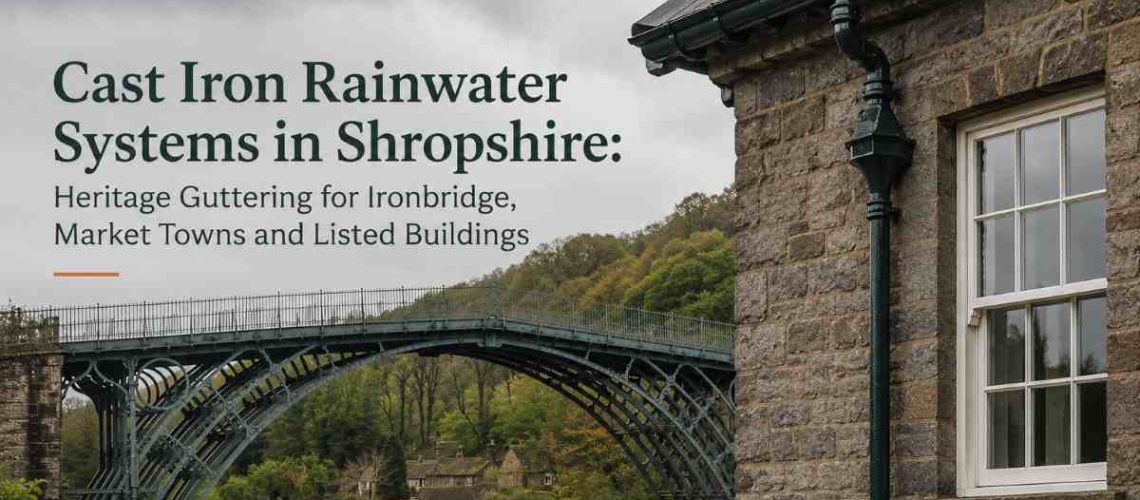
Shropshire holds a singular place in the history of cast iron. It was at Coalbrookdale, in the Ironbridge Gorge, that Abraham Darby I successfully smelted iron using coke rather than charcoal in 1709 — the technical breakthrough that made cast iron an affordable, mass-producible building material and set in motion the Industrial Revolution. For architects, surveyors and conservation officers specifying rainwater goods on Shropshire’s historic buildings, this is not simply a matter of period-appropriate detailing: it is a matter of specifying the material in the county where it was made possible.
This guide is written for professionals working on listed and traditional buildings across Shropshire — from the medieval street plan of Shrewsbury to the market towns of Ludlow, Bridgnorth, Whitchurch and Oswestry, and the internationally significant heritage assets of the Ironbridge Gorge itself. It sets out the county’s listed building stock and consent process, the specification and practical considerations particular to Shropshire’s building types, and the common mistakes that lead to rejected applications or unsuitable replacement schemes. Throughout, we draw on our experience supplying cast iron gutters and rainwater systems to conservation projects across England, Wales and Scotland.
Shropshire’s listed building stock reflects a county that shaped, and was shaped by, the birth of industrial Britain while retaining an exceptionally well-preserved network of medieval and Georgian market towns. Shropshire has approximately 6,900 listed buildings and 122 conservation areas, one of the highest totals of any English county, and the range of building types is unusually broad — from timber-framed merchants’ houses to cast iron bridges, agricultural halls, textile mills and parish churches.
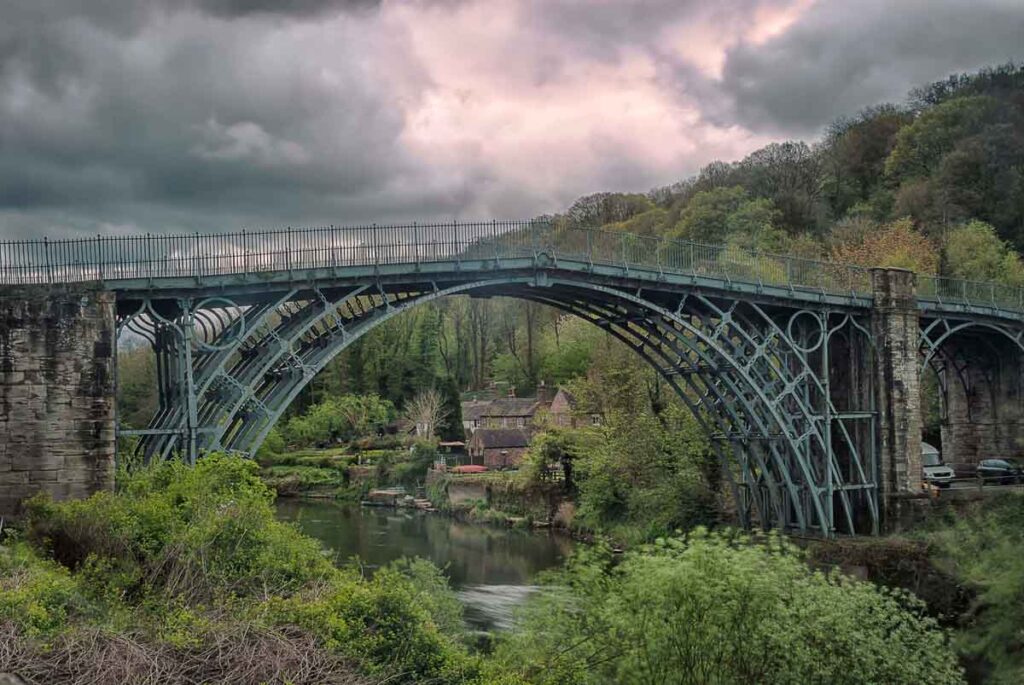
The Ironbridge Gorge is the standout heritage asset: a UNESCO World Heritage Site since 1986 and widely regarded as the birthplace of the Industrial Revolution. The Iron Bridge itself, opened in 1781, was the world’s first major bridge cast in iron, built to showcase the material pioneered a generation earlier at Coalbrookdale. The Gorge today contains a concentration of scheduled monuments and Grade I and Grade II* listed structures within a small geographic area, and works within the World Heritage Site and its buffer zone attract particularly close scrutiny from conservation officers.
Shrewsbury, the county town, sits within a dramatic loop of the River Severn and retains a substantially intact medieval street plan with more than 660 listed buildings, including an exceptional concentration of timber-framed structures alongside Georgian brick townhouses. Ludlow, frequently described as one of England’s finest market towns, has over 420 listed buildings, including nine at Grade I and twenty-five at Grade II*, centred on Ludlow Castle, St Laurence’s Church, Broad Gate and the surviving sections of the town walls.
Bridgnorth contributes a further 252 listed buildings, with a strong survival of 15th- to 17th-century timber-framed houses and shops, including Bishop Percy’s House. Whitchurch and Oswestry each retain substantial Georgian and Tudor cores, with Oswestry town centre largely designated as a conservation area around St Oswald’s Church. Beyond the towns, Shropshire’s rural estates, farmhouses, halls and parish churches make up a significant proportion of the county’s listed stock, frequently presenting access and logistics considerations that urban projects do not.
Replacing or significantly altering rainwater goods on a listed building in Shropshire will usually require Listed Building Consent (LBC) from Shropshire Council, the unitary authority responsible for planning and conservation across the county since 2009. Genuine like-for-like repair — replacing a cracked cast iron section with an identical cast iron section in the same profile — typically falls outside consent requirements, but any change of material, profile or method of fixing is capable of affecting the character of a listed building and should be discussed with the council’s conservation and heritage team before work begins.
Shropshire Council’s conservation officers assess applications against the statutory duty under the Planning (Listed Buildings and Conservation Areas) Act 1990 to have special regard to the desirability of preserving a listed building’s special interest, and against national guidance from Historic England, alongside the practice guidance published by the Institute of Historic Building Conservation (IHBC) and the Society for the Protection of Ancient Buildings (SPAB). In practice, this means officers routinely expect cast iron to be replaced with cast iron, matched to the surviving profile, rather than substituted with aluminium or uPVC, which read differently in scale, sound and weathering and are rarely considered an acceptable like-for-like alternative on a listed elevation.
The county’s industrial heritage adds a further dimension that professionals from outside Shropshire sometimes underestimate: because cast iron production began in the Ironbridge Gorge, the material carries a specific local significance that goes beyond generic conservation preference. On buildings within or near the World Heritage Site, and on buildings with a documented connection to the county’s ironworking history, specifying cast iron rainwater goods is as much about historical accuracy as visual matching.
From a material science standpoint, cast iron rainwater systems specified to BS 460:2002 offer a genuinely long service life when correctly maintained, and their behaviour differs meaningfully from the alternatives conservation officers are asked to weigh against them — see our guide to cast iron as a building material and the comparison set out in why steel does not appeal for the underlying reasoning. A correctly specified linseed oil paint system is the appropriate heritage finish for the majority of Shropshire projects, offering breathability and a traditional matt appearance that factory-applied synthetic coatings do not replicate.
Profile selection should follow the building’s period and construction, not a generic default. Shrewsbury and Ludlow’s timber-framed buildings were typically fitted with plain half-round or beaded half-round profiles historically, while the Georgian townhouses of Oswestry, Whitchurch and the wider county more commonly carry ogee or moulded profiles reflecting their classical detailing. Where the original profile survives elsewhere on the building or on a comparable neighbouring property, matching to it is normally the safest route through the consent process.
Engage Shropshire Council’s conservation team early, particularly on projects within the Ironbridge Gorge World Heritage Site or its buffer zone, where pre-application discussion is strongly advisable. Photographic evidence of the existing system, and where possible a sample or template of the profile, will support a smoother application than a generic specification. Where components are missing, badly corroded, or historically significant enough to warrant exact replication, our copy casting service can reproduce them from a photograph, drawing or physical fragment; bespoke and copy-cast work typically takes 8–10 weeks from confirmation of details, so this should be built into any project programme from the outset.
Rural Shropshire estates, farmhouses and churches often present access challenges that urban terraced properties do not — scaffolding constraints, remote locations, or roofscapes that are difficult to assess safely from ground level. For these projects in particular, a site survey visit is worth commissioning before specification is finalised. This is a chargeable service, but on complex or higher-risk sites it avoids costly mismatches and gives a far more reliable basis for both the Listed Building Consent application and the eventual quotation.
Standard profiles and stock lengths are available for prompt despatch; always confirm current availability for the specific project. Bespoke and copy-cast items should be programmed at 8–10 weeks, and any curved or radius sections at 12–14 weeks, from confirmation of full details.
Specifying uPVC or aluminium as a cost-saving substitute is the most common cause of a rejected or retrospectively challenged application. Even where a property appears modest, Shropshire Council’s conservation officers will generally expect cast iron on a listed building regardless of the replacement material’s cost advantage, and unauthorised works can result in enforcement action.
Matching the wrong profile to the building’s period is a frequent, avoidable error — fitting a Victorian ogee to a timber-framed Tudor building, or a plain half-round to a Georgian townhouse designed around a moulded cornice line, both read as incongruous and can attract objection even where the material is correctly specified as cast iron.
Mixing incompatible fixings — particularly stainless steel brackets or spikes in direct contact with cast iron — introduces a galvanic corrosion risk that shortens the system’s service life significantly faster than the cast iron itself would otherwise degrade. Fixings should be specified to be compatible with cast iron, not merely convenient to source.
Underestimating the Listed Building Consent timeline is a common programming failure. Consent determination, particularly where a conservation officer requests amendments or further information, can add weeks to a project; combined with an 8–10 week bespoke casting lead time, this means specification decisions on Shropshire’s listed buildings need to happen considerably earlier than on unlisted equivalents.
Commissioning bespoke or copy-cast work without a survey on complex sites risks an inaccurate quotation and rework. Where a hopper head or run of guttering is damaged, missing, or difficult to access safely, a site survey — while a chargeable service — is considerably cheaper than a mismatched casting.
A Grade II Listed Georgian Townhouse, Shrewsbury
A townhouse within Shrewsbury’s medieval core had lost its original ogee guttering to a mid-century aluminium replacement. Working with the owner’s architect and Shropshire Council’s conservation team, the replacement scheme specified cast iron ogee gutters matched to a surviving fragment found in storage, finished in a traditional linseed oil paint system to reflect the building’s Georgian detailing.
A Grade I Listed Building, Ludlow
A Grade I listed property close to Ludlow Castle required replacement of a badly corroded run of half-round guttering and two ornamental hopper heads. Given the building’s significance, a full site survey preceded specification, and the hopper heads were copy cast from the surviving original to preserve the exact pattern.
A Heritage Cottage, Ironbridge Gorge
A cottage within the Ironbridge Gorge World Heritage Site buffer zone needed a full rainwater system replacement following prolonged water ingress. Given the site’s World Heritage status, the conservation officer required cast iron throughout, cast to match the surviving half-round profile, with particular attention paid to fixing compatibility given the building’s exposed elevation above the Severn gorge.
A Rural Parish Church, South Shropshire
A 13th-century parish church in rural south Shropshire required replacement of failed cast iron guttering along its nave and chancel. Working within the faculty jurisdiction process alongside the diocesan advisory committee, the specification retained the existing ogee profile and incorporated additional outlets to address a long-standing overflow problem identified during a site visit.
A Timber-Framed Building, Bridgnorth
A 16th-century timber-framed building in Bridgnorth’s historic core required careful matching of beaded half-round guttering following storm damage. The replacement scheme preserved the original bracket spacing and profile, avoiding the common error of substituting a later Victorian profile onto an earlier timber-framed structure.
Genuine like-for-like repair, using the same material and profile, typically falls outside consent requirements. Any change of material, profile, or fixing method is capable of affecting the building’s character and should be discussed with Shropshire Council’s conservation team before work begins.
Shropshire Council, the unitary authority for the county since 2009, administers listed building consent through its conservation and heritage team.
Generally no. Shropshire Council’s conservation officers routinely expect cast iron to be replaced with cast iron on listed buildings; uPVC and aluminium are rarely accepted as like-for-like alternatives, regardless of cost.
Georgian townhouses in Shropshire’s market towns most commonly carried ogee or other moulded profiles reflecting their classical detailing. Where an original profile survives elsewhere on the building, matching to it is the safest specification route.
Yes. Buildings within the World Heritage Site and its buffer zone attract particularly close scrutiny given the area’s international significance, and pre-application discussion with the conservation team is strongly advisable before specifying replacement rainwater goods.
Bespoke and copy-cast items typically take 8–10 weeks from confirmation of full details. Curved or radius sections normally require 12–14 weeks. Standard stock profiles are available for prompt despatch, subject to current availability.
Yes. Site survey visits are available and are a chargeable service, particularly valuable for rural or difficult-access sites where accurate specification from photographs alone is unreliable.
A listed building has statutory protection attaching to the building itself and requires Listed Building Consent for works affecting its character. A conservation area protects the character of a wider area and may require planning permission for certain external works, but does not carry the same building-specific consent regime unless the property is also individually listed.
Yes. Our copy casting service can reproduce hopper heads and other components from a surviving original, a photograph, or a measured drawing, ensuring the replacement is indistinguishable from the original pattern.
A linseed oil paint system is generally the appropriate heritage-accurate finish, offering breathability and a traditional matt appearance suited to exposed rural elevations and listed building consent requirements.
No. Planning permission relates to development and changes of use; listed building consent relates specifically to works affecting a listed building’s special architectural or historic interest. Both may be required depending on the scope of works.
Church of England churches are generally subject to the faculty jurisdiction system rather than local authority listed building consent, administered through the diocesan advisory committee. Other denominations and non-ecclesiastical buildings follow the standard listed building consent route.
Shropshire has approximately 6,900 listed buildings across 122 conservation areas, one of the highest totals of any English county.
Typically a written and photographic schedule of the existing system, a specification of the proposed replacement (material, profile, finish and fixings), and where relevant a sample or template of the profile being matched. Pre-application discussion with the conservation team is recommended for complex or sensitive sites.
Shropshire’s listed building stock is unusually varied — timber-framed market towns, Georgian terraces, rural churches and estates, and the internationally significant industrial heritage of the Ironbridge Gorge — but the specification principle running through all of it is consistent: cast iron rainwater goods, correctly profiled to the building and correctly finished, remain the appropriate and normally required specification for listed and traditional buildings across the county. Given that Shropshire is where cast iron production itself began, this is as much a matter of historical accuracy as conservation practice.
We supply standard and bespoke cast iron gutters, downpipes and hopper heads for projects across Shropshire and the wider UK, alongside copy casting for damaged or missing components and chargeable site survey visits for complex or difficult-access sites. If you are specifying rainwater goods for a listed building in Shropshire, we are glad to discuss the project and the appropriate lead times at an early stage.